Filmlexikon.
Support
Dimmer Board
Lighting · Technique

Dimmer Board

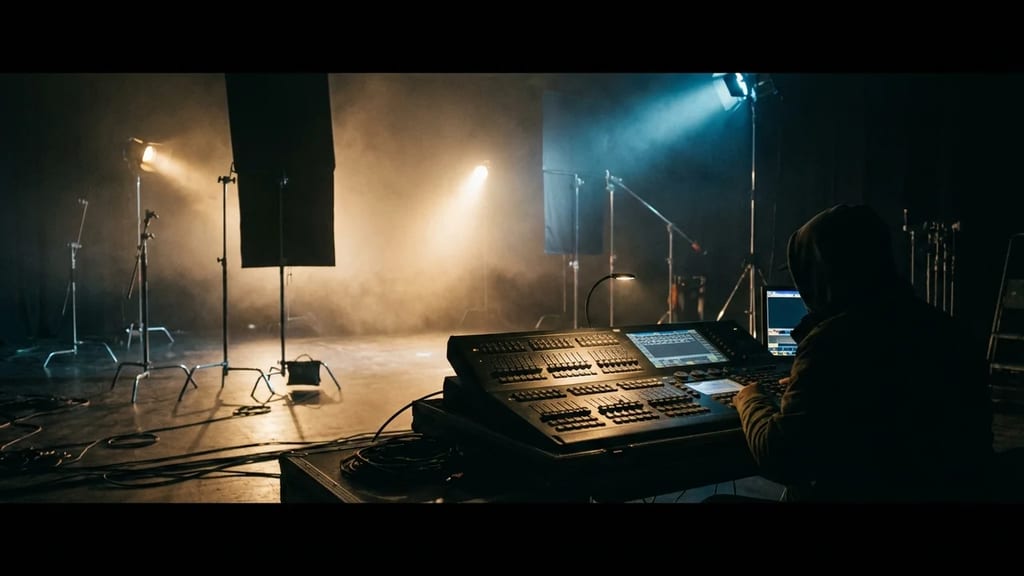
Murnau AI illustration
color temperature dimmer flow roll take

Electronic control console for precise light intensity regulation with 16-bit resolution and memory functions for programmable lighting cues.

Technical Details

Professional dimmer boards operate with 16-bit resolution (65,536 dimming levels) and offer a response time of under 20 milliseconds. The standard output voltage is 230V in Europe and 120V in North America, at a frequency of 50/60 Hz. Thyristor-based dimmers achieve precise power regulation through rapid switching cycles, while modern LED dimmers communicate via DALI, DMX512, or proprietary protocols. High-quality units like the Mole-Richardson 4812 or LTM Pepper 300 feature memory functions for up to 99 lighting cues and cross-fade times between 0.1 and 999 seconds.

History & Development

The first electronic dimmer board was developed in 1959 by Joel Spira with his company Lutron Electronics for theater stages. The film industry adapted this technology starting in 1965 when Mole-Richardson introduced the first film-specific 12-channel dimmer board, the "Senior." The breakthrough came in 1978 with the transition from analog to digital control via the DMX512 protocol (Digital Multiplex), which was established as a USITT standard in 1986. Since 2010, LED-compatible dimmers with flicker-free high-frequency control have dominated.

Practical Use in Film

In Ridley Scott's "Blade Runner" (1982), a 24-channel dimmer board enabled the characteristic light transitions between the neon-dominated street scenes. Cinematographer Roger Deakins used programmable dimmer sequences for "1917" (2019) to synchronize the continuous light changes during the seemingly single take. Typical workflows involve pre-programming lighting cues during the lighting setup phase and real-time control during shooting. The advantage lies in precise repeatability and the ability to control complex light gradients frame-accurately.

Comparison & Alternatives

Unlike mechanical irises or ND filters, a dimmer board exclusively changes light intensity, not color temperature for tungsten light (it remains constant for LEDs). Console-based lighting boards like the ETC Ion offer advanced features for larger productions, while compact 6-channel units suffice for smaller sets. For high-speed recordings above 1000fps, flicker-free DC dimmers or pulsed LED arrays are used, as conventional AC dimmers can cause interference.
From the crafts

Perspectives

Cinematographer

Ich programmiere das Dimmerpult bereits beim Licht-Setup, um reproduzierbare Übergänge zwischen verschiedenen Beleuchtungsstimmungen zu schaffen. Bei kritischen Szenen mit Zeitlupen über 200fps wechsle ich auf DC-Dimmer, da die 50Hz-Modulation sonst als Flackern sichtbar wird. Die Memory-Funktion spart mir bei Wiederholungsaufnahmen kostbare Zeit, da ich gespeicherte Lichtszenen per Knopfdruck abrufen kann.

Director

Das Dimmerpult ermöglicht mir präzise emotionale Lichtverläufe während einer Szene - etwa das langsame Abdimmen beim Übergang von Hoffnung zu Verzweiflung. Ich kann komplexe Lichtstimmungen vorab programmieren und während des Drehs spontan zwischen verschiedenen dramaturgischen Lichtszenarien wechseln. Besonders bei langen Dialogszenen nutze ich subtile Dimmverläufe, um die emotionale Entwicklung der Charaktere visuell zu unterstützen.

Producer

Ein hochwertiges 24-Kanal-Dimmerpult kostet zwischen 8.000-15.000 Euro, amortisiert sich aber durch gesparte Stromkosten und verkürzte Setup-Zeiten. Die Programmierbarkeit reduziert Wiederholungsaufnahmen aufgrund inkonsistenter Beleuchtung um etwa 20%. Bei internationalen Koproduktionen achte ich auf DMX-Kompatibilität, da verschiedene Rental-Häuser unterschiedliche Systeme verwenden.

More in the lexikon

Related terms

Test your knowledge

Quiz

1. Was beschreibt „Dimmerpult" am besten?

2. Zu welchem Department gehört „Dimmerpult"?

3. Wie viele verschiedene Fachperspektiven bietet dieser Eintrag?

Report an error
From the Filmfarm ecosystem

Understand visual language, budget productions, connect crew.

The Lexikon is part of the Filmfarm ecosystem — alongside budgeting (FilmBalance), an industry magazine (FilmCircus) and crew networking (FilmCall, CrewMesh). One shared vocabulary for the whole production.

FilmFarm FilmRadarComing soonFilmPulseComing soonFilmNumbersComing soonFilmCapitalComing soonFilmLabComing soonFilmBalanceComing soonFilmCircusComing soon