Filmlexikon.
Support
Diagonal Fisheye
Camera · Terms

Diagonal Fisheye

Murnau AI illustration
flow para roll take

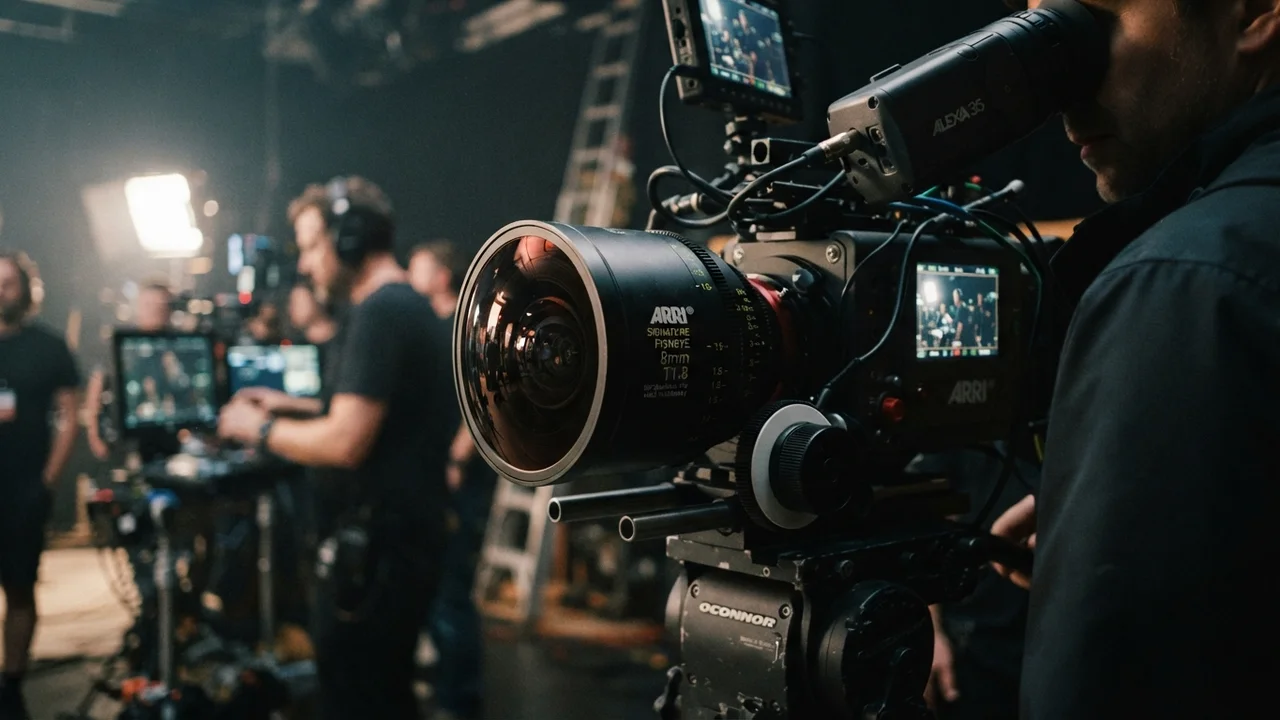
Fisheye lens with extreme diagonal field of view (140–180°), filling the entire frame with characteristic barrel distortion.

Technical Details

Standard specifications include focal lengths from 8mm (180° angle of view), 10.5mm (160° angle of view) to 16mm (140° angle of view) for full-frame. The minimum focusing distance is usually 13-25cm, and the aperture typically reaches f/2.8 to f/3.5. The optical construction consists of 10-14 lens elements in 7-10 groups, with several aspherical elements correcting the extreme curvature. The characteristic front element curves strongly outward and cannot be fitted with standard filters. Weight and dimensions are considerable due to the complex optics: 300-600g with a 70-85mm filter diameter.

History & Development

Nikon introduced the first commercial fisheye lens, the Nikkor 8mm f/8, in 1962, based on developments for meteorology in the 1920s. Canon followed in 1964 with the FD 7.5mm f/5.6. The diagonal variant became established in the 1970s with lenses like the Nikkor 16mm f/2.8, which was the first to utilize the complete 35mm format. Sigma revolutionized the market in 2005 with the 8mm f/3.5 EX DG, the first diagonal fisheye with a 180° angle of view for full-frame. Modern versions integrate image stabilization and optimized coatings for digital sensors.

Practical Use in Film

Stanley Kubrick used a modified Zeiss Distagon 8mm f/2.8 for the candlelight scenes in "Barry Lyndon" (1975). Darren Aronofsky consistently employed fisheye optics in "Requiem for a Dream" (2000) to visualize drug highs and paranoia. The lenses create extreme motion effects with handheld camera work, as peripheral image parts are disproportionately distorted. In practice, they require precise camera handling, as even minimal pans cause drastic image changes. The depth of field is practically infinite from f/8 onwards, making focus pulling unnecessary.

Comparison & Alternatives

The circular fisheye produces a round image area on a rectangular sensor, while the diagonal version utilizes the entire format. Modern alternatives include rectilinear ultra-wide-angle lenses (14mm) for undistorted shots or digital de-distortion in post-production. VR-180 cameras are increasingly replacing fisheye optics for immersive content. Specialized cine versions like the Tokina Cinema 8mm T/3.9 offer focus gears and uniform front diameters for professional rigs.
From the crafts

Perspectives

Cinematographer

Ich setze diagonale Fisheyes gezielt für subjektive Einstellungen ein, da die extreme Verzerrung Rausch- oder Angstzustände authentisch vermittelt. Bei Steadicam-Fahrten verstärkt die Optik Bewegungsdynamik erheblich, erfordert aber millimetergenaue Positionierung, da der 180°-Bildwinkel versehentlich Crew oder Equipment erfasst. Die unendliche Schärfentiefe ab Blende 8 eliminiert Fokus-Probleme, macht aber präzise Bildkomposition umso wichtiger.

Director

Ich nutze Fisheye-Objektive als narrative Verstärker für psychische Ausnahmezustände oder surreale Sequenzen, da die Verzerrung unterbewusst Unbehagen erzeugt. Die extreme Weitwinkel-Perspektive isoliert Charaktere optisch, selbst in beengten Räumen wirken sie verloren. Allerdings plane ich solche Einstellungen sparsam, da die markante Ästhetik schnell selbstzweckhafte Aufmerksamkeit erzeugt und vom eigentlichen Drama ablenkt.

Producer

Fisheye-Objektive kosten 800-2500 Euro Tagesmiete und erfordern spezialisierte Kamera-Assistenten, da Standard-Workflows nicht funktionieren. Die extreme Optik macht Continuity-Matching schwierig, weshalb ich maximal 10% zusätzliche Drehtage für Fisheye-Sequenzen kalkuliere. Postproduktions-Kosten steigen durch notwendige Bildstabilisierung und eventuelle Entzerrung um 15-20%, bieten aber einzigartige visuelle Signature für Marketingzwecke.

More in the lexikon

Related terms

Test your knowledge

Quiz

1. Zu welchem Department gehört „Diagonales Fischauge"?

2. Wie viele verschiedene Fachperspektiven bietet dieser Eintrag?

Report an error
From the Filmfarm ecosystem

Understand visual language, budget productions, connect crew.

The Lexikon is part of the Filmfarm ecosystem — alongside budgeting (FilmBalance), an industry magazine (FilmCircus) and crew networking (FilmCall, CrewMesh). One shared vocabulary for the whole production.

FilmFarm FilmRadarComing soonFilmPulseComing soonFilmNumbersComing soonFilmCapitalComing soonFilmLabComing soonFilmBalanceComing soonFilmCircusComing soon