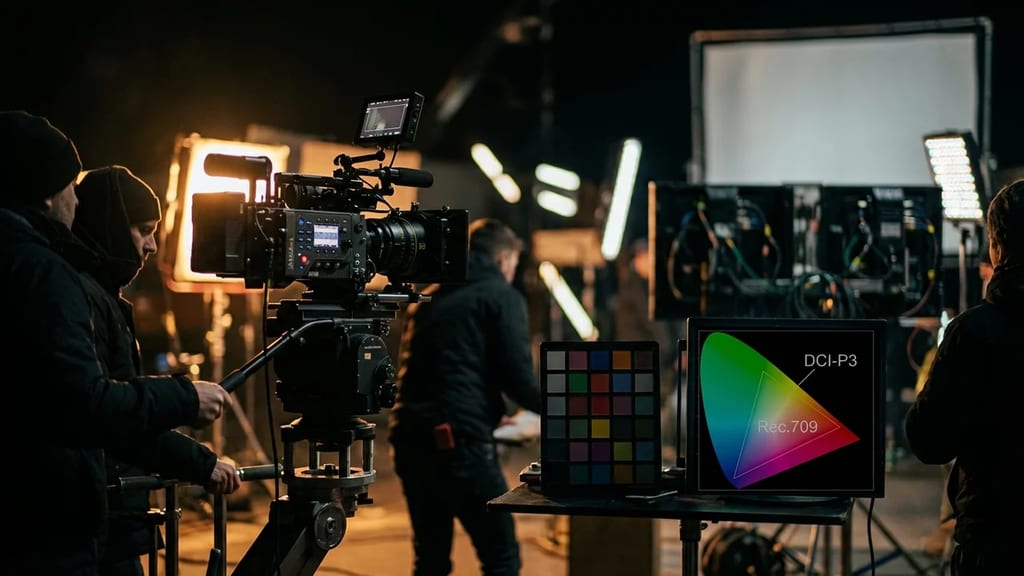
Overview
DCI-P3 is an RGB color space (color gamut) defined in 2005 by the Digital Cinema Initiatives (DCI) for theatrical digital cinema projection. It describes which range of visible colors can be reproduced in a Digital Cinema Master File (DCDM/DCP) and displayed by a DCI-compliant projector. DCI-P3 is today the reference color space for cinema distribution and lies in scope between the TV standard Rec.709 and the UHD standard Rec.2020.
Unlike Rec.709, DCI-P3 covers significantly more highly saturated reds and greens. Several variants of the DCI-P3 standard exist, differing primarily in their white point: the original theatrical DCI-P3 (tuned for xenon projection), Display P3 / P3-D65 (for consumer displays like Apple devices), and a D60-/ACES-adjacent variant for post-production.
Technical Specifications
The following key values are derived from the DCI/SMPTE specifications (including SMPTE EG 432-1, RP 431-2, ST 2113):
| Parameter | DCI-P3 (theatrical) | Display P3 (P3-D65) |
|---|
| White Point (CIE 1931 x/y) | 0.314 / 0.351 (~6300 K) | D65 (~6504 K) |
| Transfer Function | Gamma 2.6 | sRGB-like (~Gamma 2.2) |
| Red Primary Chromaticity (x/y) | 0.680 / 0.320 | identical |
| Green Primary Chromaticity (x/y) | 0.265 / 0.690 | identical |
| Blue Primary Chromaticity (x/y) | 0.150 / 0.060 | identical |
The gamut covers approximately 86.9% of the Pointer Gamut. Compared to sRGB/Rec.709, DCI-P3 is significantly wider: Apple states for the Display P3 variant an approximately 25% larger area in the CIE chromaticity diagram and about 50% larger color volume compared to sRGB. The blue primary chromaticity is identical to Rec.709/sRGB, while red is significantly deeper (longer wavelength).
Use on Set and in Post
For DoPs and colorists, DCI-P3 is primarily relevant in two phases:
- Monitoring: On-set monitors and reference displays are calibrated to a defined color space. For projects intended for cinema distribution, DCI-P3 serves as the target gamut, ensuring that what is seen on set and in the grading suite matches the final projection.
- Mastering/Grading: When creating the Digital Cinema Package (DCP), the image is converted into the XYZ-/P3 workflow. If mastered in DCI-P3, the color design is preserved from the grading suite to the screen.
DCI-P3 is a pure display/distribution color space, not a camera acquisition format: cameras record in proprietary wide-gamut/log spaces (e.g., ARRI Wide Gamut, Sony S-Gamut, RED-Gamut), which are transformed in post-production for output to DCI-P3. For TV/web delivery, however, mapping is usually done to Rec.709 or for HDR to Rec.2020.