Filmlexikon.
Support
Dailies
Production · Terms

Dailies

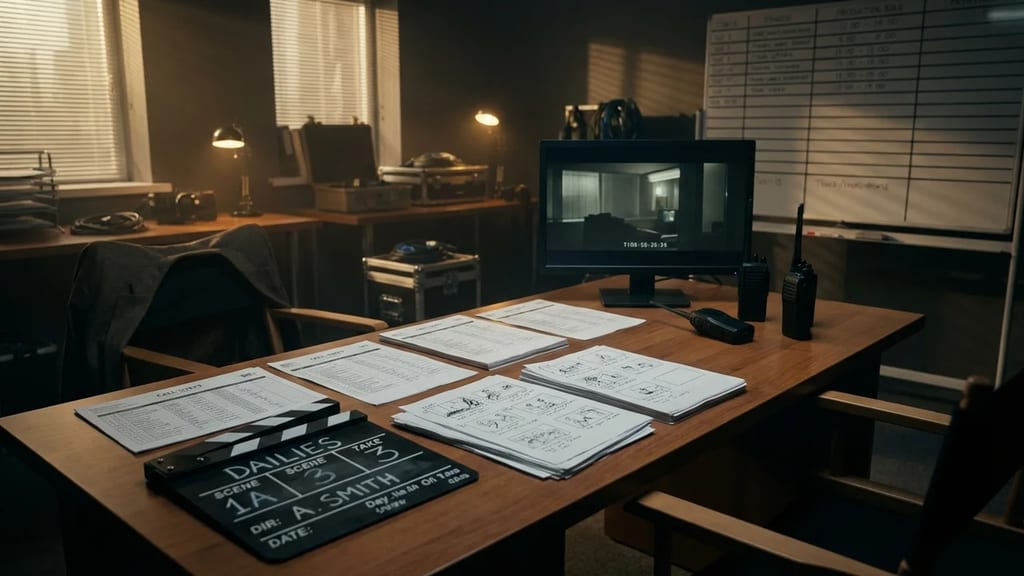
Murnau AI illustration
daily day player 2 daily call sheet

First rough cut of previous day's footage reviewed by director and cinematographer each morning to check quality and avoid costly reshoots.

Technical Details

Traditional film dailies are created by overnight processing of the 35mm negative with standard lighting and no color correction. In digital productions, dailies are generated as compressed files with a resolution of 1920×1080 or 2048×1080 at 24fps. The workflow includes applying a LUT (Look-Up Table) and burning in keycode, timecode, camera data, and scene numbers. Modern Digital Intermediate Labs deliver dailies with a data rate of 100-185 Mbit/s, while low-resolution proxies for editing only reach 15-25 Mbit/s.

History & Development

The dailies system became established in the 1930s with the introduction of standardized laboratory processes in Hollywood. Kodak developed the first automated printer for dailies production in 1952. The transition to digital dailies began in 2005 with the introduction of Avid DNxHD and Apple ProRes codecs. Since 2015, 85% of all Hollywood productions have relied on purely digital dailies workflows with cloud-based distribution.

Practical Application in Film

For "Mad Max: Fury Road" (2015), 15 hours of raw footage were compressed daily into 90 minutes of dailies and transmitted to five locations worldwide. Stanley Kubrick notoriously reviewed up to 60 takes per setup in the dailies before approving a scene for "The Shining." The standard workflow involves transmitting dailies by 10 AM, allowing the director and editor to assess quality and organize any reshoots on the same day.

Comparison & Alternatives

Dailies differ from rushes through their technical preparation with metadata and color correction. Live monitoring on set via director's viewfinders replaces immediate quality control but not the detailed review of all footage. Modern near-live systems like Pomfort LiveGrade transmit color-corrected previews during shooting, but do not reduce the need for final dailies review for editing approval.

From the crafts

Perspectives

Cinematographer

Ich nutze Muster zur präzisen Kontrolle von Belichtung, Schärfeverlauf und Farbtemperatur meiner Setups – besonders bei kritischen Szenen mit Mixed Lighting prüfe ich jeden einzelnen Take auf Hautton-Konsistenz. Die eingebrannten False-Color-Informationen und Zebras in den digitalen Mustern zeigen mir sofort, ob meine Belichtungsstrategie funktioniert oder ich am nächsten Tag Korrekturen vornehmen muss.

Director

Muster sind mein tägliches Wahrheitsserum – hier erkenne ich, ob die emotionale Nuance eines Schauspielers wirklich funktioniert oder ob scheinbar gelungene Takes bei genauer Betrachtung doch nicht die gewünschte Intensität haben. Ich sichte systematisch alle Varianten einer Szene und markiere bereits in den Mustern meine bevorzugten Takes für den Editor, um den kreativen Momentum nicht zu verlieren.

Producer

Muster kosten mich täglich 800-1200 Euro für Lab-Processing und Übertragung, aber sie verhindern teure Nachdrehe durch sofortige Qualitätskontrolle – eine einzige übersehene technische Panne würde das Zehnfache kosten. Ich organisiere die Mustersichtung als festen Termin um 10 Uhr mit allen Abteilungsleitern, damit eventuelle Probleme noch am selben Drehtag gelöst werden können.

More in the lexikon

Related terms

Test your knowledge

Quiz

1. Zu welchem Department gehört „Muster"?

2. Wie viele verschiedene Fachperspektiven bietet dieser Eintrag?

Report an error
From the Filmfarm ecosystem

Understand visual language, budget productions, connect crew.

The Lexikon is part of the Filmfarm ecosystem — alongside budgeting (FilmBalance), an industry magazine (FilmCircus) and crew networking (FilmCall, CrewMesh). One shared vocabulary for the whole production.

FilmFarm FilmRadarComing soonFilmPulseComing soonFilmNumbersComing soonFilmCapitalComing soonFilmLabComing soonFilmBalanceComing soonFilmCircusComing soon