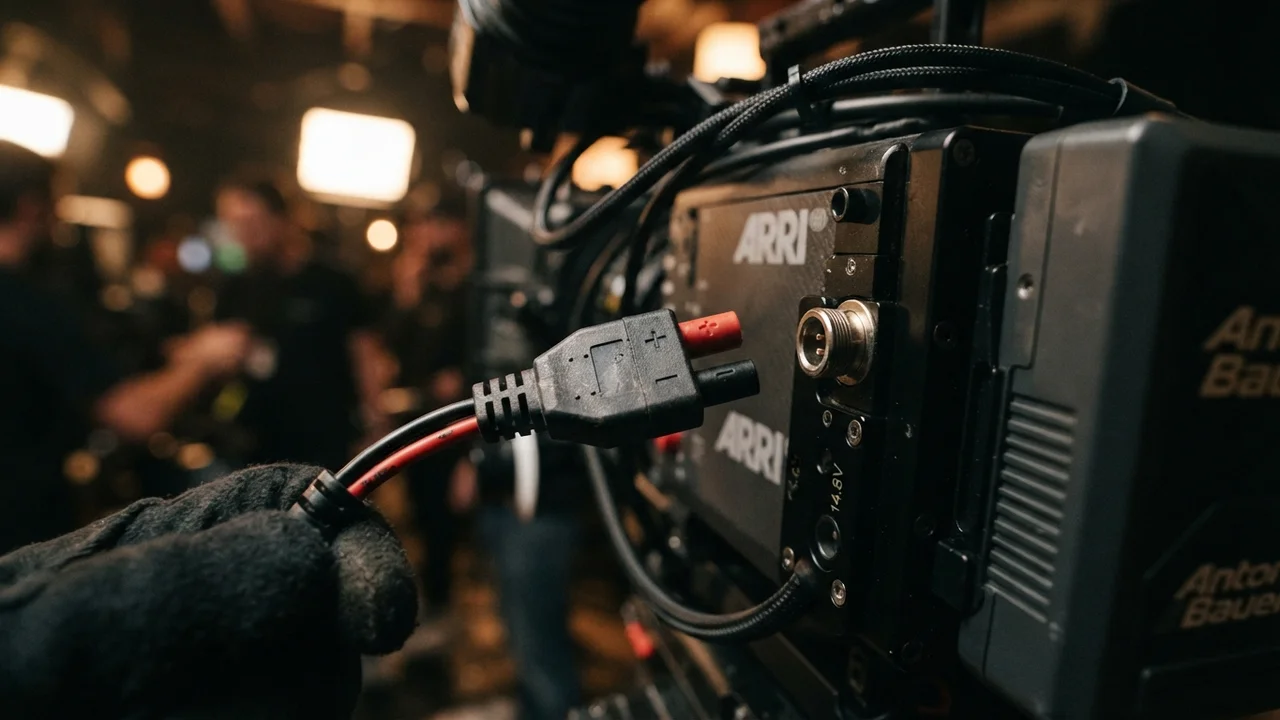
Technical Details
The D-Tap connector operates with unregulated DC voltage, drawn directly from the battery's lithium-ion cells. Standard V-Mount batteries typically feature 1-2 D-Tap outputs, with newer models often offering a regulated USB-C port as well. The contacts are made of gold-plated brass pins with a lifespan of approximately 10,000 mating cycles. An integrated overcurrent protection automatically disconnects the connection after 2-3 seconds in case of overload.
History & Development
Anton/Bauer developed the D-Tap standard in 1995 as part of the Gold Mount system, originally under the name "PowerTap." IDX System Technology adopted the design in 1998 for V-Mount batteries and established the D-Tap designation commonly used today. From 2005 onwards, D-Tap-compatible devices such as monitors, wireless transmitters, and LED panels gained traction. Since 2015, USB-C outputs have complemented the system, but D-Tap remains the standard for high-power 12V devices.
Practical Use in Film
D-Tap powers on-camera monitors like SmallHD or Atomos recorders directly from the camera battery, eliminating separate batteries and reducing rig weight by 200-400g per device. Wireless transmission systems (Teradek, Hollyland) use D-Tap for uninterrupted transmission during battery changes. In "1917" (2019), D-Tap-powered LED panels (Aputure AL-M9) enabled mobile lighting for the continuous Steadicam sequences. Focus pullers use D-Tap motors (ARRI cforce mini) for precise focus shifts without additional power supply.
Comparison & Alternatives
Unlike DC barrel connectors, D-Tap offers standardized polarity and higher current capacity. USB-C PD (Power Delivery) can reach up to 100W but is insufficient for power-hungry devices like wireless transmitters or larger monitors. XLR-4 power connectors on broadcast cameras deliver 12V at up to 30A but are camera-bound. D-Tap excels in mobility and universal compatibility between different manufacturers, while permanently installed systems allow for higher power outputs.