Filmlexikon.
Support
USB-C
Camera · Terms

USB-C

Murnau AI illustration
flow para roll take

Universal connector standard with up to 40 Gbit/s data rate and bidirectional power delivery for cameras, monitors, and DIT workflows.

Technical Details

USB-C supports various protocols: USB 2.0 (480 Mbit/s), USB 3.2 Gen 2×2 (20 Gbit/s), USB4 (40 Gbit/s), Thunderbolt 3/4 (40 Gbit/s), and DisplayPort Alt Mode for 8K video transmission. The Power Delivery specification enables bidirectional power supply with intelligent power negotiation between devices. The connector features four Shielded Differential Pairs for high-speed data, two USB 2.0 data lines, and several configuration pins for protocol detection.

History & Development

The USB Implementers Forum released the USB-C specification in August 2014. First implementations occurred in 2015 in the Apple MacBook and Google Chromebook Pixel. RED first integrated USB-C into professional cinema cameras in 2016 with the WEAPON series. Blackmagic Design followed in 2017 with USB-C recording in the URSA Mini Pro. Since 2019, USB-C has established itself as the standard for camera monitors, external recorders, and on-set workflows.

Practical Application in Film

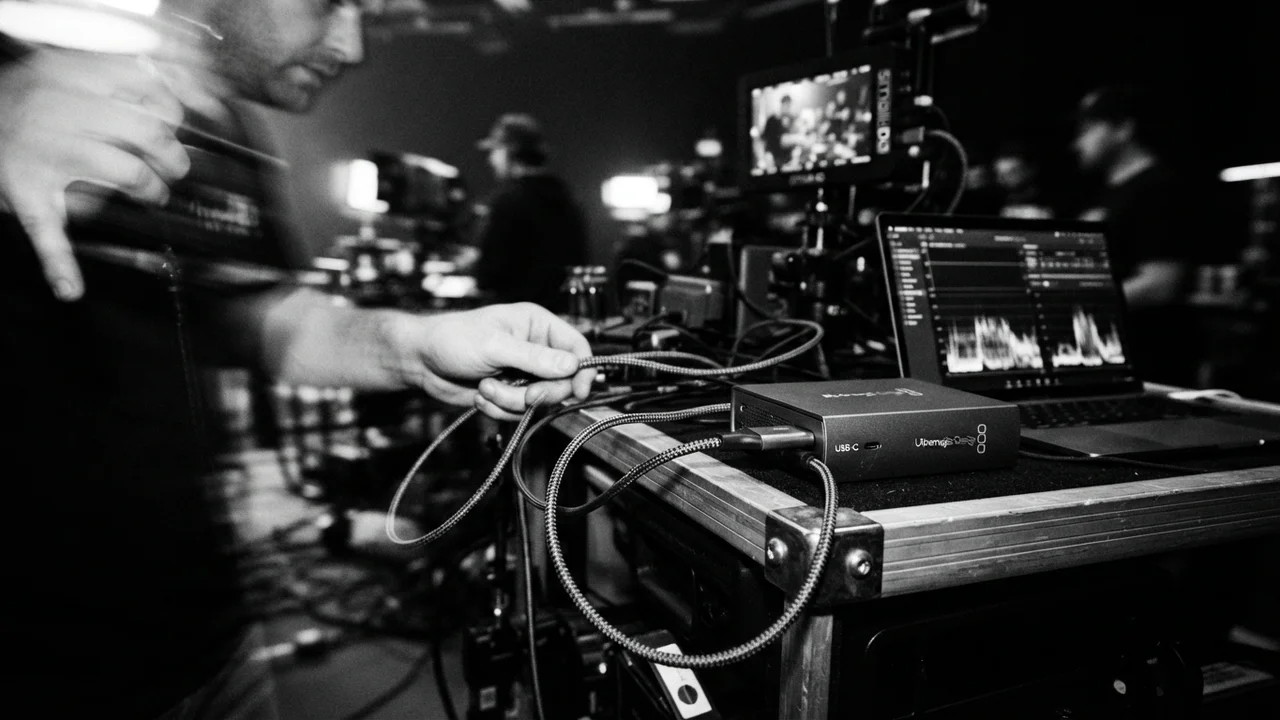
Modern cinema cameras like the RED V-RAPTOR or ARRI ALEXA 35 use USB-C for metadata transfer and camera control. DIT workflows benefit from direct USB-C connectivity between cameras and laptops for live grading with software like LiveGrade Pro. External monitor recorders from Atomos (Ninja V+) or Blackmagic (Video Assist 12G) receive 4K ProRes signals via USB-C and store them directly on SSDs. Gimbal systems like the DJI RS 3 Pro control camera functions via USB-C connections.

Comparison & Alternatives

USB-C is gradually replacing proprietary camera ports and Mini-USB/Micro-USB connectors. Compared to HDMI, USB-C offers bidirectional communication and power supply in a single cable. SDI remains dominant for transmission distances over 3 meters and in traditional broadcast environments. Thunderbolt 4 over USB-C enables higher bandwidths than standard USB-C, but at a higher cost. Ethernet-based solutions like ST 2110 dominate in fixed studio environments.
From the crafts

Perspectives

Cinematographer

Als DoP schätze ich USB-C für die direkte Verbindung zwischen Kamera und meinem Monitoring-Setup – ein Kabel für 4K-Signal und Stromversorgung meines 7"-Monitors eliminiert Kabelsalat am Rig. Die Möglichkeit, Kameraparameter wie ISO und Weißabgleich direkt vom Monitor aus zu steuern, beschleunigt meine Bildanpassungen während der Drehpausen erheblich.

Director

USB-C ermöglicht mir als Regisseur, das Live-Bild der Kamera drahtlos auf mein iPad zu streamen und dabei gleichzeitig Fokus-Pulling-Befehle zurück an die Kamera zu senden. Diese direkte Kontrolle über Bildkomposition und Schärfeverlauf gibt mir mehr kreative Flexibilität bei komplexen Kamerafahrten, ohne dass ich physisch hinter der Kamera stehen muss.

Producer

USB-C reduziert meine Equipment-Kosten erheblich – statt spezieller Kamerakabel für 200€ nutzen wir Standard-USB-C-Kabel für 15€, die auch für Laptops und Monitore funktionieren. Die universelle Kompatibilität eliminiert teure Adapter-Sets und reduziert das Transportgewicht um etwa 30%, was bei internationalen Produktionen direkt die Frachtkosten senkt.

More in the lexikon

Related terms

Test your knowledge

Quiz

1. Zu welchem Department gehört „USB-C"?

2. Wie viele verschiedene Fachperspektiven bietet dieser Eintrag?

Report an error
From the Filmfarm ecosystem

Understand visual language, budget productions, connect crew.

The Lexikon is part of the Filmfarm ecosystem — alongside budgeting (FilmBalance), an industry magazine (FilmCircus) and crew networking (FilmCall, CrewMesh). One shared vocabulary for the whole production.

FilmFarm FilmRadarComing soonFilmPulseComing soonFilmNumbersComing soonFilmCapitalComing soonFilmLabComing soonFilmBalanceComing soonFilmCircusComing soon