Filmlexikon.
Support
Cucoloris
Lighting · Terms

Cucoloris

Murnau AI illustration
color temperature flow roll take

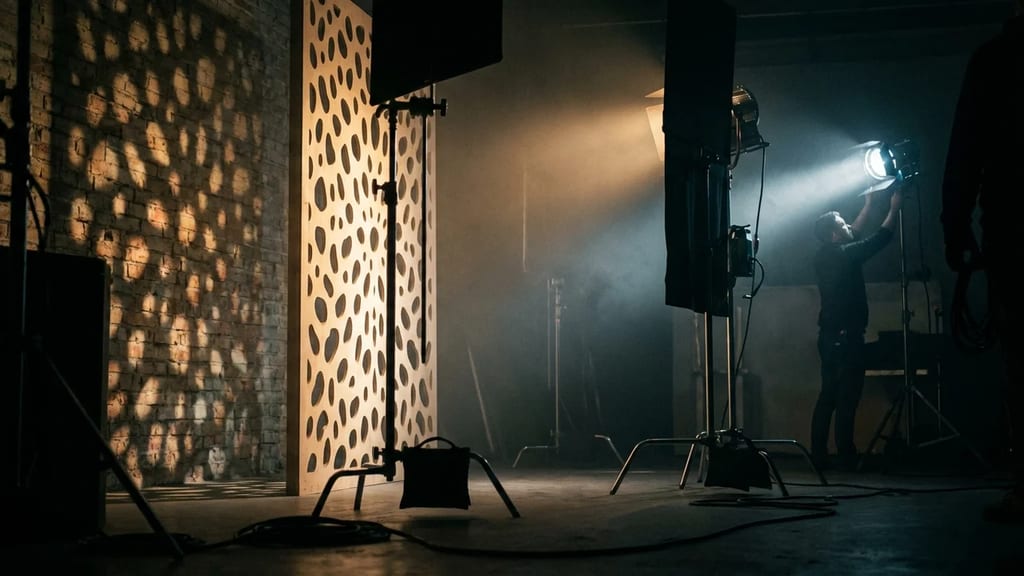
Perforated screen (plywood or plastic) placed in front of lights to cast dappled, soft-edged shadows on actors or sets; also called cookie or cucoloris.

Technical Details

Cucoloris are made from 6-12 mm thick plywood, hardboard, or modern plastic panels. The holes and slots mostly follow organic, irregular patterns without discernible repetition. The industry standard includes three main variants: "Small Pattern" (holes 2-5 cm), "Medium Pattern" (5-8 cm), and "Large Pattern" (8-15 cm). The optimal distance to the illuminated surface is 3-5 times the largest opening for soft shadow transitions, and 1-2 times for hard contours.

History & Development

In 1923, cinematographer George Folsey introduced the first cucoloris at Metro Pictures, inspired by natural foliage shadows. The technique quickly established itself in Hollywood's studio system of the 1930s. Cinematographer Gregg Toland perfected its use in "Citizen Kane" (1941) for dramatic light-shadow compositions. Since the 1990s, digital gobos and LED projectors have complemented the classic cucoloris, but cannot fully replace it in organic light modulation.

Practical Use in Film

In "The Godfather" (1972), Gordon Willis used cucoloris for the characteristic facial shadows in Vito Corleone's office. Roger Deakins employed them in "Blade Runner 2049" (2017) to simulate futuristic city shadows. The typical workflow requires test lighting with Polaroid shots for shadow positioning. Cucoloris reduce light intensity by 40-60%, thus requiring correspondingly stronger base lighting and extending exposure times.

Comparison & Alternatives

Gobos produce precise, repeatable patterns, while cucoloris provide organic, random structures. Flags and dots create hard shadow edges, whereas cucoloris offer modulated transitions. Modern LED panels with gobo projectors achieve similar effects with more flexible control but cost 10-15 times as much. For budget productions, homemade cardboard cucoloris remain the practical alternative, but only achieve 30-40% of the durability of professional versions.
From the crafts

Perspectives

Cinematographer

Ich setze Cucoloris hauptsächlich ein, um flächige Ausleuchtung zu brechen und Tiefe zu schaffen - besonders bei Nahaufnahmen wirken die strukturierten Schatten wie natürliches Fensterlicht. Die Herausforderung liegt im präzisen Positionieren: schon 10 cm Verschiebung verändert das Schattenmuster drastisch, deshalb markiere ich die Position immer mit Tape.

Director

Cucoloris helfen mir, Charakterzustände visuell zu unterstützen - zerbrochene Lichtmuster für innere Konflikte, weiche Blätterschatten für romantische Momente. Ich bespreche mit dem DoP vorab, welche emotionale Wirkung die Schatten haben sollen, denn das Publikum nimmt diese Lichtmodulation unterbewusst als Stimmungsinformation wahr.

Producer

Ein Cucoloris-Set kostet 200-400 Euro und hält jahrelang, während die vergleichbare LED-Technik 3000-5000 Euro verschlingt - allerdings brauchen wir stärkere Grundbeleuchtung, was den Stromverbrauch um etwa 40% erhöht. Der Transport ist unkritisch, aber die Setup-Zeit verlängert sich um 15-20 Minuten pro Position durch das Feintuning.

More in the lexikon

Related terms

Test your knowledge

Quiz

1. Zu welchem Department gehört „Cucoloris"?

2. Wie viele verschiedene Fachperspektiven bietet dieser Eintrag?

Report an error
From the Filmfarm ecosystem

Understand visual language, budget productions, connect crew.

The Lexikon is part of the Filmfarm ecosystem — alongside budgeting (FilmBalance), an industry magazine (FilmCircus) and crew networking (FilmCall, CrewMesh). One shared vocabulary for the whole production.

FilmFarm FilmRadarComing soonFilmPulseComing soonFilmNumbersComing soonFilmCapitalComing soonFilmLabComing soonFilmBalanceComing soonFilmCircusComing soon