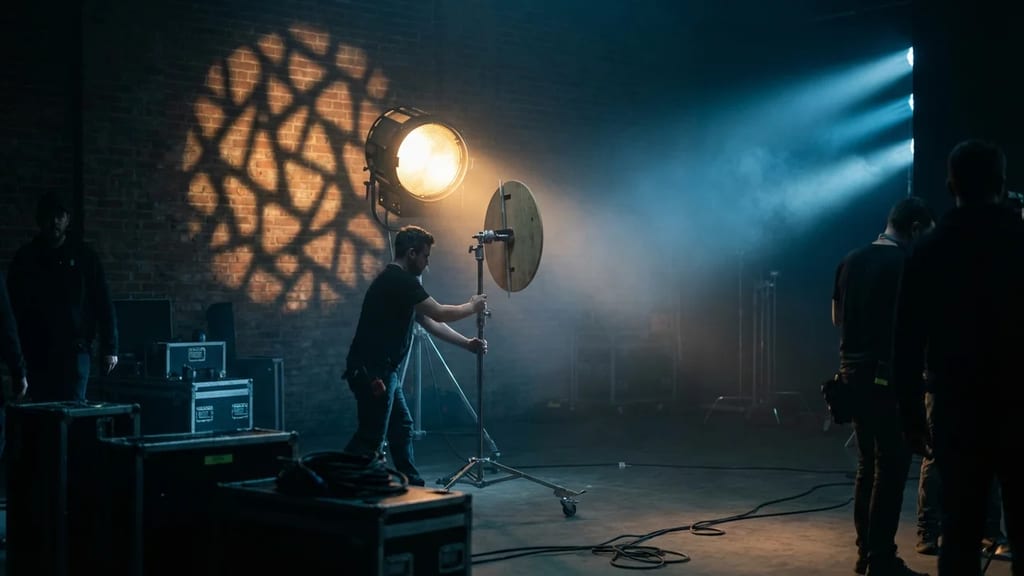
Technical Details
Film cookies consist of a lightweight aluminum tube frame with black duvetyne fabric, offering a temperature resistance of up to 180°C. Standard sizes include 18x24 inches, 24x36 inches, 4x4 feet, and 6x6 feet. The frames weigh between 0.5 kg (small size) and 3.5 kg (6x6 feet) and feature integrated mounting points for C-stands or grip arms. Modern versions utilize snap-grid systems, enabling tool-free assembly and disassembly in under 30 seconds. Special variants like "Open End Scrims" combine cookie functions with gradual dimming effects.
History & Development
The first cookies originated in 1923 at Paramount Studios when cinematographer Karl Struss adapted black theater backdrops for more precise light shaping. In 1935, Mole-Richardson developed the first industrially manufactured film cookies with standardized dimensions. The breakthrough came in 1941 with Gregg Toland's work on "Citizen Kane," where cookies were systematically used for low-key lighting for the first time. In the 1960s, Matthews Studio Equipment introduced collapsible frames, revolutionizing transport and storage. Today's cookies integrate UV-resistant materials and modular mounting systems.
Practical Use in Film
Cookies create hard shadow edges for film noir aesthetics, as seen in "Blade Runner" (1982), where Ridley Scott created Venetian blind effects through precise cookie placement in front of 10K tungsten lights. In "The Godfather" (1972), Gordon Willis used cookies to create characteristic eye-socket shadows. Typical workflow: a cookie is mounted 2-4 meters in front of the light source to avoid soft shadow transitions, or directly on the light for sharp delineations. During daylight shoots, large 12x12-foot cookies serve as "negative fill" to increase contrast.
Comparison & Alternatives
Flags block light completely in rectangular areas, while cookies create specific shapes and patterns. Scrims gradually reduce light intensity, whereas cookies create binary light-dark contrasts. Cutters function as linear shading, while cookies allow for complex geometric shadows. Modern LED panels with built-in barn doors partially replace cookie setups but do not achieve the precise shadow rendering of physical cookies. Digital post-production can simulate cookie effects, but it lacks the natural light interaction on set for authentic shadows on objects and actors.