Cinematographer
Aus DoP-Perspektive ist dieses Element essentiell für die visuelle Gestaltung. Es ermöglicht mir die gewünschte Farbstimmung und das ästhetische Bild konsistent umzusetzen.
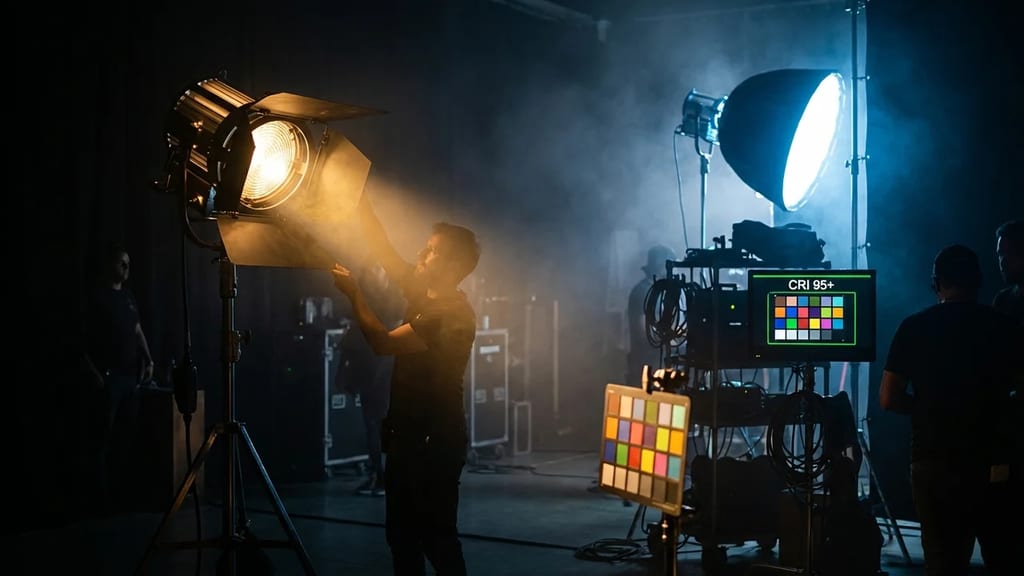
CRI 95+ denotes the premium tier of color rendering index (Ra 95–100), the industry standard for professional LED film lighting.
"CRI 95+" is not a device or a manufacturer, but a specification: it identifies lights whose Color Rendering Index (CRI, also Ra) is in the range of 95 to 100. The CRI describes on a scale of 0 to 100 how true-to-life a light source renders colors compared to a reference light source (daylight or black-body radiator). The higher the value, the less color distortion.
In film and TV, CRI 95+ has established itself as a quality threshold for professional LED lights. Lower levels like CRI 80 (consumer/office level) or CRI 90 are generally insufficient for demanding skin tones and precise color design. Important: CRI evaluates color rendering for the human eye, not for the camera sensor – the complementary TLCI (Television Lighting Consistency Index) is used for camera-related assessment.
The general CRI (Ra) is the arithmetic mean of eight standardized, rather weakly saturated test colors (R1 to R8). Crucial for practical application: Saturated and strong colors are described using additional test colors (R9 to R15) that are not included in the average. Particularly relevant is R9 – a saturated red that determines the rendering of skin tones.
This leads to a central pitfall when selecting equipment: a light can show a high Ra value and still perform poorly (in extreme cases, negatively) at R9 because R9 is not factored into the Ra. Therefore, a high CRI alone does not guarantee clean skin tones.
| CRI Level | Typical Classification |
|---|---|
| CRI 80 | Consumer/General Lighting; critical for camera |
| CRI 90 | High-end level, often minimum requirement |
| CRI 95+ | Professional Film/TV Standard, high color fidelity |
For high-quality productions, the rule of thumb is the combination CRI 95+ and R9 ≥ 90. Only both values together ensure that skin tones appear natural, warm reds are clean, and materials (wood, fabrics, food) look correct. Many inexpensive LED lights advertise "CRI 95+" but achieve the average value through uncritical test colors and fail on camera-critical colors.
Related: CRI (Color Rendering Index) · TLCI · Color Temperature.
Aus DoP-Perspektive ist dieses Element essentiell für die visuelle Gestaltung. Es ermöglicht mir die gewünschte Farbstimmung und das ästhetische Bild konsistent umzusetzen.
Diese professionelle Lösung erhöht die Produktionseffizienz und reduziert Post-Production-Anforderungen. Sie ermöglicht flexible, schnelle Anpassungen während des Drehs.
Als Gaffer ist dies ein unverzichtbares Werkzeug meines täglichen Handwerkszeugs. Es ermöglicht mir professionelle Lichtkontrolle und schnelle Anpassungen auf Set, was Zeit spart und Qualität sichert.
1. Zu welchem Department gehört „CRI 95+"?
2. Wie viele verschiedene Fachperspektiven bietet dieser Eintrag?
The Lexikon is part of the Filmfarm ecosystem — alongside budgeting (FilmBalance), an industry magazine (FilmCircus) and crew networking (FilmCall, CrewMesh). One shared vocabulary for the whole production.