Technical Details
The optical construction consists of 5 lenses in 4 groups based on the classic Planar design with a symmetrical layout. The image circle fully covers the 6x6cm format with an 88mm diagonal. The minimum focusing distance is 0.9 meters, and the filter thread diameter is 67mm. The lens weighs 470 grams and measures 66mm in length. The aperture operates in half-stop increments from f/2.8 to f/22, with optimal image quality achieved between f/5.6 and f/11. Various versions were produced between 1957 and 2013, including the CF model with a central shutter from 1/500s to 1s.
History & Development
Carl Zeiss developed the first Planar 80mm as early as 1957 for the Hasselblad 1000F. The design is based on Paul Rudolph's Planar patent from 1896 but was recalculated for medium format. In 1970, the C version with improved coating followed, and in 1982, the CF version with a central shutter. The last CFE model from 1988 received electronic shutter contacts for newer Hasselblad bodies. Production ended in 2013 with the discontinuation of the V system.
Practical Use in Film
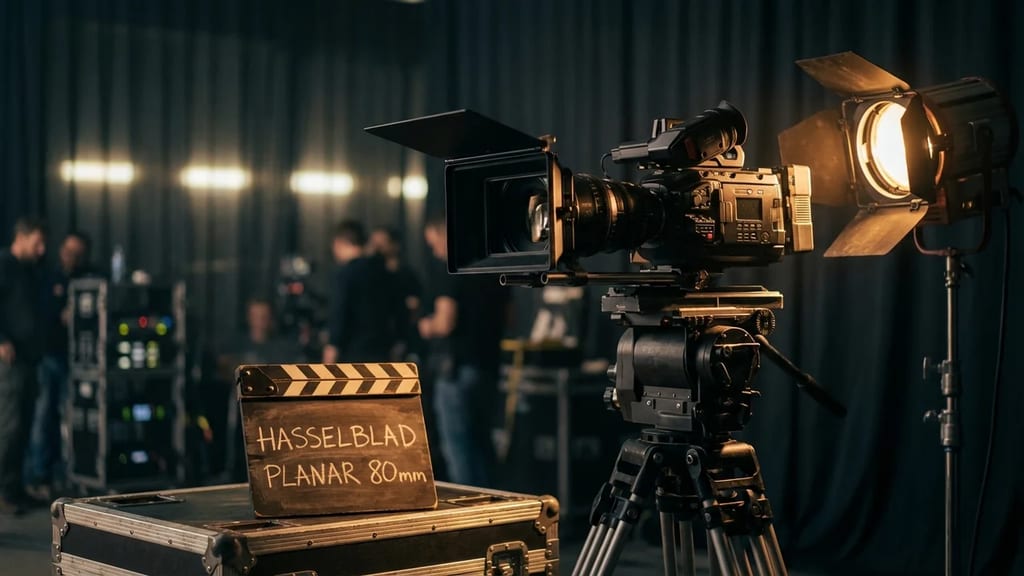
The Planar 80 was primarily used for still photography and advertising shots during film production, less so for moving images. Cinematographers like David Bailey used it for portraits of Bond actors in the 1960s. In Stanley Kubrick's "Barry Lyndon" (1975), still photos were taken with this lens, while modified Zeiss lenses on 35mm cameras were used for the actual film recordings. The shallow depth of field at f/2.8 allows for precise subject isolation but requires accurate focusing via the Hasselblad's ground glass.
Comparison & Alternatives
Compared to the Hasselblad Distagon 50mm, the Planar 80 offers more natural proportions without wide-angle distortion. The competing Mamiya 80mm f/2.8 for the RB67 system achieves similar optical performance with a larger image format. Modern alternatives include the Fujifilm GF 80mm f/1.7 for the GFX system or the Phase One 80mm f/2.8 LS. For digital film production, full-frame lenses like the Zeiss Otus 85mm now replace classic medium format setups, but they do not achieve the characteristic image aesthetic of the 6x6 format.