Filmlexikon.
Support
Coma
Camera · Terms

Coma

Murnau AI illustration
flow para roll take

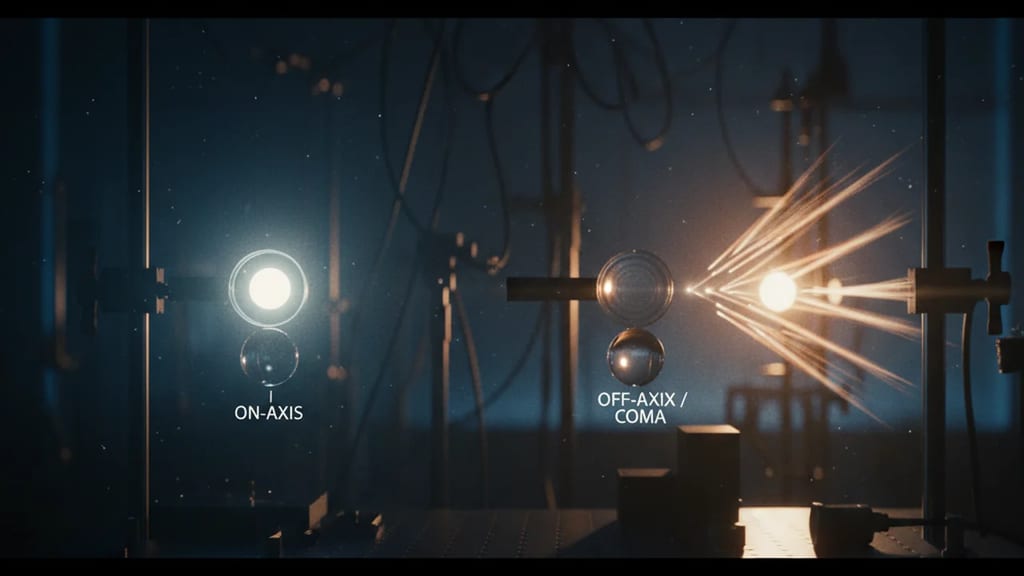
Optical aberration that distorts point light sources into comet-shaped streaks, especially at wide apertures; common in wide-angle and fast lenses.

Technical Details

Coma primarily occurs in lenses with wide apertures (f/1.4 to f/2.8) and in the image corners, where the distance to the optical axis is greatest. The strength of the aberration is measured by the coma coefficient (in wavelengths) – values below 0.1λ are considered acceptable. Sagittal and meridional coma differ in their orientation: sagittal coma points radially outward, meridional tangentially to the image circle. Modern lenses reduce coma through aspherical lens elements and special glass types with anomalous partial dispersion.

History & Development

Ernst Abbe first scientifically described coma aberration in 1873 and developed the sine condition for its correction. In 1896, Paul Rudolph designed the first largely coma-corrected lens, the Zeiss Planar. In the 1950s, new glass types from Schott and Ohara enabled improved corrections. Since the 1980s, computer-aided lens calculations and aspherical elements have significantly reduced coma – modern cine lenses like the Zeiss Master Prime series achieve near coma-free imaging even at wide-open apertures.

Practical Use in Film

Coma particularly affects night shots and low-light scenes, where wide apertures are necessary. Roger Deakins deliberately utilized slight coma effects in "Blade Runner 2049" for atmospheric light sources. During Steadicam movements, coma is amplified by the continuous motion – here, lenses like the Angenieux Optimo 24-290mm compensate through special coma correction. In digital post-production, coma can be partially corrected by lens correction tools in DaVinci Resolve or Nuke, but at the cost of image sharpness.

Comparison & Alternatives

Coma differs from spherical aberration due to its asymmetric shape and its occurrence only at off-axis points. While astigmatism distorts point-like light sources into lines, coma creates teardrop-shaped distortions. Modern Master Anamorphic lenses exhibit significantly less coma than vintage anamorphics from the 1960s. Alternative corrections are offered by field flattener systems or by using smaller image sensors with the same field of view, thereby utilizing only the low-coma central lens area.
From the crafts

Perspectives

Cinematographer

Als DoP achte ich besonders bei Nachtaufnahmen mit punktförmigen Lichtquellen auf Koma - die charakteristischen "Kometen" in den Bildecken können atmosphärisch wirken oder störend sein, je nach gewünschter Bildsprache. Bei kritischen Einstellungen teste ich verschiedene Blendenstufen, da bereits ein Stop Abblenden von f/1.4 auf f/2.0 die Koma-Artefakte erheblich reduziert, ohne die Low-Light-Performance zu stark zu beeinträchtigen.

Director

Ich setze Koma gezielt als Stilmittel ein - die weichen, asymmetrischen Lichtflecken verstärken die Traumhaftigkeit romantischer Szenen oder die Desorientierung in Thriller-Sequenzen. Besonders bei Autofahrten durch nächtliche Städte erzeugen die "verschmierten" Straßenlampen eine kinematische Unschärfe, die das Publikum emotional in die Geschwindigkeit und den Rausch der Szene hineinzieht.

Producer

Koma-Korrekturen durch hochwertige Master-Prime-Objektive kosten 2.000-4.000 Euro Tagesmiete extra gegenüber Standard-Cine-Objektiven, rentieren sich aber bei anspruchsvollen Nachtaufnahmen durch reduzierte Nachbearbeitungszeiten. Die Post-Production-Korrektur von Koma-Artefakten dauert 2-3 Stunden pro Einstellung und kostet etwa 800-1.200 Euro pro VFX-Tag - oft günstiger als teure Optiken zu mieten.

More in the lexikon

Related terms

Test your knowledge

Quiz

1. Zu welchem Department gehört „Koma"?

2. Wie viele verschiedene Fachperspektiven bietet dieser Eintrag?

Report an error
From the Filmfarm ecosystem

Understand visual language, budget productions, connect crew.

The Lexikon is part of the Filmfarm ecosystem — alongside budgeting (FilmBalance), an industry magazine (FilmCircus) and crew networking (FilmCall, CrewMesh). One shared vocabulary for the whole production.

FilmFarm FilmRadarComing soonFilmPulseComing soonFilmNumbersComing soonFilmCapitalComing soonFilmLabComing soonFilmBalanceComing soonFilmCircusComing soon