Filmlexikon.
Support
Circular Fisheye
Camera · Terms

Circular Fisheye

Murnau AI illustration
flow para roll take

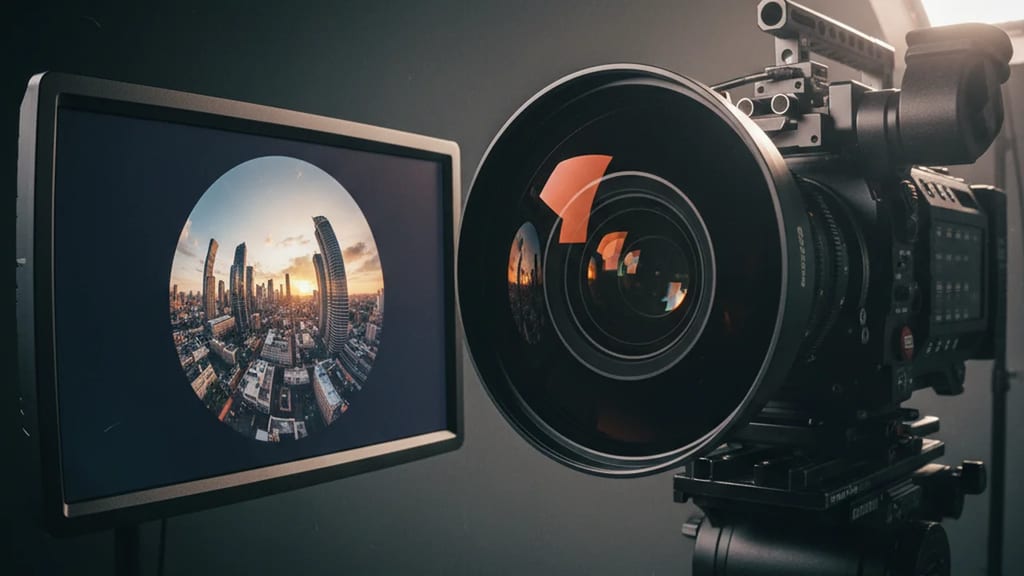
Fisheye lens with 180° angle of view that projects a circular image onto the sensor. Uses retrofocal design with 8–12 elements for hemispherical imaging.

Technical Details

Circular fisheye lenses achieve exact 180° diagonal angles of view and use a retrofocus design with 8-12 lens elements. The Nikon 8mm f/2.8 and Canon EF 8-15mm f/4L cover a full semicircle at an 8mm focal length, while the Sigma 4.5mm f/2.8 captures even 183°. The front nodal point is extremely far forward, making conventional filters impossible. The image follows an equidistant projection: f × θ = image radius, where θ is the angle to the optical axis.

History & Development

In 1962, Nikon developed the first commercial fisheye lens, the Nikkor 8mm f/8, for meteorology and astronomy. Hill Sky Lens Company had already produced early prototypes for cloud observation in 1924. In 1972, Nikon released the legendary 6mm f/2.8 with a 220° angle of view – still the most extreme fisheye for 35mm film to this day. Modern versions like the Laowa 4mm f/2.8 or the Entaniya HAL series achieve better edge sharpness with more compact designs thanks to new glass types.

Practical Use in Film

Stanley Kubrick used the Zeiss 6mm fisheye in "The Shining" (1980) for the oppressive hotel corridors, creating spatial disorientation. "Requiem for a Dream" (2000) utilized circular fisheyes for subjective drug-induced sequences. In music videos like "Around the World" (Daft Punk, 1997), they create surreal dance studio perspectives. Post-production is usually done in DaVinci Resolve or Adobe Premiere with Lens Distortion plugins for partial correction of the image center while retaining edge distortion.

Comparison & Alternatives

Diagonal fisheyes fill the entire sensor format and offer more practical image composition, while circular fisheyes convey a full hemispherical impression. Rectilinear ultra-wide-angle lenses (14-24mm) correct perspective distortion but lose the characteristic fisheye aesthetic. Digitally, similar effects are created by 360° cameras with subsequent "Little Planet" projection or VR headset recordings, but they rarely achieve the optical quality of true fisheye lenses.
From the crafts

Perspectives

Cinematographer

Ich setze zirkulare Fisheyes gezielt für subjektive Shots ein, da die kreisförmige Vignettierung einen Tunnel-Effekt erzeugt, der perfekt für Bewusstseinszustände oder räumliche Bedrängnis funktioniert. Die extrem kurze Schärfentiefe bei Offenblende erlaubt interessante Fokus-Pulls vom Vordergrund in die verzerrte Peripherie. Allerdings muss ich die Kamera absolut waagerecht halten, da bereits kleine Neigungen das Kreisbild asymmetrisch verschieben.

Director

Ich nutze das zirkulare Fischauge als visuelles Stilmittel für Paranoia, Claustrophobie oder surreale Traumsequenzen, da der schwarze Bildrand wie ein natürliches Matte wirkt und die Aufmerksamkeit ins Zentrum lenkt. Die extreme Verzerrung eignet sich hervorragend für Charaktere am psychischen Limit - jede Bewegung wird zur bedrohlichen Wölbung des Raums. Allerdings funktioniert es nur in kurzen Einstellungen, da das Auge schnell ermüdet.

Producer

Zirkulare Fisheye-Objektive kosten zwischen 800-2.500 Euro Tagesmiete und erfordern spezialisierte Kamera-Assistenten, da Focus Pulling extrem schwierig ist. Die Postproduktion verlängert sich um 15-20% durch aufwändige Lens-Correction-Workflows. Ich kalkuliere diese Shots nur für gezielten kreativen Impact ein, da die Nachbearbeitung teuer ist und viele Kinobetreiber Probleme mit der ungewöhnlichen Bildgeometrie haben.

More in the lexikon

Related terms

Test your knowledge

Quiz

1. Zu welchem Department gehört „Zirkulares Fischauge"?

2. Wie viele verschiedene Fachperspektiven bietet dieser Eintrag?

Report an error
From the Filmfarm ecosystem

Understand visual language, budget productions, connect crew.

The Lexikon is part of the Filmfarm ecosystem — alongside budgeting (FilmBalance), an industry magazine (FilmCircus) and crew networking (FilmCall, CrewMesh). One shared vocabulary for the whole production.

FilmFarm FilmRadarComing soonFilmPulseComing soonFilmNumbersComing soonFilmCapitalComing soonFilmLabComing soonFilmBalanceComing soonFilmCircusComing soon