Filmlexikon.
Support
Eyeline
Camera · Terms

Eyeline

Murnau AI illustration
flow para roll take

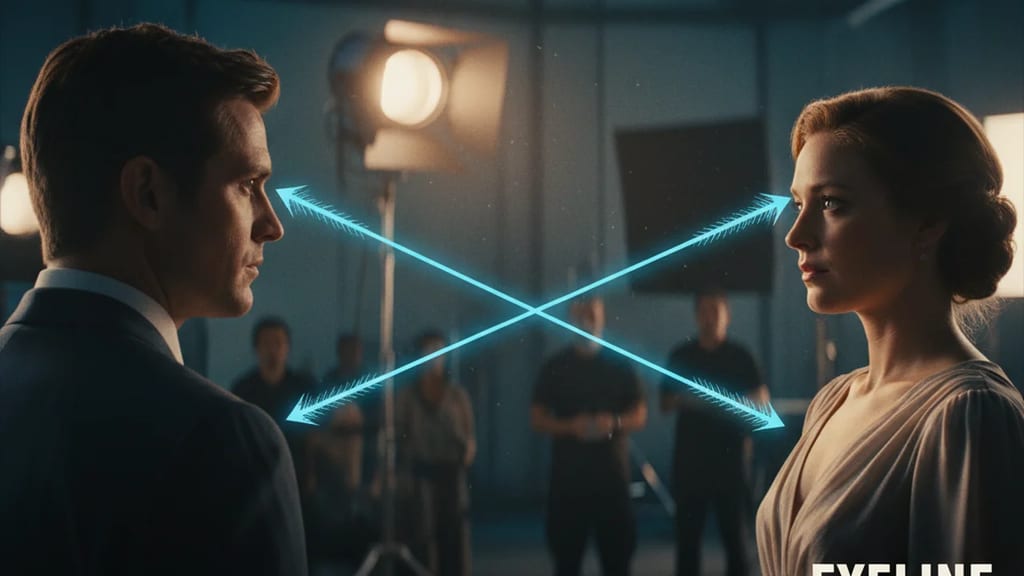
Imaginary line through main subject defining spatial relationship between shots for screen direction continuity.

Technical Details

Correct eyeline requires precise angle calculations: for a standard dialogue, cameras are typically positioned at a 30°-45° angle to the direction of gaze. Eye level is standardly set at 150-180 cm depending on the performer, with deviations of ±20 cm creating dramatic effects. Three main variants exist: direct eyeline to the camera (Direct Address), lateral to the off-screen partner, and motivated towards a visible object in the frame. Modern continuity software calculates gaze angles using vectors and 3D coordinates to avoid matching errors.

History & Development

In 1924, Lev Kuleshov established the systematic use of the eyeline as a narrative tool with his montage experiments. D.W. Griffith, as early as 1915 in "The Birth of a Nation," used deliberate gaze direction for emotional impact. In 1935, the Hollywood Studio System codified the 180° rule as a technical standard. Digital Intermediate workflows since the 2000s enable post-production correction of gaze directions through eye-tracking and CGI retouching.

Practical Application in Film

Stanley Kubrick deliberately used broken eyelines in "2001: A Space Odyssey" (1968) to disorient the audience. Conversational scenes follow the shot-reverse-shot technique: Camera A films performer 1 looking to the right, Camera B films performer 2 looking to the left. In phone call scenes, both performers look in the same direction to emphasize spatial separation. Incorrect eyelines destroy spatial logic and confront viewers with "unrealistic" situations.

Comparison & Alternatives

The eyeline differs from the action line, which defines directions of movement. Screen Direction describes the resulting gaze direction in the final image, while Eyeline Match denotes the correct cut between the looking subject and the object being looked at. Point-of-View shots replace the eyeline with subjective camera. Virtual Production with LED walls requires real-time calculation of eyelines to generate correct reflections in the eyes.
From the crafts

Perspectives

Cinematographer

Ich messe die Blickrichtung mit einem Winkelmesser und markiere die Eyeline am Monitor, damit beide Kameras bei Dialogszenen exakt spiegelverkehrte Winkel erfassen. Bei Steadicam-Fahrten folge ich der Blickachse des Darstellers dynamisch und halte dabei einen konstanten 35°-Winkel zur Sichtlinie. Virtual Sets erfordern präzise Eye-Tracking, damit die digitalen Reflexionen in den Augen des Schauspielers mit seiner tatsächlichen Blickrichtung übereinstimmen.

Director

Ich nutze bewusst gebrochene Blickachsen, um Verwirrung oder psychische Instabilität zu visualisieren – wenn der Antagonist plötzlich in dieselbe Richtung blickt wie der Protagonist, entsteht sofort Unbehagen beim Zuschauer. Bei emotionalen Wendepunkten lasse ich Darsteller ihre Blickrichtung um 180° ändern, um den inneren Wandel der Figur räumlich zu manifestieren. Die Eyeline bestimmt letztendlich, ob das Publikum mit der Figur mitfühlt oder sie beobachtet.

Producer

Falsche Blickachsen bedeuten Reshoots, die schnell 50.000€ pro Drehtag kosten, daher investiere ich in präzise Script Supervision und Continuity-Software mit 3D-Tracking. Bei internationalen Ko-Produktionen vereinbare ich einheitliche Eyeline-Standards, damit Second Unit-Material nahtlos mit Hauptdrehs kombinierbar ist. Virtual Production reduziert Blickachsen-Probleme um 70%, erfordert aber 15% höhere Prep-Zeit für technische Kalibrierung.

More in the lexikon

Related terms

Test your knowledge

Quiz

1. Zu welchem Department gehört „Blickachse"?

2. Wie viele verschiedene Fachperspektiven bietet dieser Eintrag?

Report an error
From the Filmfarm ecosystem

Understand visual language, budget productions, connect crew.

The Lexikon is part of the Filmfarm ecosystem — alongside budgeting (FilmBalance), an industry magazine (FilmCircus) and crew networking (FilmCall, CrewMesh). One shared vocabulary for the whole production.

FilmFarm FilmRadarComing soonFilmPulseComing soonFilmNumbersComing soonFilmCapitalComing soonFilmLabComing soonFilmBalanceComing soonFilmCircusComing soon