Filmlexikon.
Support
Blade
Lighting · Terms

Blade

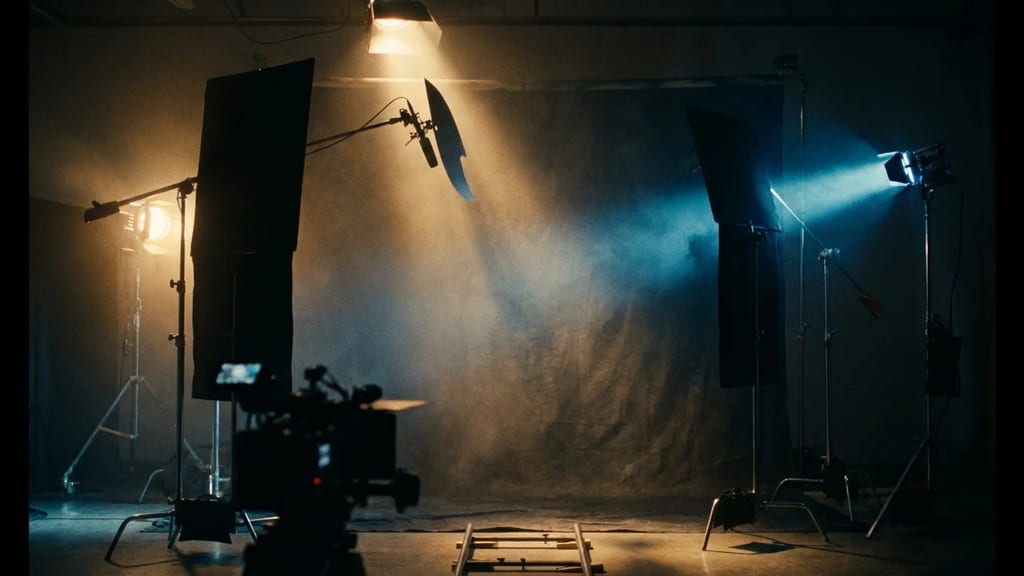
Murnau AI illustration
color temperature flow roll take

Metal flags made from aluminum or steel for precise light shaping and shadow control, mounted on C-Stands with 5/8" stud.

Technical Details

Blades are made of 0.8-1.2 mm thick aluminum or steel with a matte black coating (reflectivity below 2%). They are mounted via grip heads on C-stands or special blade arms. Typical variants include solid flags (completely opaque), single nets (25% light reduction), double nets (50% reduction), and silk flags (light diffusion with 85% transmission). Mounting is done via standardized 5/8-inch spigots or clamps.

History & Development

Blades originated in the 1920s in Hollywood studios as an evolution of theatrical set design techniques. Mole-Richardson standardized the sizes and mounting systems still in use today in 1934. In the 1960s, Matthews Studio Equipment introduced modular grip systems, allowing for more precise positioning. Since 2010, modern LED panels have necessitated new blade designs with smaller dimensions for more compact light sources.

Practical Use in Film

In "The Godfather" (1972), Gordon Willis systematically used blades to create the characteristic shadow play on Marlon Brando's face. In "Blade Runner 2049" (2017), Roger Deakins employed precisely positioned 2x3-foot blades to shape the geometric light patterns of interiors. Blades enable millimeter-accurate shadow edges without light spill contaminating adjacent image areas. The working distance to the light source determines the sharpness of the shadow edge: a 1:1 ratio creates half-shadow-free, razor-sharp demarcations.

Comparison & Alternatives

Unlike barn doors, blades create more precise cuts without the circular limitations of spotlight shutters. Cucaloris (cookies) produce textured shadows, while blades create clear geometric boundaries. Modern gobo projectors partially replace blades for more complex patterns but do not achieve their absolute sharpness for large-area shielding. Digital light shaping via DMX-controlled shutters offers flexibility but requires appropriately equipped lights and does not achieve the precision of mechanical blades with soft light sources.
From the crafts

Perspectives

Cinematographer

Ich setze 18x24-Zoll-Blades primär zur Kontrolle von Spill-Light und zur Schaffung präziser Gesichtsmodellierung ein. Die exakte Positionierung über Grip-Arms ermöglicht mir millimetergenaue Schattenkanten, die in der Postproduktion nicht replizierbar sind. Bei Available-Light-Situationen verwende ich Blades zur selektiven Abschirmung störender Lichtquellen ohne Beeinflussung der gewünschten Beleuchtung.

Director

Blades sind mein Werkzeug zur visuellen Charakterzeichnung durch gezielte Licht-Schatten-Führung im Gesicht der Darsteller. Die harten Schattenkanten verstärken dramatische Momente und schaffen psychologische Distanz oder Bedrohung. In Verhörszenen nutze ich Blades zur Teilung des Gesichts, wodurch die innere Zerrissenheit der Figur visuell manifest wird.

Producer

Ein 4er-Set professioneller Blades kostet 800-1200 Euro, amortisiert sich aber durch Zeitersparnis gegenüber aufwendiger Postproduktion. Die kompakte Bauweise reduziert Transportkosten und Setup-Zeiten erheblich – ein Blade-Setup dauert 3-5 Minuten versus 15-20 Minuten für vergleichbare digitale Lösungen. Bei Low-Budget-Produktionen ersetzen sie teure Spezialscheinwerfer.

More in the lexikon

Related terms

Test your knowledge

Quiz

1. Zu welchem Department gehört „Blade"?

2. Wie viele verschiedene Fachperspektiven bietet dieser Eintrag?

Report an error
From the Filmfarm ecosystem

Understand visual language, budget productions, connect crew.

The Lexikon is part of the Filmfarm ecosystem — alongside budgeting (FilmBalance), an industry magazine (FilmCircus) and crew networking (FilmCall, CrewMesh). One shared vocabulary for the whole production.

FilmFarm FilmRadarComing soonFilmPulseComing soonFilmNumbersComing soonFilmCapitalComing soonFilmLabComing soonFilmBalanceComing soonFilmCircusComing soon