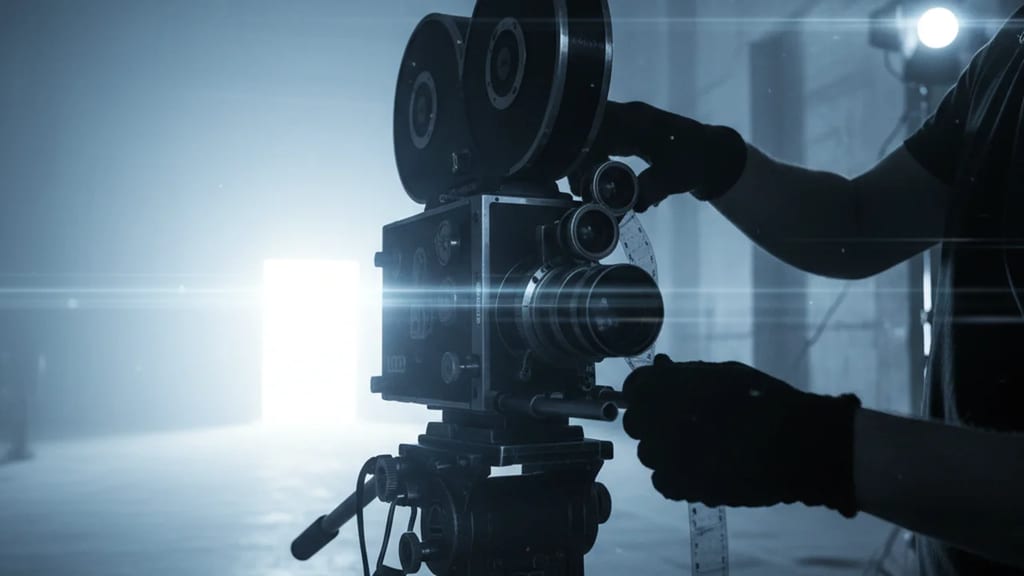
Legendary American film camera manufacturer (1911–1970s) — 35mm still and motion cameras. The 2709 became the working standard for documentary and newsreel.
Anyone who sat in front of a camera for documentaries or newsreels in the 1950s and 60s knew the Bell & Howell 2709 — a machine that wasn't elegant, but was as reliable as clockwork. The Chicago-based company revolutionized not the aesthetics of film, but its feasibility, starting in 1911. Bell & Howell built cameras for people who had to work, not philosophize.
The legendary 2709 — often internally referred to as "the Howell" — was the workhorse of newsreel cinema. 35mm, hand-cranked or later with an electric motor, robust enough for field shoots, agile enough for studios. Its big advantage: it could quickly switch between different aperture settings, and the interchangeable film magazine back allowed for quick changes in the field. This may sound trivial today — in the early 1950s, it was craftsmanship. Cameramen who worked with it swore by its mechanical precision and low running vibration. No elegant lines like those of Debrie or Eclair, but if your lens got dirty or the cold set in, the 2709 still worked.
Besides the 2709, Bell & Howell also produced the 35 NA and later models — all based on the same principle: functional, repairable, optimized for mass use. The company also supplied complete laboratory equipment and projectors, which is why many film studios and newsreel departments operated within a Bell & Howell ecosystem. You shot with their camera, your negative was developed in a Bell & Howell machine, and it was shown in cinemas from a Bell & Howell projector.
Today, original 2709 cameras are collectible, but not glamorous — they're at best useful for experimental filmmaking or as museum pieces. Their technical legacy, however, is tangible: the standardization of film magazines, modular construction, maintainability — every subsequent camera manufacturer learned from Bell & Howell. They weren't the inventors of revolutionary optics or shutter mechanisms, but they understood that a camera's primary function is to work. Period.
Related terms
Quiz
1. Zu welchem Department gehört „Bell & Howell"?