Technical Details
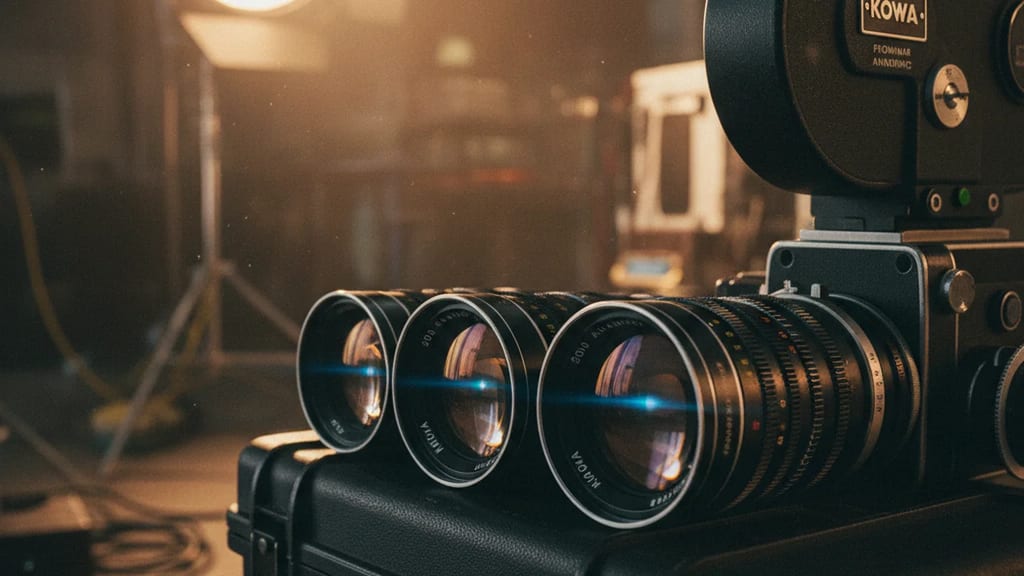
Kowa anamorphic lenses utilize cylindrical lens elements that compress the image horizontally by a factor of 2:1. Common focal lengths include 40mm, 50mm, 75mm, and 100mm with a constant aperture of f/2.3. The optical system consists of 8-12 elements in 6-8 groups, with the characteristic horizontal lens flares produced by the special coating on the front element. The lenses weigh between 2.8kg (40mm) and 4.2kg (100mm) and require a flange focal distance of 52mm for standard 35mm cameras.
Kowa produced two main series: the "8-Z" series for professional cinema productions and the more compact "Prominar" series for television. The 8-Z lenses are distinguished by their low distortion of less than 0.5% and a minimum focus distance of 0.9m.
History & Development
In 1952, Kowa began developing anamorphic lenses in response to the growing popularity of the CinemaScope format since 1953. The first series lenses appeared in 1954 and quickly established themselves as a cost-effective alternative to Chrétien's French Hypergonar systems. In 1962, Kowa introduced improved coatings that enhanced the characteristic blue and orange lens flare behavior.
Production ceased in 1970 as digital imaging formats and new competitors like Panavision dominated the market. Today, original Kowa lenses are considered sought-after vintage optics.
Practical Use in Film
Kowa lenses shaped the visual appearance of numerous films in the 1960s, including Sergio Leone's Spaghetti Westerns and early James Bond productions. The characteristic horizontal streaks from light sources and the warm color rendition with a slight magenta shift are now intentionally used for retro aesthetics. Netflix series like "Stranger Things" utilize adapted Kowa lenses for an authentic 80s look.
The workflow requires de-squeezing in post-production from a 4:3 to a 2.35:1 aspect ratio. The relatively shallow depth of field at wide apertures and the smooth bokeh make Kowa lenses particularly suitable for close-ups and dramatic scenes.
Comparison & Alternatives
Kowa lenses differ from modern anamorphic systems through their organic image rendering and technical limitations such as breathing and edge distortion. While current Cooke or ARRI anamorphic lenses are technically more perfect, Kowa lenses offer a distinctive vintage look.
Modern adaptations by SLR Magic or Moment use Kowa front groups with new spherical elements for digital cameras. These hybrid solutions cost €8,000-€15,000 per lens, while original Kowa sets can fetch €50,000+ at auctions.