Cinematographer
Aus DoP-Perspektive ist dieses Element essentiell für die visuelle Gestaltung. Es ermöglicht mir die gewünschte Farbstimmung und das ästhetische Bild konsistent umzusetzen.
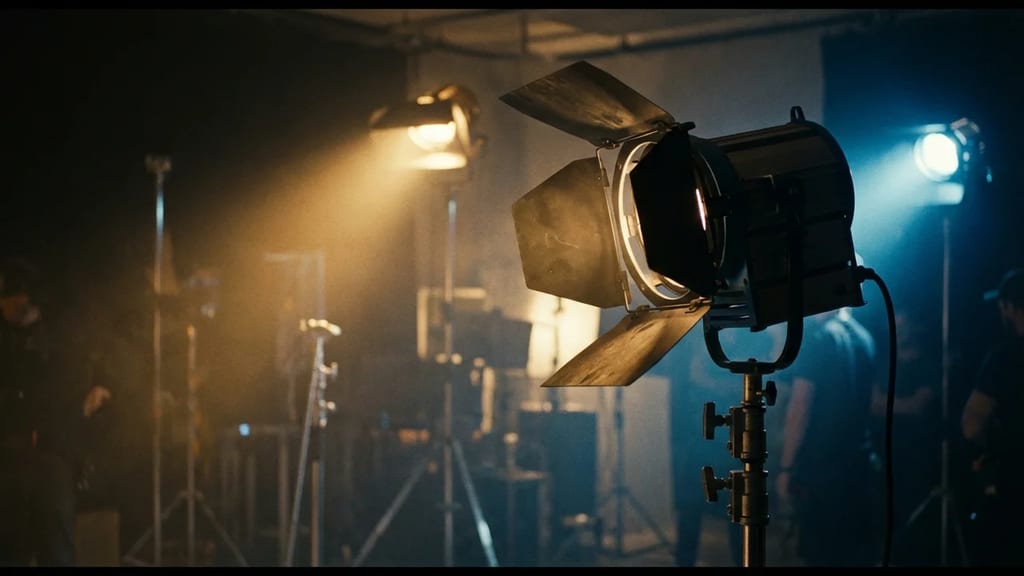
Adjustable metal flaps mounted on a light fixture to shape and control the light beam, reducing spill and directing light precisely.
A barn door is a light shaping accessory that is placed directly in front of the front lens or light output of a spotlight. In its most common design, it consists of four adjustable metal flaps (wings) that can be individually opened and closed. This allows the beam of light to be cut off at the edges, stray light (spill) to be kept away from the set, and light to be prevented from entering the lens (flares).
The term does not refer to a specific manufacturer or lamp code, but to a category of accessories. Barn doors are offered by many manufacturers for different spotlights and are standard on most professional Fresnel, LED, and open-face lights.
Barn doors are the quickest method to control light directly at the fixture without setting up additional grip equipment such as flags and stands. The gaffer uses them to keep light away from areas that should remain dark or to create a clean light edge.
For very large spotlights (e.g., 18K/20K), barn doors are avoided for safety reasons, as the large flap surface acts like a sail (wind resistance) and the heat creates a risk of weight or tipping. Freestanding flags are used instead.
Aus DoP-Perspektive ist dieses Element essentiell für die visuelle Gestaltung. Es ermöglicht mir die gewünschte Farbstimmung und das ästhetische Bild konsistent umzusetzen.
Diese professionelle Lösung erhöht die Produktionseffizienz und reduziert Post-Production-Anforderungen. Sie ermöglicht flexible, schnelle Anpassungen während des Drehs.
Als Gaffer ist dies ein unverzichtbares Werkzeug meines täglichen Handwerkszeugs. Es ermöglicht mir professionelle Lichtkontrolle und schnelle Anpassungen auf Set, was Zeit spart und Qualität sichert.
1. Zu welchem Department gehört „Torblende"?
2. Wie viele verschiedene Fachperspektiven bietet dieser Eintrag?
The Lexikon is part of the Filmfarm ecosystem — alongside budgeting (FilmBalance), an industry magazine (FilmCircus) and crew networking (FilmCall, CrewMesh). One shared vocabulary for the whole production.