Filmlexikon.
Support
Auro-3D
Sound · Terms

Auro-3D

Murnau AI illustration
Sound · Terms

Auro-3D

immersive audioobject based audiosound perspective · 6 Related terms Murnau AI illustration
immersive audio object based audio sound perspective dolby atmos atmos mix dolby r

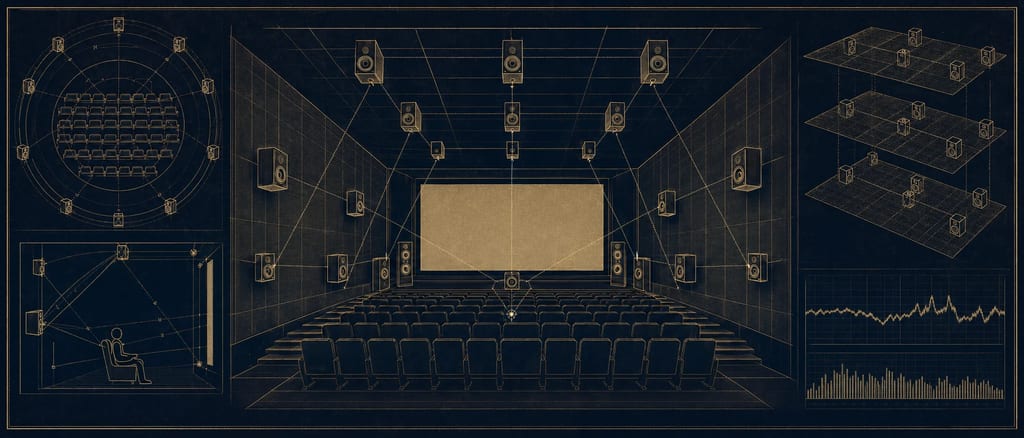
3D audio format with 11.1 channels: 5 main speakers, 4 height speakers at side walls, 2 top speakers plus subwoofer for immersive cinema sound.

Technical Details

The standard configuration comprises 11.1 channels: 5 lower speakers (L, C, R, Ls, Rs), 4 height speakers at a height of 9.5 meters on the side walls, 2 top speakers on the ceiling, plus a subwoofer. Extended setups reach 13.1 with additional rear-height speakers. The AuroCodec compresses audio data with lossless 48kHz/24bit quality and utilizes downward compatibility for 5.1 systems. The decoders operate with 32-bit floating-point processing and a latency under 10 milliseconds.

History & Development

Auro-3D was developed between 2005-2010 by Wilfried Van Baelen at the Belgian company Galaxy Studios/Auro Technologies. The first commercial installation took place in 2012 at Kinepolis Antwerp. In 2013, the first Auro-3D film "Red Tails" followed in a re-recording, while "The Amazing Spider-Man 2" (2014) was the first to be natively produced in Auro-3D. Barco integrated Auro-3D technology into its digital cinema projectors in 2014. By 2020, over 800 Auro-3D cinemas had been installed worldwide, primarily in Europe and Asia.

Practical Application in Film

Productions like "Fantastic Beasts and Where to Find Them" (2016) and "Blade Runner 2049" (2017) utilized Auro-3D for atmospheric soundscapes, where rain or city noises are distributed across the height layers. The Voice-of-God layer is suitable for helicopter sounds, thunderclaps, or mystical voices. The workflow requires special monitoring setups in mixing studios and separate stems for each layer. Lower adoption compared to competitors complicates distribution but offers cost-effective retrofitting of existing cinemas.

Comparison & Alternatives

In contrast to Dolby Atmos' object-based approach, Auro-3D works channel-based with fixed speaker positions. DTS:X combines both approaches, while IMAX Enhanced targets consumer hardware. Auro-3D requires fewer speakers than Atmos (11.1 vs. up to 64 objects) and enables more affordable installations. For smaller cinemas or retrofits, Auro-3D offers practical advantages, while Atmos dominates premium cinemas and Hollywood productions. AuroMax can upmix existing 5.1 material, increasing program diversity.
From the crafts

Perspectives

Cinematographer

Ich muss bei Auro-3D-Produktionen die Bildkomposition so planen, dass sie mit der mehrstufigen Tonebene harmoniert – wenn ein Helikopter durch den Voice-of-God-Layer fliegt, sollte die Kamera das unterstützen, nicht dagegen arbeiten. Die präzise Lautsprecherpositionierung erfordert eine exaktere Synchronisation zwischen Bild und Ton als bei Standard-5.1, besonders bei Schwenks und Fahrten.

Director

Ich nutze die drei Auro-3D-Ebenen für narrative Hierarchien – Dialoge unten, Atmosphäre in der Mitte, göttliche oder bedrohliche Elemente oben. Die festen Kanalpositionen geben mir verlässliche kreative Kontrolle darüber, wo bestimmte Story-Elemente im Raum positioniert werden, anders als bei objektbasierten Systemen, wo die finale Wiedergabe vom jeweiligen Kino abhängt.

Producer

Auro-3D kostet etwa 30% weniger als eine Dolby Atmos-Installation, was kleinere Kinoketten anzieht, aber die begrenzte Verbreitung reduziert unsere Vermarktungsreichweite erheblich. Die Nachmischung benötigt nur 2-3 zusätzliche Studiotage gegenüber Atmos' 5-7 Tagen, dafür fehlen uns die Premium-Multiplexe als Abnehmer für die ersten Spielwochen.

More in the lexikon

Related terms

Test your knowledge

Quiz

1. Was beschreibt „Auro-3D" am besten?

2. Zu welchem Department gehört „Auro-3D"?

3. Wie viele verschiedene Fachperspektiven bietet dieser Eintrag?

Report an error
From the Filmfarm ecosystem

Understand visual language, budget productions, connect crew.

The Lexikon is part of the Filmfarm ecosystem — alongside budgeting (FilmBalance), an industry magazine (FilmCircus) and crew networking (FilmCall, CrewMesh). One shared vocabulary for the whole production.

FilmFarm FilmRadarComing soonFilmPulseComing soonFilmNumbersComing soonFilmCapitalComing soonFilmLabComing soonFilmBalanceComing soonFilmCircusComing soon