Filmlexikon.
Support
Audition
Production · Terms

Audition

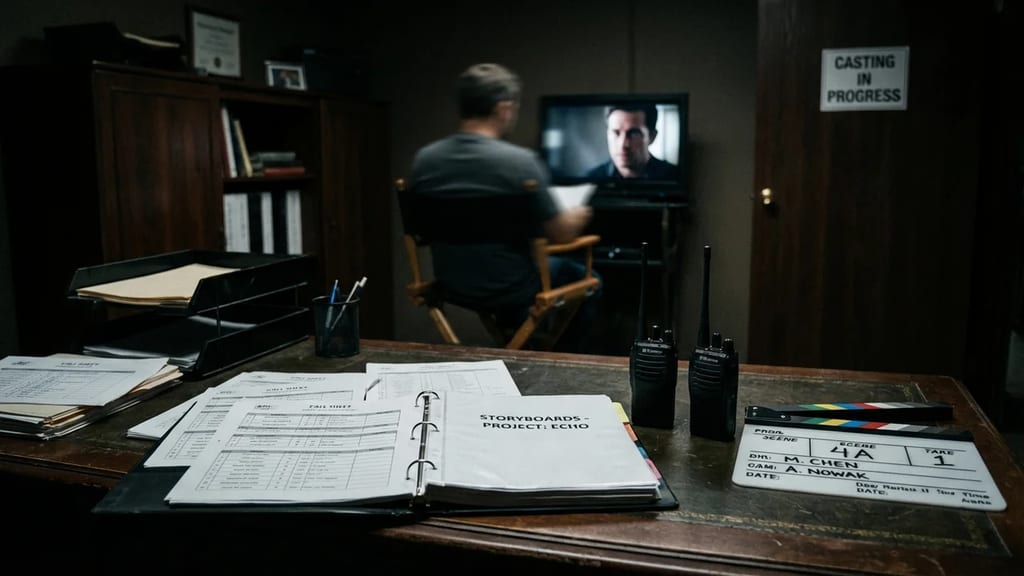
Murnau AI illustration
visual audi recording production aufnahmeleitung record principal photography shooting production

Actor audition recorded in Full-HD with 3-point lighting at 2.5m camera distance. Three formats: Cold Reading, Prepared Reading, and Improvisation.

Technical Details

Standard auditions take place in rooms measuring 20-40 m² with 3-point lighting (Key Light 2000W, Fill Light 1000W, Back Light 500W). Camera positioning is 2.5-3 meters away from the candidate, with recording in Full-HD (1920x1080) at 25 fps. Self-tapes, established since 2010, use smartphones or consumer cameras with a minimum resolution of 1080p. Three main variants exist: Cold Reading (unprepared text), Prepared Reading (24-48 hours preparation time), and Improvisation (5-10 minutes of free scene development).

History & Development

Formalized auditions became established in Hollywood in 1920 with the introduction of the studio system. MGM was the first studio to introduce systematic camera tests in 1925. The transition to sound film in 1927 revolutionized casting through mandatory voice tests. In 1960, Casting Director Marion Dougherty developed the "callback" structure with up to four audition rounds. Digital recording became widespread from 1995 onwards, self-tapes were established in 2008 and became an industry standard during COVID-19 in 2020-2022.

Practical Application in Film

Christopher Nolan conducts an average of 3.2 audition rounds for leading roles; for "The Dark Knight" (2008), 42 actors tested for the Joker. Marvel Studios has used improvisation tests for 60% of their casting decisions since "Iron Man" (2008). Quentin Tarantino prefers 45-minute one-on-one meetings with integrated auditions. Streaming productions reduce audition duration by an average of 40% compared to theatrical productions but use self-tapes more frequently for pre-selection.

Comparison & Alternatives

Screen tests differ from standard auditions through more elaborate costumes and set recreations. Chemistry Reads exclusively test the interaction between actors, while Solo Auditions evaluate individual performance. Work Sessions are increasingly replacing traditional auditions – here, candidates work with the director on scenes for 2-4 hours. Virtual Reality Auditions, in testing phase since 2019, allow for spatial interaction in digital sets but have not yet reached market maturity.
From the crafts

Perspectives

Cinematographer

Ich positioniere die Kamera bewusst neutral auf Augenhöhe, um dem Regisseur eine unverfälschte Bewertung zu ermöglichen, ohne durch dramatische Winkel abzulenken. Die Beleuchtung halte ich flach und gleichmäßig, damit Gesichtszüge und Emotionen klar erkennbar sind – Schatten würden die Casting-Entscheidung verfälschen. Bei Self-Tape-Anweisungen spezifiziere ich immer Fenster-Licht von vorne und Handy im Querformat.

Director

Ich nutze das Vorsprechen, um die emotionale Bandbreite und Spontaneität des Schauspielers zu testen, nicht seine Textkenntnis. Oft gebe ich bewusst andere Regieanweisungen als im Drehbuch stehen, um zu sehen, wie flexibel und kreativ der Kandidat reagiert. Die ersten 30 Sekunden entscheiden meist schon – entweder die Chemie stimmt oder nicht.

Producer

Ich kalkuliere 150-300 Euro pro Vorsprechen-Tag für Raummiete und Technik, bei Hauptrollen oft 2000-5000 Euro für mehrtägige Casting-Sessions. Self-Tapes reduzieren meine Kosten um 70%, verlängern aber die Vorproduktion um 2-3 Wochen durch langsamere Entscheidungsprozesse. Pro Rolle rechne ich mit 15-40 Kandidaten, abhängig von Budget und Bekanntheitsgrad.

More in the lexikon

Related terms

Test your knowledge

Quiz

1. Was beschreibt „Vorsprechen" am besten?

2. Zu welchem Department gehört „Vorsprechen"?

3. Wie viele verschiedene Fachperspektiven bietet dieser Eintrag?

Report an error
From the Filmfarm ecosystem

Understand visual language, budget productions, connect crew.

The Lexikon is part of the Filmfarm ecosystem — alongside budgeting (FilmBalance), an industry magazine (FilmCircus) and crew networking (FilmCall, CrewMesh). One shared vocabulary for the whole production.

FilmFarm FilmRadarComing soonFilmPulseComing soonFilmNumbersComing soonFilmCapitalComing soonFilmLabComing soonFilmBalanceComing soonFilmCircusComing soon