Filmlexikon.
Support
Atmos
Sound · Technique

Atmos

Murnau AI illustration
atmos mix dolby atmos omnies

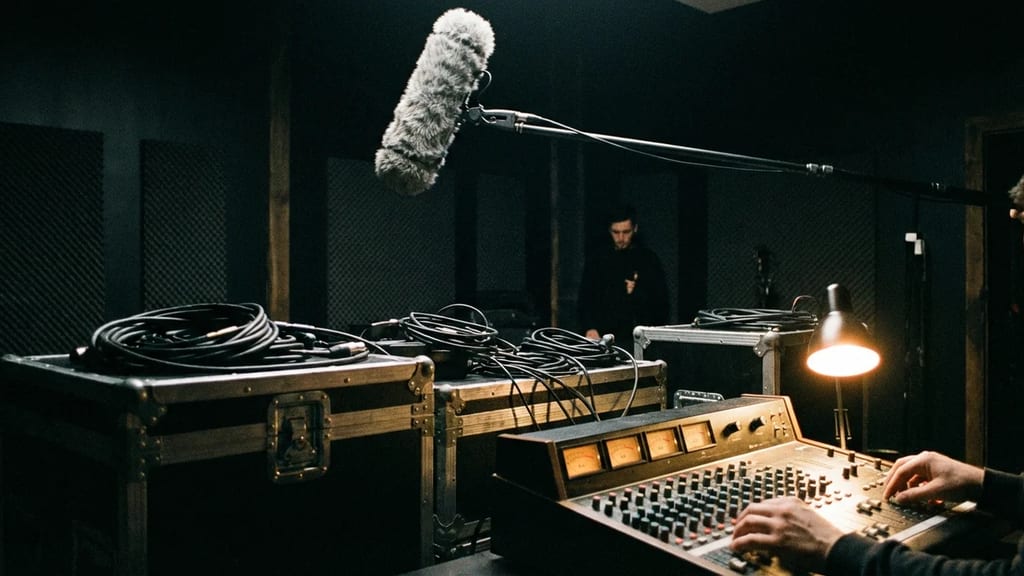
Continuous ambient background sound recorded to characterize acoustic space, typically captured with condenser microphones like Schoeps CMIT 5U at 3–5 meters from sound sources.

Technical Details

Atmosphere recordings are made with condenser microphones such as the Schoeps CMIT 5U or Audio-Technica AT4053b with wind protection values below 5 m/s. The minimum distance to the sound source is 3-5 meters for diffuse room recordings. Stereophonic atmospheres are realized using AB technique (microphone distance 2-3 meters) or MS method. The recording duration is between 2-10 minutes per take, with at least 30 seconds of seamless loops being possible. The dynamic range typically ranges between 15-25 dB.

History & Development

Systematic atmosphere recordings began around 1930 at the UFA studios in Babelsberg, where sound engineers like Gustav Bellers created the first "sound effect libraries." In 1952, Warner Bros. introduced standardized atmosphere sessions. The breakthrough came in 1977 with Ben Burtt's sound design for "Star Wars," where synthetic atmospheres were combined with natural recordings for the first time. Since the 1990s, digital workstations like Pro Tools have enabled seamless integration of atmosphere tracks. Modern object-based audio formats like Dolby Atmos since 2012 position atmosphere elements three-dimensionally in space.

Practical Application in Film

In "Blade Runner 2049," sound designer Theo Green used 47 different atmosphere layers for the city scenes, recorded in Budapest and Los Angeles. Typical categories include room atmosphere (reverb tails 0.8-2.4 seconds), weather atmosphere, and traffic atmosphere. The standard workflow involves 4-6 atmosphere tracks in the final mix, with crossfades of 250-500 ms between cuts. Gary Rydstrom created 180 minutes of jungle atmosphere for "Jurassic Park" from recordings from the Amazon and Hawaii.

Comparison & Alternatives

Atmosphere differs from sound effects (SFX) by continuous rather than punctual playback and from Foley by natural rather than post-dubbed creation. Modern alternatives include AI-generated ambiences (AudioStellar, Krotos) and interactive atmosphere systems like WWise for games. With budgets under 100,000 Euros, library atmospheres (Zapsplat, Freesound) dominate, while larger productions invest 15-25% of the sound budget in original atmosphere recordings. Convolution reverbs are increasingly replacing static room atmospheres with algorithmically generated reverb tails.
From the crafts

Perspectives

Cinematographer

Ich plane Atmo-Aufnahmen bereits beim Location Scouting mit ein, da bestimmte Räume spezifische Hallzeiten von 0,5 bis 3 Sekunden erzeugen, die später in der Postproduktion schwer nachzustellen sind. Bei Außenaufnahmen koordiniere ich mit dem Tonteam goldene Stunden für wind- und verkehrsarme Atmo-Takes. Die Kontinuität der Atmo beeinflusst meine Schnittplanung, da abrupte akustische Wechsel auch visuell motiviert werden müssen.

Director

Ich nutze Atmo als unsichtbaren Charakter – die 2,3 Sekunden Hallfahne in der Kathedralenszene verstärken die Isolation der Protagonistin stärker als jeder Dialog. Spezifische Atmo-Signaturen wie das 50 Hz-Brummen in Industrieszenen konditionieren das Publikum auf Bedrohung, während Naturatmos mit Vogelstimmen zwischen 2-8 kHz Entspannung signalisieren. Ich arbeite mit 3-4 Atmo-Ebenen gleichzeitig, um emotionale Komplexität zu schaffen.

Producer

Original-Atmo-Aufnahmen kosten mich 800-1.500 Euro pro Drehtag zusätzlich, aber sparen später 3.000-5.000 Euro für Bibliothekslizenzen und ADR-Sessions zur Reparatur schlechter Originalatmo. Internationale Koproduktionen erfordern rechtefreie Atmo-Aufnahmen, da Urheberrechte bei Straßengeräuschen in 12 Ländern unterschiedlich geregelt sind. Ich plane 2-3 reine Atmo-Drehtage ohne Cast ein, um später in der Postproduktion flexibel zu bleiben.

More in the lexikon

Related terms

Test your knowledge

Quiz

1. Zu welchem Department gehört „Atmo"?

2. Wie viele verschiedene Fachperspektiven bietet dieser Eintrag?

Report an error
From the Filmfarm ecosystem

Understand visual language, budget productions, connect crew.

The Lexikon is part of the Filmfarm ecosystem — alongside budgeting (FilmBalance), an industry magazine (FilmCircus) and crew networking (FilmCall, CrewMesh). One shared vocabulary for the whole production.

FilmFarm FilmRadarComing soonFilmPulseComing soonFilmNumbersComing soonFilmCapitalComing soonFilmLabComing soonFilmBalanceComing soonFilmCircusComing soon