Filmlexikon.
Support
Arri Bayonet
Camera · Terms

Arri Bayonet

Murnau AI illustration
arri flow para roll take

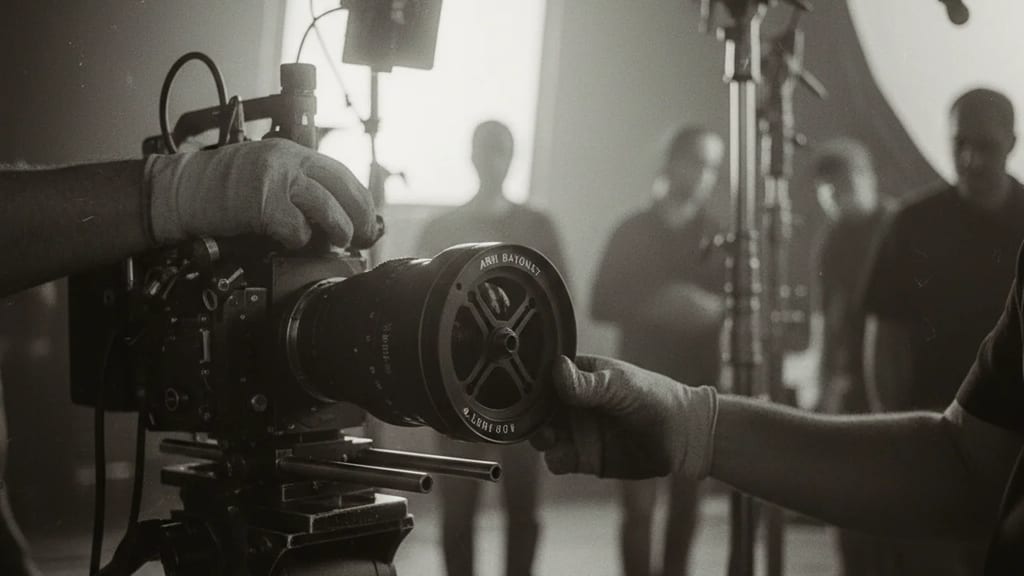
Arri Bayonet: lens mount system by Arnold & Richter featuring four locking pins and 52mm flange focal distance, enabling lens changes in under five seconds.

Technical Details

The Arri Bayonet operates with four symmetrically arranged locking cams that engage into corresponding recesses on the lens. The flange focal distance is exactly 52mm. Modern versions integrate electronic contacts for aperture control and metadata transmission. The original Arri Standard Bayonet is supplemented by the Arri LDS Bayonet (Lens Data System), which provides up to 19 electrical contacts for communication between the lens and the camera.

History & Development

Arnold & Richter introduced the bayonet in 1937 with the Arriflex 35 – the first handheld 35mm reflex camera. August Arnold developed the system as an alternative to screw threads to enable faster lens changes. In 1972, the Arri Bayonet also came to 16mm cameras with the Arriflex 16SR. The LDS system was introduced in 2010 with the Alexa and expanded in 2018 with the LPL Bayonet (Large Positive Lock), which optimally serves larger sensors with its 62mm diameter.

Practical Use in Film

Arri cameras with this bayonet shaped classics such as "Apocalypse Now" (1979, Vittorio Storaro used Arriflex 35BL) or "Blade Runner 2049" (2017, Roger Deakins worked with Alexa 65). The system allows lens changes in under five seconds, which is crucial for documentary shooting or quick setups. The precise mechanical coupling prevents backfocus issues that can occur with other systems. Professional lenses from Zeiss, Cooke, or Leica are standardly available with the Arri Bayonet.

Comparison & Alternatives

The Arri Bayonet competes with the PL Mount (Positive Lock), which was developed in 1982 and is the industry standard today. While the PL Mount offers identical optical properties with its 52mm flange focal distance, the Arri system is limited to Arri cameras. Adapters allow the use of Arri lenses on PL cameras, but not vice versa. The modern LPL Bayonet addresses large full-frame sensors, which the classic Arri Bayonet with its smaller image circle requirements would overwhelm.
From the crafts

Perspectives

Cinematographer

Ich schätze das Arri-Bajonett für seine absolute Präzision – nach 50 Objektivwechseln am Tag sitzt jede Optik millimetergenau ohne Backfocus-Korrektur. Die LDS-Integration erspart mir das manuelle Eingeben von Brennweite und Blende in die Kamera-Metadaten. Bei schnellen Handheld-Sequenzen ist der sichere Vier-Nocken-Verschluss Gold wert.

Director

Für mich bedeutet das Arri-System Flexibilität in der visuellen Erzählung – ich kann zwischen Vintage-Zeiss-Optiken für warme Rückblenden und modernen Master Primes für knackige Gegenwart wechseln, ohne das Kamerasystem zu ändern. Die schnellen Objektivwechsel halten den Rhythmus am Set aufrecht. Das LDS-System dokumentiert automatisch jede Einstellung für die Post-Production.

Producer

Das Arri-Bajonett bindet mich an einen Hersteller, aber die Investitionssicherheit ist enorm – Objektive von 1970 funktionieren heute noch an Alexa-Kameras. Meine Objektivsammlung behält ihren Wert über Jahrzehnte. Bei internationalen Co-Produktionen finde ich weltweit kompatible Ausrüstung, da Arri-Kameras Industriestandard sind.

More in the lexikon

Related terms

Test your knowledge

Quiz

1. Was beschreibt „Arri-Bajonett" am besten?

2. Zu welchem Department gehört „Arri-Bajonett"?

3. Wie viele verschiedene Fachperspektiven bietet dieser Eintrag?

Report an error
From the Filmfarm ecosystem

Understand visual language, budget productions, connect crew.

The Lexikon is part of the Filmfarm ecosystem — alongside budgeting (FilmBalance), an industry magazine (FilmCircus) and crew networking (FilmCall, CrewMesh). One shared vocabulary for the whole production.

FilmFarm FilmRadarComing soonFilmPulseComing soonFilmNumbersComing soonFilmCapitalComing soonFilmLabComing soonFilmBalanceComing soonFilmCircusComing soon