Filmlexikon.
Support
Anamorphic Adapter
Camera · Technique

Anamorphic Adapter

Murnau AI illustration
Camera · Technique

Anamorphic Adapter

anamorphic clampmoment anamorphic adapteranamorphic · 3 Related terms Murnau AI illustration
anamorphic clamp moment anamorphic adapter anamorphic

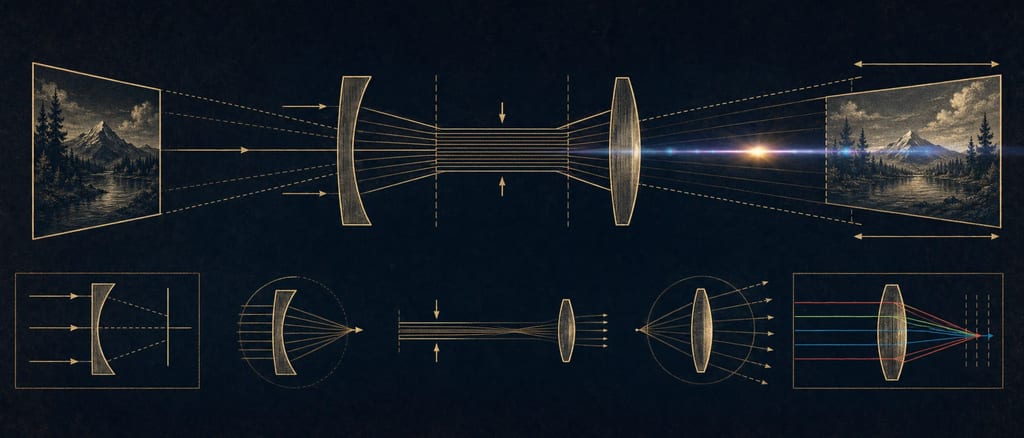
Optical lens attachment that horizontally compresses the image by a factor of 1.33x or 2x and produces characteristic horizontal lens flares.

Technical Details

Modern anamorphic adapters work with a two-lens system of cylindrical glass lenses that exclusively influence the horizontal image axis. Standard adapters compress the image by a factor of 1.33x, while 2x adapters produce a stronger compression of 2:1. The adapters are manufactured in T-stops from T/1.3 to T/5.6 and require a minimum focusing distance between 0.9m and 1.2m. The additional weight varies between 1.2kg and 2.8kg depending on the manufacturer. The optical design leads to characteristic horizontal lens flares, increased chromatic aberration, and an asymmetry in depth of field between the horizontal and vertical planes.

History & Development

Henri Chrétien originally developed the Hypergonar lens system in 1926 for military purposes for panoramic surveillance. 20th Century Fox acquired the rights in 1952 and introduced the system as CinemaScope with the film "The Robe" (1953). Panavision perfected the technology from 1957 onwards with the Ultra Panavision series and dominated the market for decades. Since 2010, anamorphic optics have experienced a renaissance through manufacturers like Atlas Lens Co., Cooke, and ARRI, as they are more cost-effective than native anamorphic lenses and optimally utilize digital sensors.

Practical Application in Film

Christopher Nolan used Panavision anamorphic adapters for "Dunkirk" (2017) to achieve the widescreen format while maintaining flexibility with various focal lengths. Denis Villeneuve employed ARRI Master Anamorphic adapters in "Blade Runner 2049" (2017) to enhance the characteristic horizontal streaks in night scenes. The workflow requires precise calibration of focus systems, as the asymmetrical depth of field complicates manual tracking. Adapters offer a 60-70% cost saving compared to native anamorphic lenses with 85% of the optical quality.

Comparison & Alternatives

Anamorphic adapters differ from native anamorphic lenses in their lower optical precision but higher flexibility in lens changes. Modern alternatives include digital cropping with subsequent scaling or specialized sensors like the ARRI ALEXA 65 with 6K resolution. Adapters are suitable for productions with limited budgets or frequent focal length changes, while native anamorphic optics remain superior for high-end productions with controlled lighting conditions.

From the crafts

Perspectives

Cinematographer

Als DoP schätze ich Anamorphot-Adapter für die kostengünstige Erweiterung meines Objektivparks, muss aber die asymmetrische Schärfentiefe und die Fokus-Herausforderungen bei Handheld-Sequenzen einkalkulieren. Die charakteristischen horizontalen Flares nutze ich gezielt für Nacht- und Gegenlichtszenen, während ich bei Close-ups die erhöhte chromatische Aberration an den Bildrändern im Auge behalten muss.

Director

Ich setze Anamorphot-Adapter ein, um das epische 2.39:1-Format zu erreichen und dabei die emotionale Wirkung der horizontalen Lens Flares für dramatische Momente zu nutzen. Die charakteristische Verzerrung an den Bildrändern verstärkt bei mir die Immersion in futuristische oder nostalgische Welten, während das breite Format Ensemble-Szenen und Landschaftsaufnahmen visuell aufwertet.

Producer

Anamorphot-Adapter reduzieren meine Optik-Kosten um etwa 65% gegenüber nativen anamorphen Objektiven, erfordern aber 15-20% mehr Zeit beim Dreh durch komplexere Fokussierung. Ich kalkuliere zusätzliche Postproduktionskosten für die Entzerrung und Farbkorrektur ein, spare aber bei der Anschaffung und kann flexibler auf Objektivwünsche der Regie reagieren.

More in the lexikon

Related terms

Test your knowledge

Quiz

1. Zu welchem Department gehört „Anamorphot-Adapter"?

2. Wie viele verschiedene Fachperspektiven bietet dieser Eintrag?

Report an error
From the Filmfarm ecosystem

Understand visual language, budget productions, connect crew.

The Lexikon is part of the Filmfarm ecosystem — alongside budgeting (FilmBalance), an industry magazine (FilmCircus) and crew networking (FilmCall, CrewMesh). One shared vocabulary for the whole production.

FilmFarm FilmRadarComing soonFilmPulseComing soonFilmNumbersComing soonFilmCapitalComing soonFilmLabComing soonFilmBalanceComing soonFilmCircusComing soon