Filmlexikon.
Support
Aging Makeup
Art Department · Terms

Aging Makeup

Murnau AI illustration
flow makeup roll

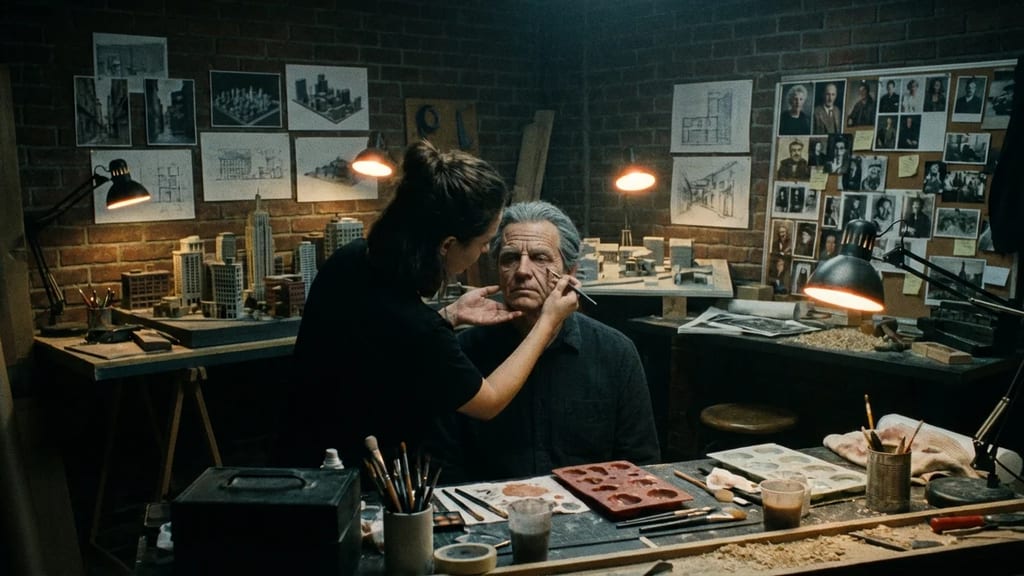
Specialized makeup technique using silicone and gelatin appliances (15–25 pieces) to age actors by decades; application requires 3–6 hours daily.

Technical Details

Modern aging makeup predominantly uses platinum-catalyzed silicone (Shore hardness A10-A30) for facial parts and gelatin (250-300 Bloom) for skin textures. Standard applications include prefabricated forehead wrinkles (0.5-2mm material thickness), nasolabial folds, eye bags, and neck skin extensions. Adhesion is achieved using medical silicone adhesive or Pros-Aide adhesive, with durability lasting 12-16 hours. Three main categories exist: Basic Aging (3-5 pieces), Medium Aging (8-12 pieces), and Full-Face Aging (15-25 individual components).

History & Development

Makeup artist Jack Pierce developed the first multi-piece latex applications in 1931 for "Dr. Jekyll and Mr. Hyde." In 1970, Dick Smith revolutionized the field with "Little Big Man" using ultra-light foam latex pieces that aged Dustin Hoffman by 50 years. The breakthrough came in 1985 with Rick Baker's silicone technology for "Cocoon." Since 2008, Digital Extensions have complemented practical makeup, but remain secondary in close-ups.

Practical Application in Film

In 2017, Gary Oldman spent 4 hours daily in makeup to portray Churchill for "Darkest Hour." "The Irishman" (2019) combined traditional makeup with digital de-aging technology for Robert De Niro. Standard workflow: Life casting (2 hours), sculpting (2-3 days), mold making (1 day), on-set application (3-6 hours daily). Disadvantages: Limited facial expression with thick applications, perspiration under the pieces, daily re-adhesion required.

Comparison & Alternatives

Distinction from pure makeup aging without prosthetics, which achieves a maximum of 10-15 years. Since 2016, CGI aging has increasingly replaced elaborate full-face makeup, but costs €50,000-€200,000 per character compared to €15,000-€40,000 for practical solutions. Hybrid approaches use makeup for facial contour and digital post-production for skin details. In dialogue scenes, directors often prefer practical makeup due to natural skin elasticity and direct actor control.
From the crafts

Perspectives

Cinematographer

Ich plane bei Alterungsmasken grundsätzlich weichere Beleuchtung, da hartes Licht die Klebekanten der Silikonteile sichtbar macht. Meine Standardkonfiguration nutzt großflächige Softboxen mit 2700K-3200K Farbtemperatur, weil kühleres Licht die künstliche Hautstruktur entlarvt. Close-ups erfordern präzise Schattensetzung, um die Maskenübergänge zu kaschieren.

Director

Ich lasse Alterungsmasken immer schrittweise über mehrere Drehtage entwickeln, um die Darsteller an die eingeschränkte Mimik zu gewöhnen. Die Maske definiert oft unbewusst die Körperhaltung und Sprechweise des Characters - ein 80-jähriger Churchill spielt sich anders als ein geschminkter Gary Oldman. Diese physische Transformation nutze ich gezielt als Charakterisierungshilfe.

Producer

Alterungsmasken kosten mich durchschnittlich 25.000 Euro pro Hauptcharakter plus 2.000 Euro täglich für Maskenbildner und Material. Die 4-6 Stunden tägliche Vorbereitungszeit blockiert teure A-List-Darsteller, weshalb ich Drehtage mit Aging-Szenen auf maximal 3-4 Wochen konzentriere. CGI-Alternativen rechnen sich ab 15 Drehtagen.

More in the lexikon

Related terms

Test your knowledge

Quiz

1. Zu welchem Department gehört „Alterungsmaske"?

2. Wie viele verschiedene Fachperspektiven bietet dieser Eintrag?

Report an error
From the Filmfarm ecosystem

Understand visual language, budget productions, connect crew.

The Lexikon is part of the Filmfarm ecosystem — alongside budgeting (FilmBalance), an industry magazine (FilmCircus) and crew networking (FilmCall, CrewMesh). One shared vocabulary for the whole production.

FilmFarm FilmRadarComing soonFilmPulseComing soonFilmNumbersComing soonFilmCapitalComing soonFilmLabComing soonFilmBalanceComing soonFilmCircusComing soon