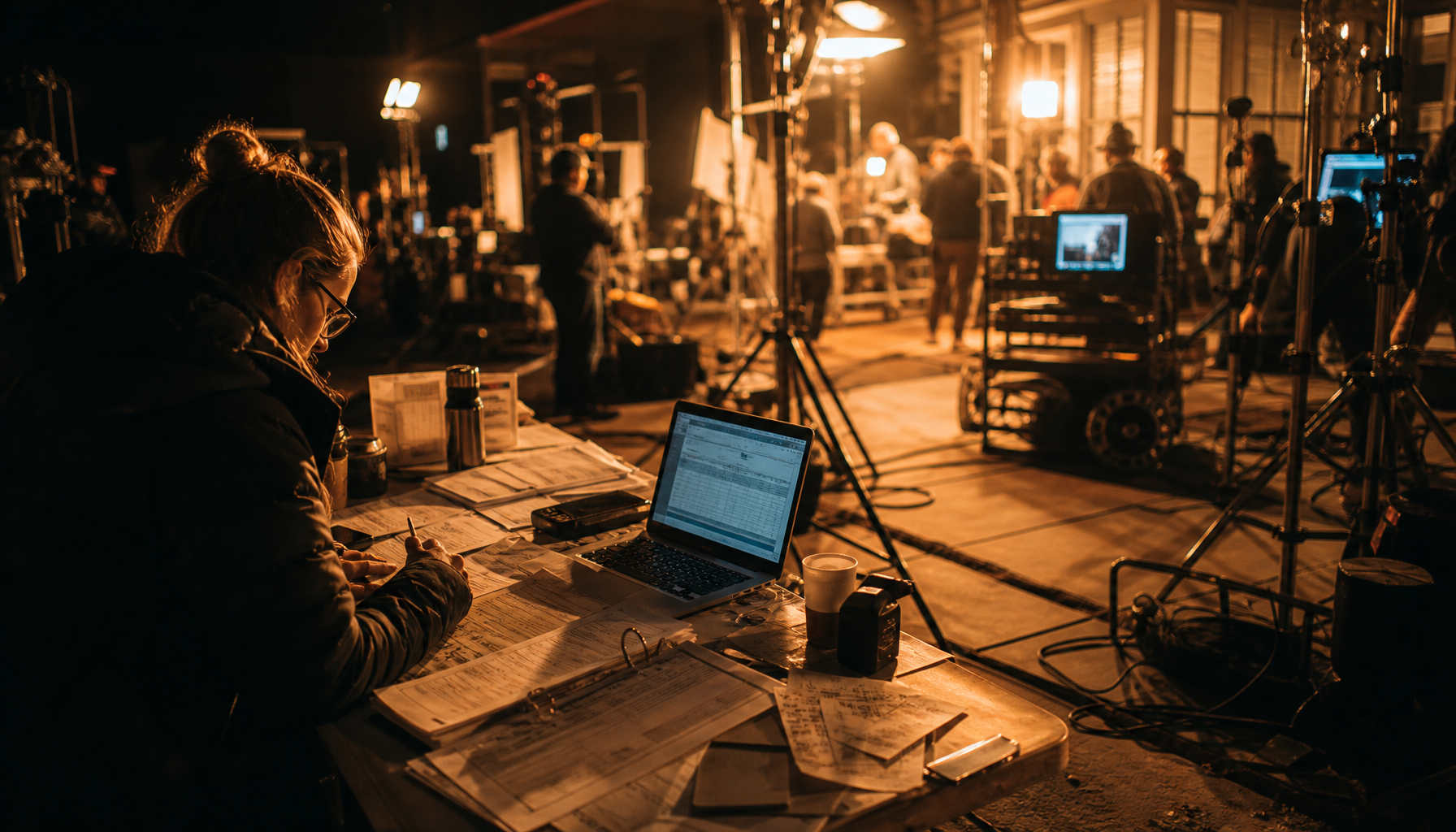
The ongoing bookkeeping of a film production: tracks every expense against the budget, produces cost reports, and shows whether the film is on budget while it is being shot — not after.
Production Accounting is the bookkeeping that runs alongside production rather than calculating it afterward. The Production Accountant—a separate department on larger productions—records every expenditure against the budget line item from which it is paid: fees, location rentals, equipment, catering, travel expenses. The basis is the approved budget; the tool is the chart of accounts, in which each item has a number and each receipt is assigned a number.
Cost Reports, POs, and Daily Reconciliation
The central document is the Cost Report, usually weekly: It compares, per budget line item, what has been spent, what is contractually committed, and what is expected to be spent by the end of the shoot—the Estimated Final Costs. To avoid surprises, money is managed through Purchase Orders: Before a department orders anything, the expenditure is created as a PO and approved, making it visible in the report before the invoice exists. In addition, there are daily reconciliations—overtime, surcharges, expenses, petty cash receipts—which are recorded daily because otherwise, they would accumulate by the end of the shooting week into a figure that no one can assign.
Relationship to Line Producer and Production Management
The Production Accountant does not decide how money is spent—that is the role of the Line Producer or Production Management. They provide the numbers with which these individuals can make decisions: If the Cost Report shows that location costs are running high, the Line Producer can take countermeasures as long as there are still shooting days left. Therefore, Cost Reporting governs the shooting schedule: an extra day at an expensive location, an additional night premium, a weather contingency day—the Report answers whether these are feasible, not gut feeling. Productions whose accounting is two weeks behind make shooting schedule decisions blindly.
- Create POs before ordering, not after invoicing—otherwise, the Cost Report shows the past instead of the current status.
- Take Estimated Final Costs seriously: The question is never "What have we spent?" but "Where will we end up?"
- Have petty cash and small receipts reconciled daily—individually they are harmless, and in sum, they are the most frequent unexplained deviation.
Related terms
Quiz
1. Zu welchem Department gehört „Produktionsbuchhaltung"?