Overview
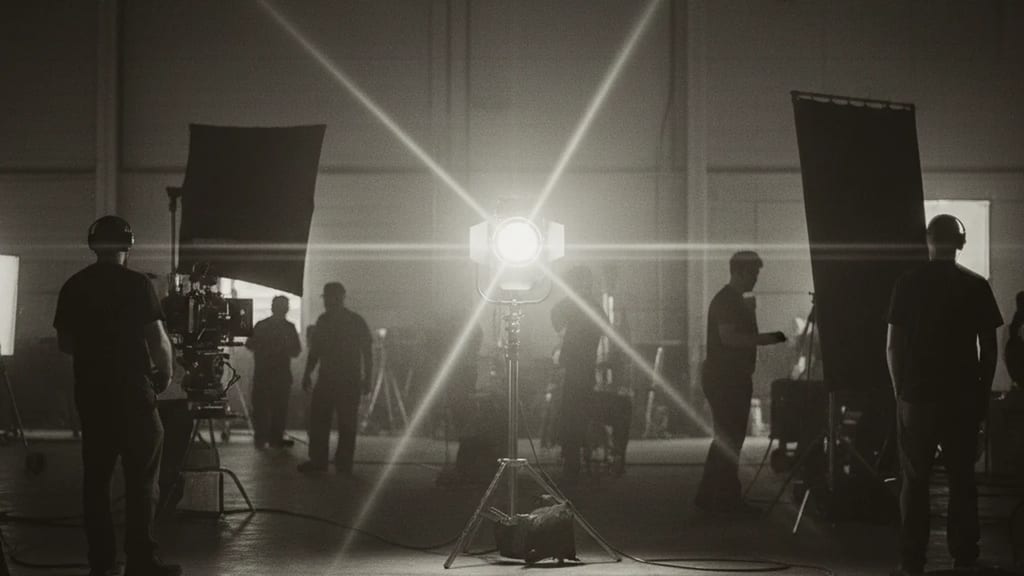
The term "8-Point Star" refers to a star effect filter (English: star filter or cross screen) that creates a star with eight radiating beams from bright, point-like light sources in the image. It is therefore an optical effect accessory placed in front of the lens – not a light fixture and not a grip device.
The effect is created by a fine grid of lines etched into the otherwise clear optical surface of the filter. Light is diffracted at these lines and fanned out into beams. The number of star points is determined by the number of etched line sets: two perpendicular line sets produce 4 beams, three sets produce 6 beams, and four sets (at 45° angles each) produce the eight-pointed star. Typically, the filter can be rotated in its holder to set the orientation of the beams.
Technical Specifications
Star effect filters are specified by their grid spacing (English: grid spacing), which is given in millimeters. Spacings of 1, 2, 3, or 4 mm are common; 2 mm is a standard size. The grid spacing controls the intensity of the effect:
| Grid Spacing | Number of Lines | Effect |
|---|
| fine (e.g., 1 mm) | more lines | brighter, more pronounced beams |
| wide (e.g., 4 mm) | fewer lines | more subtle, weaker effect |
Manufacturers produce these filters from optical glass (e.g., Tiffen, Hoya) or optical resin (e.g., LEE Filters, Cokin). They are available both as screw-in filters in common lens threads (e.g., 49–82 mm) and as rectangular or square plate filters for matte box/filter systems (common formats include 4×4″ and 4×5.65″).
On-Set Usage
The 8-Point Star is mounted in a matte box or filter holder in front of the lens. It only works on bright, preferably point-like light sources or specular highlights – such as streetlights, candles, practical lamps, stage and concert lighting, reflections on chrome, glass, jewelry, or water. Area or diffuse light does not create a star effect.
Unlike a natural aperture star, which only becomes noticeable at small apertures (strong stopping down), the filter generally creates the star effect independently of the aperture. Nevertheless, the aperture influences the result: at very small apertures, individual beams may appear weaker, which is why the result should be checked on the monitor. Since the eight-pointed star has many lines and can easily dominate the image, it is used deliberately and sparingly.