Cinematographer
From a DoP's perspective, this element is essential for the visual design. It allows me to consistently implement the desired color mood and the aesthetic image.
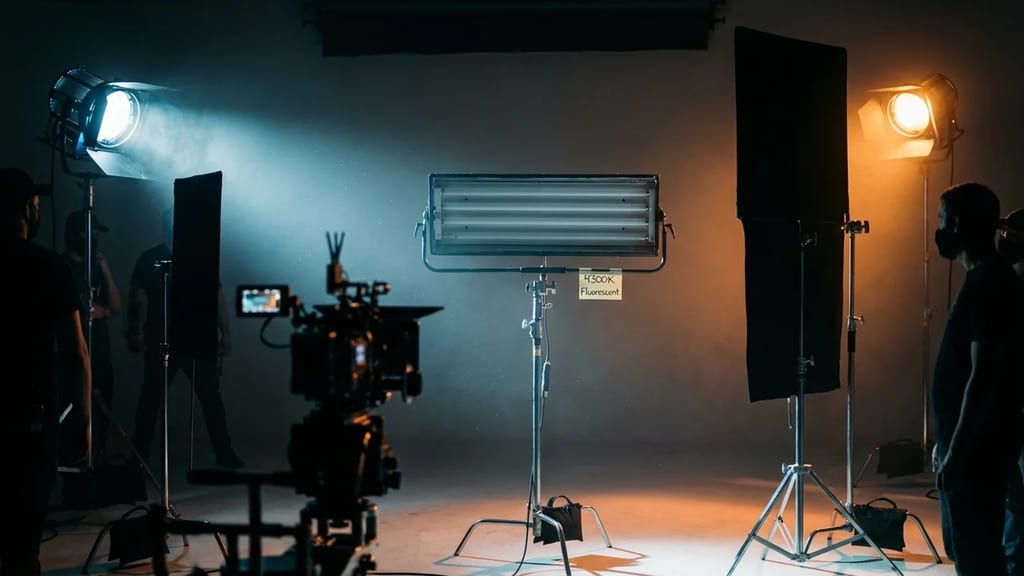
4300K is a neutral to slightly cool color temperature between tungsten (3200K) and daylight (5600K). It is the reference standard for the FL filter system (e.g. LEE 242) to match white fluorescent lamps.
"4300K" refers to a color temperature of 4300 Kelvin. It is not a standalone device or an ANSI lamp code, but a point on the Kelvin scale between warm white artificial light (Tungsten, approx. 3200K) and daylight (approx. 5600K). 4300K thus lies in the neutral to slightly cool white range and subjectively appears neither distinctly warm nor clearly blue.
In everyday film and TV production, this value is primarily relevant in two contexts: as the reference value for fluorescent tubes in office and practical lighting situations, defined as "White" in the FL filter system, and as the namesake value of correction filters that match film stock to precisely these light sources.
In lighting technology, 4300K is primarily known as the "White" value for fluorescent correction filters. In practice, "white" or Cool-White fluorescent tubes in offices, hallways, and retail spaces exhibit varying values; Cool-White tubes around 4100K are common, while 4300K is specifically the namesake "White" reference value of the FL filter system. Such light is generally problematic for the camera because it does not match either Tungsten or daylight balance, and fluorescent tubes can additionally exhibit a green cast (spike in the spectrum).
On set, this results in typical mixed lighting: existing ceiling tubes, warm Tungsten practicals, and daylight through windows converge. The department resolves this either by replacing the tubes (e.g., with daylight or Tungsten-balanced film tubes), by gelding the fixtures, or by adjusting their own film lights to the existing color temperature.
Several manufacturers offer correction gels and filters that reference the 4300K "White" fluorescent light. Verified examples include:
FL-B and FL-D are thus two different filters for opposite film stocks, even though both reference the 4300K "White" fluorescent light. FL-B is used with artificial light film, FL-D with daylight film.
Technical specifications of LEE 242 gel according to the manufacturer:
| Parameter | Value |
|---|---|
| Function | Tungsten -> Fluorescent 4300K (White) |
| Transmission (Tungsten 3200K) | 39.3 % |
| Transmission (Daylight, Source C approx. 6774K) | 37.3 % |
| Full Sheet | 1.22 m x 0.53 m |
| Half Sheet | 0.61 m x 0.53 m |
4300K is the desired target value when the existing practical lighting is to be preserved and film lights must adapt to it, rather than vice versa. Modern LED fixtures can be set directly to 4300K (Bi-Color and RGBWW units cover this range without issues). With Tungsten sources, a correction filter like LEE 242 is used instead. Due to the potential green cast of real fluorescent tubes, a measurement with a color temperature or spectral meter on location is recommended, along with a possible additional minus-green correction.
From a DoP's perspective, this element is essential for the visual design. It allows me to consistently implement the desired color mood and the aesthetic image.
This professional solution increases production efficiency and reduces post-production requirements. It allows for flexible, quick adjustments during the shoot.
As a gaffer, this is an indispensable tool in my daily toolkit. It allows me professional light control and quick adjustments on set, which saves time and ensures quality.
1. Zu welchem Department gehört „4300K (Fluoreszierend)"?
2. Wie viele verschiedene Fachperspektiven bietet dieser Eintrag?
The Lexikon is part of the Filmfarm ecosystem — alongside budgeting (FilmBalance), an industry magazine (FilmCircus) and crew networking (FilmCall, CrewMesh). One shared vocabulary for the whole production.