Overview
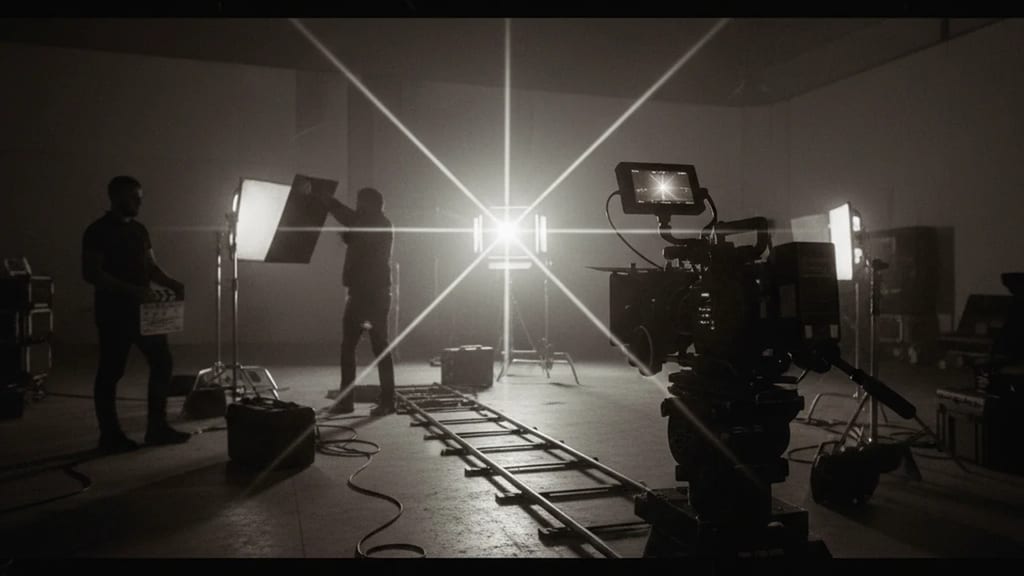
The "4-Point Star" (German: Vierstrahl-Sternfilter, also Cross-Screen-Filter) is an optical effect filter placed in front of the camera lens. It transforms point-like, specular light sources – such as streetlights, candles, reflections on glass or jewelry, and nighttime lights – into four-pointed light stars. It is not a lighting or grip device, but camera accessory from the realm of optical effect filters.
The effect is created by a fine grid of lines engraved into the filter surface. In a 4-point filter, two sets of lines cross at right angles, causing light to diffract along these axes and form four rays. More sets of lines result in more rays (typical variants: 4-, 6-, and 8-point stars).
How it Works
The lines engraved into the optical glass diffract light (diffraction) and deflect it along fixed axes. This leads to:
- The number of rays is determined by the pattern of engraved lines – in the 4-Point Star, two sets of lines cross.
- The orientation of the stars can be adjusted via the rotatable filter mount; in moving images, a wandering star pattern can be created by rotating the mount.
- Visibility and shape depend on the aperture, size, and brightness of the light source, as well as the distance. Small, bright point lights produce sharp stars; large, weaker sources tend to bloom (bloom/halation).
- Star effect filters also create a slight general softening of the image.
Technical Data
Specific dimensions depend on the manufacturer and model. In Tiffen's Star-FX series, the grid spacing (line raster) determines the width and extent of the rays:
| Feature | Specification |
|---|
| Filter Type | Optical Effect/Star Filter (Cross Screen) |
| Number of Rays | 4 (four-pointed star) |
| Grid Spacing (Tiffen Star FX) | e.g., 2 mm, 3 mm, 4 mm – larger spacing = wider spread rays |
| Mount | Rotatable for star alignment |
| Mounting | Screw-in or matte box/drop-in filter, depending on size |
Use on Set
The 4-Point Star is used specifically to dramatize light points and emphasize highlights – for example, in night shots with city lighting, in jewelry, product, and glass shots, or for a glamorous, "dreamy" image mood. The four-pointed star appears distinct and stylized; multi-pointed variants (6/8 points) create a finer, more uniform sparkle effect. The effect was common in Old Hollywood productions and experienced a comeback in glamour photography in the 1970s.
Practically, the look can be controlled via the aperture: a smaller aperture generally enhances the star effect. For precise ray direction, the filter mount is rotated; in moving images, this can be deliberately used as a dynamic creative tool.