Overview
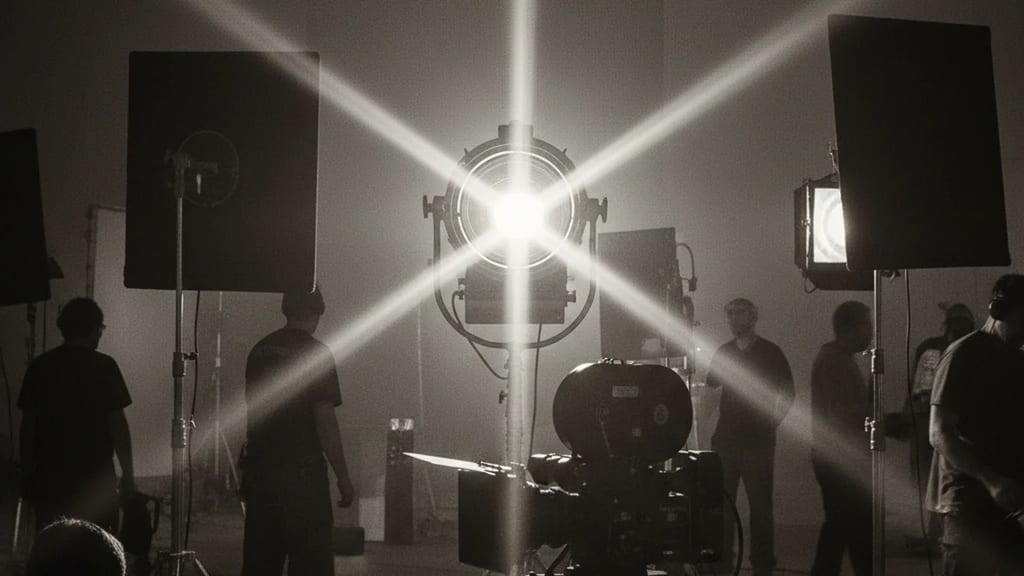
The 6-Point Star (German: Sechspunkt-Stern, also "Cross Screen 6x") is not a lighting or grip device, but an optical effect filter used in front of the lens. It transforms bright point light sources and specular highlights in the image into a star-shaped light flare with six rays emanating symmetrically from the light source.
The effect is created by a fine grid of lines engraved into the surface of the clear glass filter. The light is diffracted at these lines and fanned out into rays. In the 6-point pattern, three sets of lines intersect so that six rays become visible per light point. The effect is strongest when hard point lights are placed against a dark background (e.g., street lamps at night, candles, reflections on glass or chrome).
Technical Specifications
The strength of the star effect is controlled by the grid spacing in millimeters: the smaller the distance between the lines, the more lines are on the filter surface, and the brighter and more pronounced the rays become. Tiffen offers the 6-point variant in several grid spacings (including 1 mm, 2 mm, 3 mm, and 4 mm).
| Property | Specification |
|---|
| Filter Type | Star/Cross Screen Effect Filter (Glass) |
| Number of Rays | 6 per point light source |
| Principle of Operation | Light diffraction at engraved line grid |
| Grid Spacing (Tiffen) | e.g., 1 / 2 / 3 / 4 mm – smaller = brighter star |
| Forms | Cine rectangular filters (e.g., 4x5.65", 5.65x5.65") as well as round screw-in filters |
| Orientation | Rotatable; rays rotate with the filter, symmetry is maintained |
Use on Set
The 6-Point Star is used specifically for stylized, "glamorous," or atmospheric looks – for example, in night cityscapes, string lights, music videos, jewelry and product shots, or car reflections. Since the filter is rotatable, the direction of the rays can be freely adjusted; the six-fold symmetry is always maintained.
Such effect filters are available from several manufacturers, including Tiffen, Hoya (Cross Screen / Star 6), Heliopan (Cross Screen 6x), Tide Optics (CineStar), as well as K&F Concept and Neewer. Since the star effect is purely optical and not reversible in the material, it should be used sparingly – high grid densities can quickly overdraw the image.