Overview
3G-SDI (Third Generation Serial Digital Interface) is a professional, uncompressed standard for transmitting digital video signals over a single coaxial cable. It is defined in the SMPTE 424M standard (first published in 2006, revised in 2012) and, along with the associated mapping standard SMPTE 425M, forms the third generation of the SDI family. The "3G" stands for the nominal data rate of approximately 3 Gbit/s.
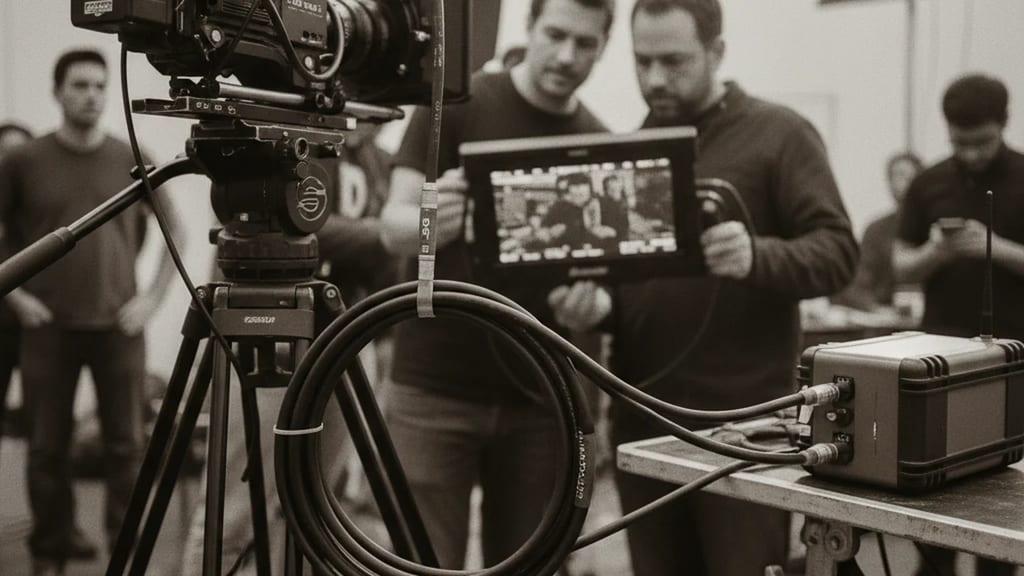
On set and in the studio, 3G-SDI is the common connection between camera, monitor, recorder, wireless video transmitter, and video engineering. Unlike HDMI, the interface is designed for long, locking connections and is therefore more robust for professional continuous use.
Technical Specifications
| Parameter | Value |
|---|
| Standard | SMPTE 424M (Mapping: SMPTE 425M) |
| Data Rate (nominal) | 2.970 Gbit/s (or 2.970/1.001 Gbit/s) |
| Connector | BNC |
| Cable / Impedance | Coaxial cable, 75 Ohm |
| Typical Resolution | 1080p50 / 1080p60, 10 Bit, 4:2:2 |
3G-SDI distinguishes between two mapping variants: Level A transmits the 1080p signal as a direct, single data stream. Level B maps two combined HD-SDI streams (e.g., a dual-link signal or two independent signals). Both use the same physical 3 Gbit/s connection; however, the source and sink must be configured to the same variant, otherwise the image will remain black.
Position in the SDI Family
3G-SDI is the successor to HD-SDI (SMPTE 292M, approx. 1.5 Gbit/s) and uses the same connectors and coaxial cables, but doubles the bandwidth. This allows 1080p to be transmitted at full frame rate over a single line, which previously required a dual-link connection with two cables for HD-SDI. Above 3G-SDI follow 6G-SDI (approx. 6 Gbit/s) and 12G-SDI (approx. 12 Gbit/s) for 4K/UHD over a single cable.
On-Set Usage
- Connection from camera output to director's monitor, field monitor, and video engineering.
- Playback to external recorders and wireless transmission systems (wireless video transmitters) for live image distribution.
- Range: Over high-quality 75-ohm coax, significantly longer distances are possible than with HDMI, depending on cable quality; usable cable length decreases with increasing data rate (6G/12G).
- Practical advantage: locking BNC connector, robust coaxial cable, and a defined, uncompressed signal path.