Filmlexikon.
Support
Milo
Camera · Terms

Milo

Murnau AI illustration
flow para roll take

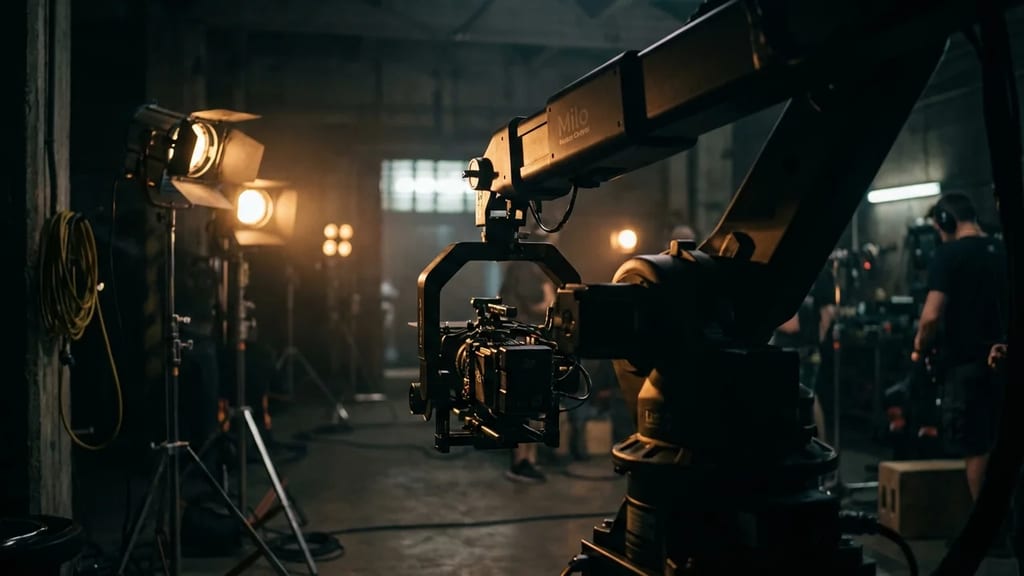
Motion-control robotic arm by Mark Roberts featuring 7 programmable axes for millimeter-precise, repeatable camera movements in VFX production.

Technical Details

The Milo features seven programmable axes: three for translation (X, Y, Z), three for rotation (pan, tilt, roll), and one for focus/zoom control. The maximum movement speed is 2 meters per second, with an acceleration of 3 m/s². The system operates with servo motors and encoder feedback for millimeter-accurate repeatability. Variants include the more compact Milo Compact (reach 2.13 m) and the heavy-duty Milo for loads up to 45 kg.

History & Development

Mark Roberts Motion Control developed the first Milo system in 1992 in the UK as an advancement of their motion control technology for commercials and feature films. The breakthrough came in 1999 with "The Matrix," where Milo systems were used for the iconic "Bullet Time" sequences. In 2003, the Milo Compact followed, and in 2010, the Milo on-rail system. Today, Milo is considered an industry standard for motion control in high-end productions.

Practical Application in Film

Christopher Nolan extensively used Milo systems in "Inception" (2010) for complex spatial sequences and slow-motion effects. In "Gravity" (2013), multiple synchronized Milo units enabled the seamless integration of live-action and CGI elements. Typical workflow: programming camera movement via software, multiple takes for different passes (actor, greenscreen, clean plates), followed by compositing integration. Advantages: Absolute repeatability, integration of live-action and VFX. Disadvantages: High cost, time-consuming programming, limited spontaneity.

Comparison & Alternatives

Compared to conventional camera cranes, Milo offers programmable precision instead of manual operation. Competitor products include the Technodolly from Technovision or the Mo-Sys system. For smaller productions, systems like the Bot & Dolly or modern gimbal systems serve as more cost-effective alternatives. Motion control is used for VFX-intensive sequences, product shots, or complex choreography, while traditional camera movements are preferred for spontaneous, organic movements.
From the crafts

Perspectives

Cinematographer

Ich schätze am Milo besonders die Möglichkeit, identische Kamerabewegungen für verschiedene VFX-Passes zu fahren - einmal für die Schauspieler, dann für Clean Plates oder Greenscreen-Elemente. Die millimetergenaue Wiederholbarkeit ermöglicht mir komplexe Bildkompositionen, die mit herkömmlichen Mitteln unmöglich wären. Allerdings muss ich meine Bildgestaltung im Voraus durchplanen, da spontane Änderungen während der Programmierung teuer werden.

Director

Das Milo eröffnet mir narrative Möglichkeiten, die über menschliche Kamerabewegungen hinausgehen - perfekt fluide Bewegungen durch unmögliche Räume oder Zeitlupen-Sequenzen mit komplexer Choreographie. Ich kann emotionale Beats präzise mit Kamerabewegungen synchronisieren und mehrere Takes identisch wiederholen, um verschiedene schauspielerische Nuancen einzufangen. Die Planungsphase wird dadurch intensiver, aber das Endergebnis rechtfertigt den Aufwand.

Producer

Ein Milo-Drehtag kostet zwischen 8.000-15.000 Euro inklusive Operator, plus zusätzliche Zeit für Setup und Programmierung - mindestens 2-3 Stunden vor dem ersten Take. Bei VFX-lastigen Sequenzen amortisiert sich das durch eingesparte Postproduktionskosten, da perfekte Plates weniger Compositing-Aufwand bedeuten. Ich plane Milo-Einsätze strategisch und blocke mehrere Setups an einem Tag, um die Fixkosten zu optimieren.

More in the lexikon

Related terms

Test your knowledge

Quiz

1. Zu welchem Department gehört „Milo"?

2. Wie viele verschiedene Fachperspektiven bietet dieser Eintrag?

Report an error
From the Filmfarm ecosystem

Understand visual language, budget productions, connect crew.

The Lexikon is part of the Filmfarm ecosystem — alongside budgeting (FilmBalance), an industry magazine (FilmCircus) and crew networking (FilmCall, CrewMesh). One shared vocabulary for the whole production.

FilmFarm FilmRadarComing soonFilmPulseComing soonFilmNumbersComing soonFilmCapitalComing soonFilmLabComing soonFilmBalanceComing soonFilmCircusComing soon