Technical Specifications
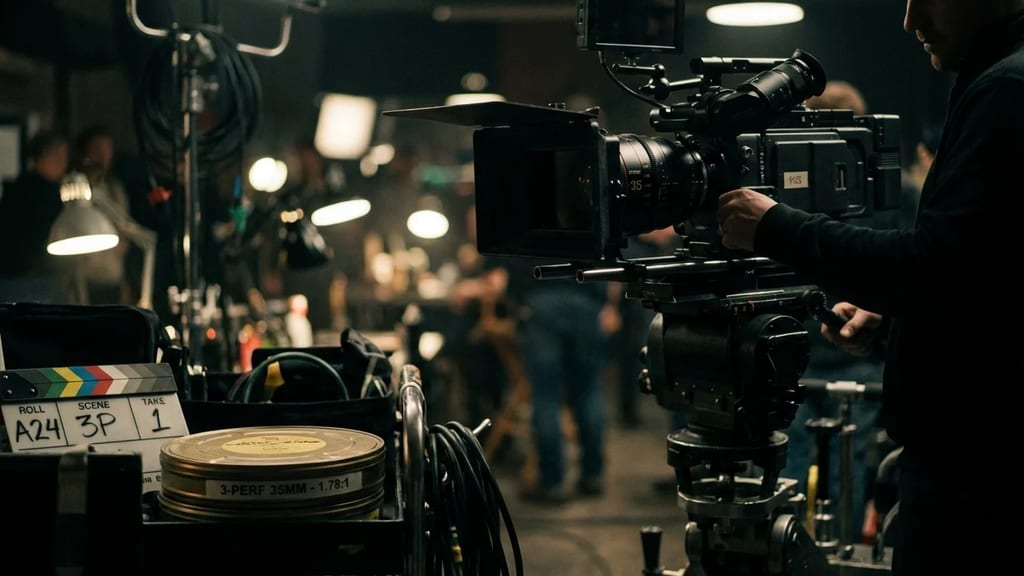
The 3-Perf format uses 3 perforations per frame on standard 35mm film. The aspect ratio is natively 1.78:1 – exactly 16:9 HDTV standard.
Technical parameters:
- Perforations per frame: 3 (instead of 4)
- Negative size: 24.89mm x 13.87mm (Super 35 extraction)
- Native aspect ratio: 1.78:1 (16:9)
- Film consumption: 75% of 4-Perf (5.33 minutes per 400ft roll)
- Resolution: Equivalent 3K+ scan, optimal for HD/UHD
Camera compatibility:
- ARRI 435: Natively 3-Perf capable with gate change
- ARRI 235: 2-Perf and 3-Perf variants
- Panavision Millennium: 3-Perf option available
- Moviecam Compact: 3-Perf conversion possible
The grain is barely noticeably stronger in 3-Perf than in 4-Perf – practically identical for TV and streaming.
History & Development
3-Perf was developed in the 1980s as a compromise between film costs and image quality. The format optimized 35mm for TV production, where 4-Perf surplus (1.33:1 Academy) remained unused.
With the transition to HD (from 1998), 3-Perf became the standard for TV drama – the native 16:9 ratio eliminated cropping, and the 25% film savings made film economically competitive for TV.
The "Golden Age of TV" (2000-2012) was largely shot in 3-Perf – "The Sopranos," "Mad Men," "Breaking Bad" (early seasons) used the format for a premium film look on a TV budget.
Practical Use in Film
HBO's "The Sopranos" (1999-2007) established 3-Perf as a premium TV standard – DP Alik Sakharov chose the format for film aesthetics with TV efficiency. The series defined the "cinematic TV" look.
"Mad Men" (AMC, 2007-2015) used 3-Perf for an authentic 60s film look – DP Chris Manley chose Kodak Vision2 stock for a warm, nostalgic color palette.
"Breaking Bad" (Seasons 1-2, 2008-2009) was shot in 3-Perf before switching to digital (RED Epic) in later seasons – DP Michael Slovis used both formats seamlessly.
Digital Transition & Legacy
Digital Replacement: From 2010, digital (ARRI Alexa, RED) replaced 3-Perf for TV drama. The cost savings were marginal (film costs vs. digital workflow), but digital offered more flexibility.
Niche Application: 3-Perf remains relevant for directors who want a film aesthetic – however, Tarantino, Nolan, and PT Anderson use 4-Perf for cinema.
Scanning Workflow: Modern scanners (ARRISCAN XT) support 3-Perf for 4K+ archival scans of historical TV productions.
The main advantage of 3-Perf was its efficiency for TV – today, the format has been largely replaced by digital, but it remains relevant for retrospectives and film purists.