Overview
"3D Modeling" (also "Modeling", English modelling) in film lighting does not refer to a category of equipment or gear, but rather a lighting technique. It means shaping a subject with light so that a flat, two-dimensional camera image gains the impression of volume, depth, and plasticity. The term originally comes from the visual arts, where "modeling" refers to the creation of three-dimensional form through light-dark contrasts.
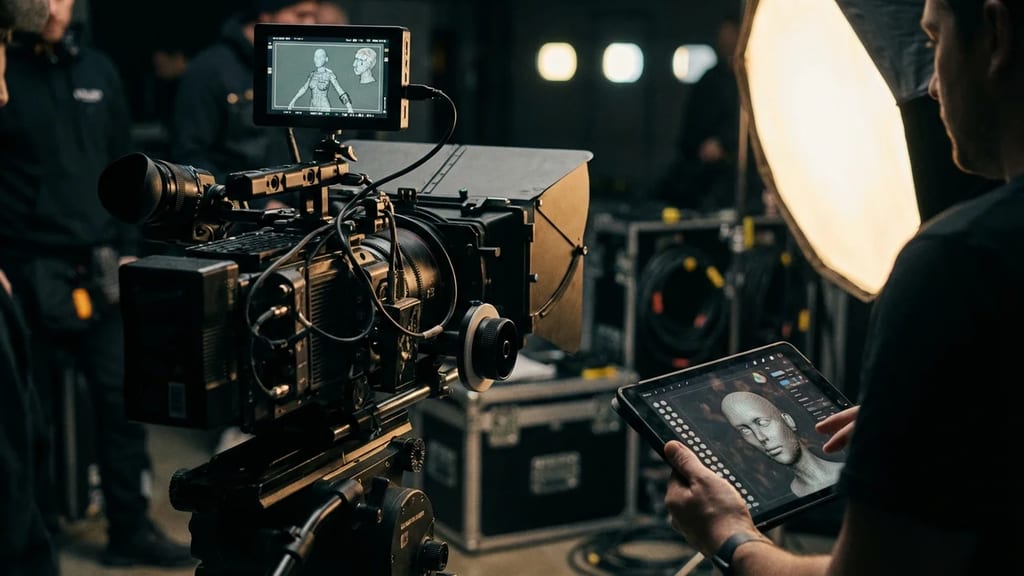
Important distinction: In the field of computer graphics/VFX, "3D Modeling" refers to the creation of digital 3D objects on a computer. In the set, grip, and lighting context, on the other hand, it is about the physical "modeling" of a real subject through light direction.
How it Works
Crucial for the plastic effect are the so-called attached shadows – that is, the shadow areas on the subject itself, where it is turned away from the light. These shadows describe the roundness and contours of an object and convince the eye that the image possesses depth.
- Frontal light from the camera axis fills in shadows and makes a subject appear flat and two-dimensional – little modeling.
- Laterally displaced light creates a bright side and attached shadows on the opposite side; on a face, it brings out cheekbones, nose, and jawline – strong modeling.
- Light character: Soft/diffuse light creates smooth transitions and flattering modeling; hard light emphasizes form and texture more strongly, but with higher contrast.
Use on Set
Modeling is primarily controlled by the position of the key light (Key) relative to the camera and the subject. A lateral key position increases plasticity, a camera-near position reduces it. The amount of fill light (Fill) can be used to fine-tune the contrast between the bright and shadowed sides – and thus the degree of modeling. In classic three-point lighting (Key, Fill, Back), the targeted modeling is the core of the spatial effect that the lighting imparts to the subject.