Cinematographer
As a cinematographer, I make sure to consider the limitations of 8-bit right from the shoot. For critical scenes with smooth gradients or skin tones, I ensure we record in a higher bit depth, even if the final product will be 8-bit.
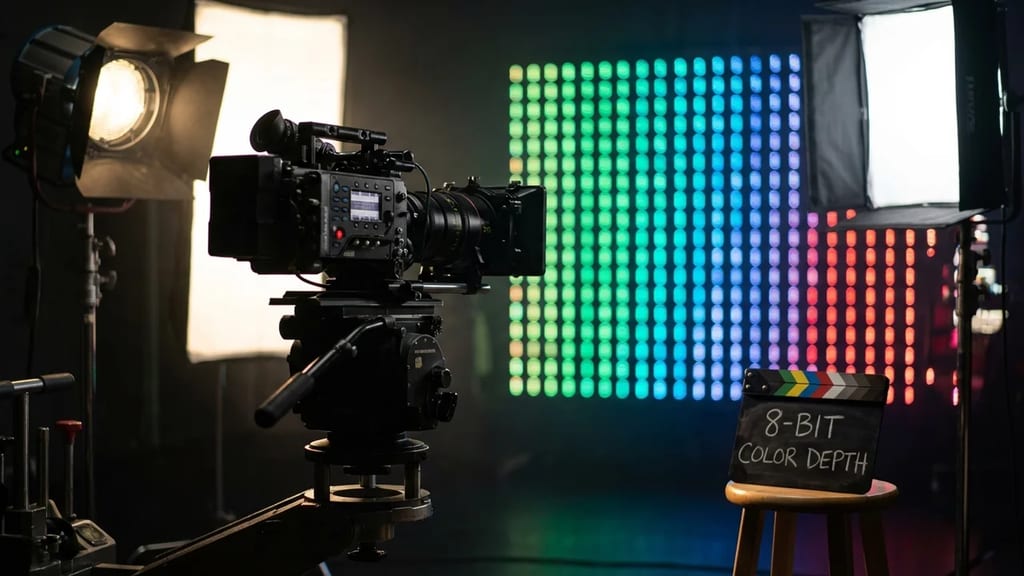
Color depth of 8 bits per channel, providing 256 tonal levels per channel and approximately 16.7 million displayable colors.
In camera and video technology, 8-bit refers to the color depth (German: Farbtiefe) of an image signal. This designation relates to the number of bits available per color channel (red, green, and blue) for storing brightness gradations. With 8 bits, there are 2⁸ = 256 possible gradations per channel.
Color depth should not be confused with resolution (pixel count); it describes how finely color and brightness gradients are quantized, not how many pixels are present. 8-bit is the classic color depth of many delivery formats (broadcast, web, common H.264 codecs) and ranks below 10-bit and 12-bit in the hierarchy.
The total number of representable colors is derived from the 256 gradations per channel by combining all three channels:
| Color Depth | Gradations per Channel | Representable Colors (Total) |
|---|---|---|
| 8-bit | 256 (2⁸) | approx. 16.7 million (256³ = 16,777,216) |
| 10-bit | 1,024 (2¹⁰) | over 1 billion |
| 12-bit | 4,096 (2¹²) | several billion |
In practice, color depth is usually specified along with chroma subsampling (e.g., 8-bit 4:2:0 or 10-bit 4:2:2), which separately defines how much the color information is reduced relative to brightness.
8-bit material is widely supported, generates comparatively small files, and is hardware-friendly for recording and editing. It is widely used for fast productions, broadcast, and online delivery.
However, the limited number of 256 gradations per channel makes visible banding (posterization) more likely in fine tonal gradients, such as in sky areas or skin transitions. For complex color correction, log recording, and HDR with a wide color gamut, 8-bit offers significantly fewer reserves than 10-bit or 12-bit, which is why demanding productions prefer higher color depths.
As a cinematographer, I make sure to consider the limitations of 8-bit right from the shoot. For critical scenes with smooth gradients or skin tones, I ensure we record in a higher bit depth, even if the final product will be 8-bit.
For me, 8-bit is usually enough as long as the story is told well. I discuss with my cinematographer and colorist when higher bit depths are truly necessary – for example, in very atmospheric scenes with complex color transitions.
8-Bit means smaller data amounts for me, and therefore lower storage and transmission costs. I always calculate whether the extra effort for higher bit depths is really justified, especially for TV productions with tight budgets.
1. Zu welchem Department gehört „8-Bit"?
2. Wie viele verschiedene Fachperspektiven bietet dieser Eintrag?
The Lexikon is part of the Filmfarm ecosystem — alongside budgeting (FilmBalance), an industry magazine (FilmCircus) and crew networking (FilmCall, CrewMesh). One shared vocabulary for the whole production.