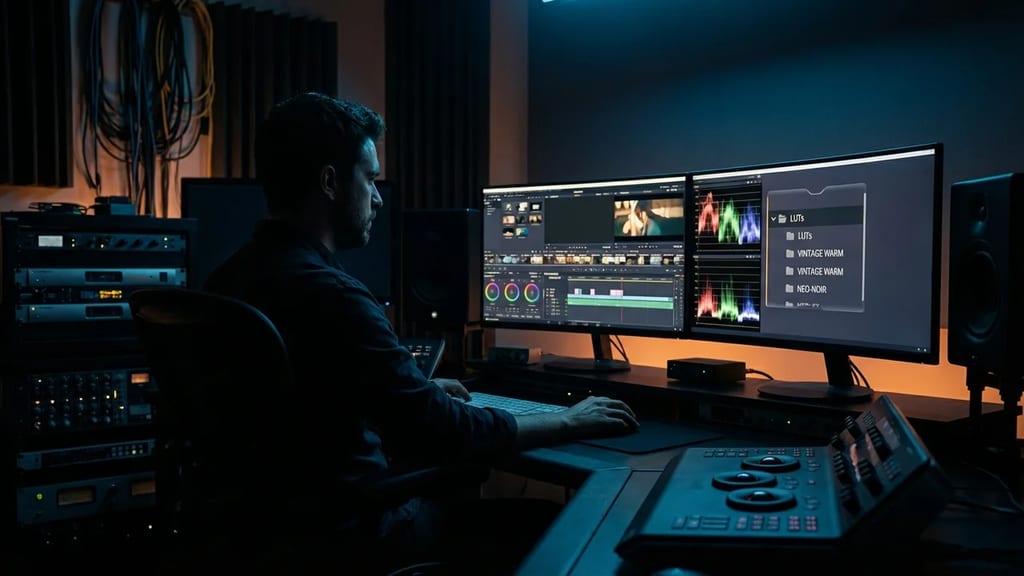
Overview
A Creative LUT (Creative Look-Up Table) is a file used in color grading that maps input color values to new output values, thereby imparting a stylistic look to the footage – such as a specific mood, a blockbuster tone, or the emulation of a film stock. This is in contrast to a technical LUT (e.g., log-to-Rec.709 conversion or camera normalization), whose sole purpose is correct, neutral color reproduction. While the technical LUT creates the foundation, the Creative LUT adds a stylistic layer on top.
Creative LUTs are supported in practically all common editing and grading software, including DaVinci Resolve, Adobe Premiere Pro, After Effects, and Final Cut Pro.
Technical Fundamentals
LUTs are usually available as 1D or 3D LUTs:
| Type | Effect | Suitability |
|---|
| 1D LUT | Maps an input value to an output value for each channel (gamma, contrast, brightness) | Tone adjustments, no true color shift |
| 3D LUT | Maps R/G/B as three axes of a cube; each color can be mapped to any other (hue, saturation) | Creative grading, film emulation, complex color transformations |
Creative LUTs are typically 3D LUTs. They do not store every possible color value but rather control points in a grid (lattice). Common grid resolutions are approximately 17x17x17, 33x33x33, or 65x65x65 – the finer the grid, the higher the precision. Interpolation occurs between the control points, typically using trilinear or tetrahedral interpolation; the interpolation method is important to avoid image artifacts.
The most common, cross-program exchange format is the .cube file.
Usage On Set and in Post
The order in grading is crucial: first, the image is balanced and neutralized (primary/technical correction), and only then is the Creative LUT applied. If the LUT is applied too early – before balancing – the settings become difficult to adjust cleanly. In a node/layer-based workflow, the Creative LUT therefore typically sits after normalization and after the primaries.
- Look Discovery: Colorists "audition" multiple Creative LUTs to quickly find a stylistic direction.
- Starting Point, Not End Product: A Creative LUT is usually a starting point; individual fine-tuning (secondaries, power windows, tracking) follows.
- On-Set Monitoring: A pre-defined Look LUT can be used as a monitor/show LUT on set to estimate the future image appearance on the DIT cart or director's monitor, while Log/RAW is recorded in the background.