Technical Specifications
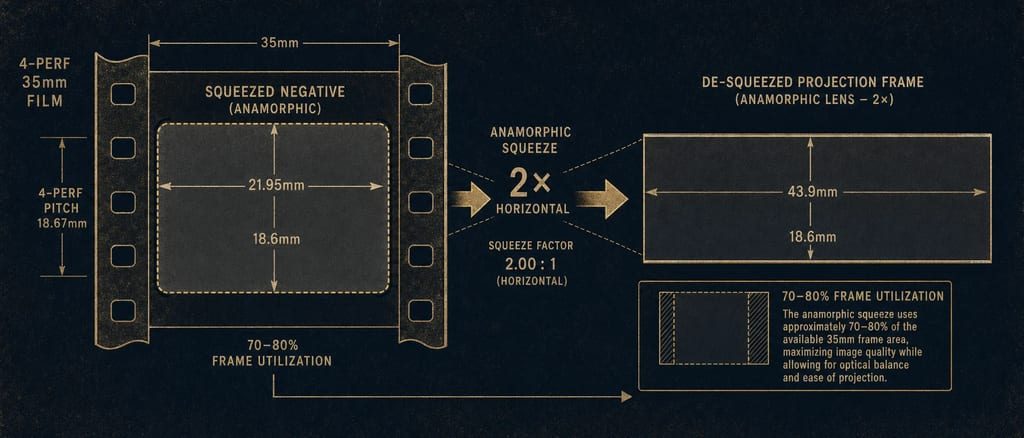
The 2.35:1 aspect ratio was originally created by 2x anamorphic compression on 4-perf 35mm. The taking lens compresses the horizontal image by a factor of 2, and projection decompresses ("de-squeezes") it to full width.
Technical Parameters:
- Anamorphic Squeeze: 2x horizontal
- Negative Usage: Approx. 70-80% of the 4-perf frame
- Projected Resolution: 21.95mm x 18.6mm (squeezed) → 43.9mm x 18.6mm (de-squeezed)
- Pixel Equivalent (4K DI): 4096 x 1744 pixels (2.35:1)
Optical de-squeeze produces characteristic artifacts:
- Elliptical Bokeh: Out-of-focus circles become oval
- Horizontal Lens Flares: Anamorphic lenses produce horizontal streaks
- Breathing: Slight focal length change when focusing
Digitally, 2.35:1 is often simulated by cropping, which loses the anamorphic aesthetic.
History & Development
2.35:1 originated in 1953 with CinemaScope, 20th Century Fox's answer to television audiences. The original CinemaScope technology used Bausch & Lomb anamorphic lenses with a 2x squeeze. The initial format was 2.55:1 but was standardized to 2.35:1 in 1957 to make space for the optical soundtrack.
Panavision took over from 1960 with improved optics and became synonymous with "Scope." Panavision lenses eliminated many CinemaScope issues (distortion, edge softness) and established 2.35:1 as a premium format.
In 1970, the format was technically adjusted to 2.39:1 (SMPTE standardization), but "2.35:1" remains the colloquial term for all Scope formats.
Practical Use in Film
Sergio Leone's "Once Upon a Time in the West" (1968) defined the 2.35:1 aesthetic – extreme wide-angle compositions, faces at the edge of the frame, endless horizontals. DP Tonino Delli Colli utilized every corner of the Scope frame.
Stanley Kubrick's "2001: A Space Odyssey" (1968) demonstrated Scope for science fiction – the horizontal expanse enhances cosmic loneliness and architectural precision.
Denis Villeneuve's "Blade Runner 2049" (2017) showcases modern Scope mastery – DP Roger Deakins composes each frame like a painting, using anamorphic artifacts as stylistic elements.
Variants & Related Formats
2.39:1: The current SMPTE standard, technically identical to 2.35:1 for practical purposes. All modern "Scope" productions use 2.39:1.
2.76:1 (Ultra Panavision 70): Even wider, used for epics like "Ben-Hur" (1959) and Tarantino's "The Hateful Eight" (2015).
Spherical 2.35:1 Crop: Digital productions often crop spherical footage to 2.35:1, but lose the anamorphic aesthetic.
The main advantage of 2.35:1 remains its unparalleled epic quality – no other format creates the same visual impact and horizontal immersion.