Overview
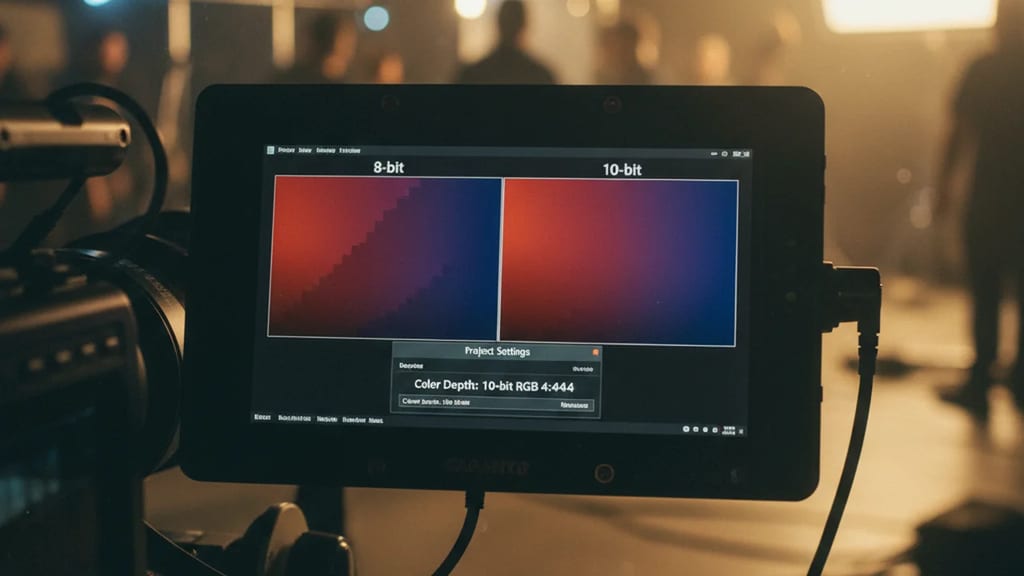
10-bit refers to the color depth (bit depth) of a video signal, meaning the number of digital gradations with which each color channel (red, green, blue, or the luminance and color difference channels) is recorded. With 10 bits, 1024 gradations are available per channel. Compared to the common 8-bit standard with 256 gradations per channel, 10-bit significantly refines the transitions between tonal values.
10-bit is not a brand or a device, but a characteristic of the recording or output format. The term appears with cameras, external recorders, monitors, and codecs. For lighting and image design on set, 10-bit is relevant because it determines how much latitude the material offers for exposure and color correction in post-production.
Technical Specifications
| Characteristic | 8-bit | 10-bit |
|---|
| Gradations per channel | 256 | 1024 |
| Total possible colors | approx. 16.7 million | approx. 1.07 billion |
| Risk of banding in gradients | higher | lower |
| Grading latitude | limited | significantly greater |
10-bit is often specified in combination with chroma subsampling and a codec, for example as 10-bit 4:2:2. This combination is considered a common professional standard, as it allows for flexible grading with manageable file sizes. Consumer formats, on the other hand, often rely on 8-bit 4:2:0.
On-Set Use
10-bit recording is a prerequisite for tonally stable gradients – for example, in skies, skin tones, or soft light walls – because the finer gradations reduce visible color artifacts (banding). Especially when filming in log gamma curves or for HDR workflows (e.g., HLG), a bit depth of at least 10 bits is practically mandatory to preserve shadow and highlight detail for later correction.
- Many cameras output 10-bit via HDMI/SDI to external recorders/monitors (e.g., devices from Atomos), which record the signal in 10-bit ProRes codecs.
- 10-bit provides the colorist with more headroom to shift exposure and color without the image breaking up – even if the final output is on an 8-bit display.
- For greenscreen/keying work, the higher color precision (often combined with 4:2:2) is advantageous as it enables cleaner masks.