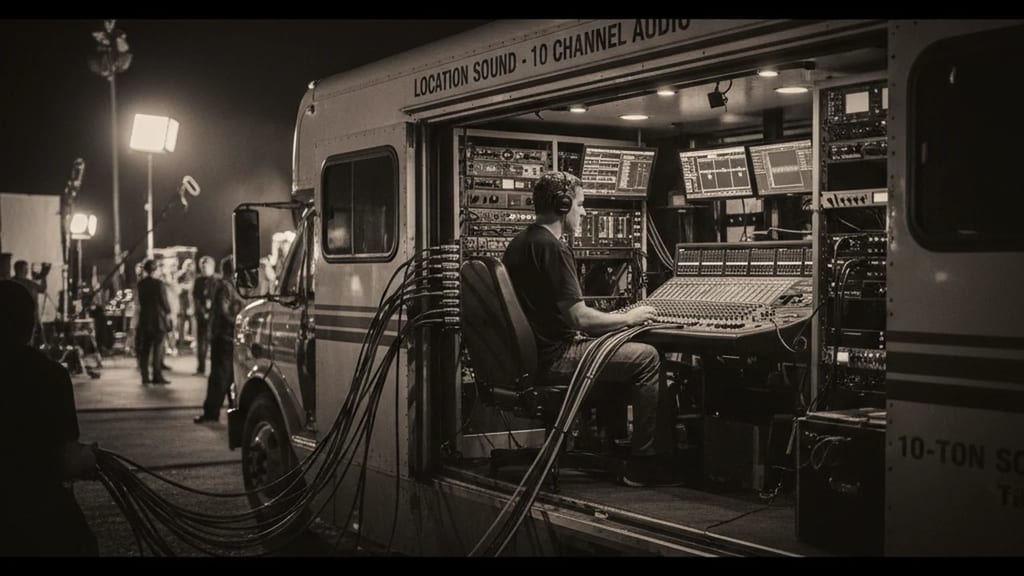
Technical Fundamentals
The 10-track audio recording system is a professional standard for film sound production that enables 10 separate audio channels to be recorded simultaneously and independently. This provides maximum flexibility in post-production and reduces the need for re-shoots or ADR (Automated Dialogue Replacement).
Why 10 Tracks and Not Fewer/More?
- Under 4 Tracks: Severely limited; dialogue and ambience compete for space
- 4-6 Tracks: Standard for smaller productions (documentaries, independent films)
- 10 Tracks: Gold standard for feature films, TV series, high-end productions
- 16+ Tracks: Only for specialized applications (orchestral recording, Dolby Atmos productions)
10 tracks offer the optimal compromise between flexibility, technical complexity, and practical utility on set.
The Standard 10-Track Configuration
A typical 10-track arrangement on a film set:
| Track | Channel | Use | Microphone Type |
|---|
| 1 | L-Dialogue | Lead actor (Condenser) | Boom (Shotgun) |
| 2 | R-Dialogue | Lead actor (Backup) | Lavalier/Wireless |
| 3 | Secondary Dialogue | Supporting actors/extras | Boom or Lav |
| 4 | Effects | Doorbell, paper rustle, objects | Close-field microphone |
| 5 | Room Tone (Ambience) | Environmental noise, wind | Stereo-pair (Overhead) |
| 6 | Room Tone (Backup) | Fallback for ambience or additional source | 2nd Overhead or Ambient |
| 7 | Camera Audio | Backup from camera (if available) | Camera XLR or Wireless |
| 8 | Music/Click | Playback for sync or click-track | Direct audio input |
| 9 | Reserve | SFX backup, additional microphones, or safety | Flexible |
| 10 | Reserve | Additional creative options or redundancy | Flexible |
This configuration is flexible – it is adapted based on the scene and production requirements.
Common Equipment for 10-Track Recording
Portable digital recorders (set standard):
- Sound Devices MixPre-10 II: Professional standard, 10 channels, 32-bit float recording (best quality)
- Zoom F8n/F6: Budget option, sufficient for smaller productions
- Sennheiser ENG Mixer: Portable, 8 channels, for ENG/documentaries
Stationary systems (studio/location):
- Dante Network Audio: Scalable to 64+ channels, for larger orchestras or multi-camera scenes
- Studer Vista Console: Broadcast standard, 16+ channels
- DigiCo Consoles: For live events with 10+ channels
Important: The Sound Devices MixPre-10 II is the de facto standard for film sets because it:
- Enables 32-bit float recording (quality not concerned with clipping)
- Is robust and integrates wireless systems
- Runs on battery
- Weighs only 1kg
Standards and Platforms
Broadcast and Streaming Standards for 10-Track Material
Although 10 tracks are recorded, they are later mixed down to various standard formats:
| Output Format | Channels | Use |
|---|
| Stereo | 2 | Streaming (Spotify, YouTube, Podcast) |
| 5.1 Surround | 6 | Home cinema, Blu-Ray, broadcast TV |
| 7.1 Surround | 8 | Premium home cinema, feature films |
| Dolby Atmos | 10-16+ | Premium streaming (Apple TV+, Netflix, Disney+) |
| Immersive Audio | 12-16 | Cinema, premium streaming |
The 10-track material is thus downmixed or remixed to serve different platforms.
Example: Film for Cinema + Streaming
- Recording: 10 tracks on set
- Mixing (Cinema): Downmix to 7.1 surround, mastering to -24 LUFS for cinema
- Mixing (Streaming): Stereo downmix, mastering to -14 LUFS for Netflix
- Mixing (Broadcast): 5.1 surround, mastering to -24 LUFS for TV
All these mixes use the same 10-track source material.
Practice on Film Set: The Workflow
Phase 1: Preparation (Pre-Production)
- Sound Design Meeting: Sound mixer, director, and producer discuss requirements
- How many locations?
- Are there dialogue-heavy scenes?
- Is there music/playback?
- How many actors?
- Track Planning: Based on requirements, the 10-track configuration is planned
- For a dialogue scene with 3 actors: 6 tracks for dialogue, 2 for ambience, 2 reserve
- For an action scene: 4 tracks dialogue, 4 SFX, 2 ambience/reserve
- Equipment Check: Sound Devices MixPre-10, microphones, wireless systems tested
- Check battery life (minimum 8 hours per production day)
- Coordinate wireless frequencies (no interference)
- Ensure cable connections and redundancy
Phase 2: Recording (Production)
Before each scene:
- Sound mixer sets levels for all 10 channels (observe headroom: -6 dB for safety)
- All channels are started simultaneously before the camera rolls
- Synchronization slate: "Scene 5A, Take 3, Sound Rolling"
During recording:
- Continuous monitoring of all 10 tracks (sound mixer wears headphones)
- Real-time level corrections if needed (e.g., if actor gets louder)
- Recording of notes (microphone 3 had feedback, ambience had bird song – OK for take)
After take:
- Immediate review with director: "Audio was clean" or "Let's do another take"
- Safety backup: File is immediately copied to a second hard drive (redundancy)
- Metadata is captured: take number, time, actor names, notes
Phase 3: Data-Logging and Backup (In-Production)
- Daily: All recorded audio files are copied to two external drives (RAID mirroring)
- Weekly: Hard drive is sent to post-production (offsite backup)
- Format: Usually WAV 24-bit 48kHz, stored with metadata for easy retrieval
Phase 4: Integration in Post-Production
The sound designer receives:
- All 10 original tracks for each scene
- Metadata and take notes
- Video reference (so sound is synchronized with picture)
The sound designer does this with it:
- Dialogue Editing: Uses tracks 1-3, cuts best moments, removes breath sounds
- Ambience Building: Uses tracks 5-6 for room character
- SFX Layering: Uses tracks 4, 9-10 for effects (doors, footsteps, impacts)
- Music Integration: If music is present, mixed from separate track
- Final Mix: All 10 tracks are mixed to 7.1 surround or stereo
Common Mistakes and Best Practices
Mistake 1: Poor Cable Management
- Problem: Too many cables, incorrect routing, noise in signal
- Consequence: Hum (50/60 Hz), wireless interference
- Solution: Use professional XLR cables, position wireless antennas correctly, avoid ground loops
Mistake 2: Overly Aggressive Levels
- Problem: Sound mixer sets levels too high to get "more volume"
- Consequence: Digital clipping that is not repairable
- Solution: Always leave headroom (-6 dB safety margin), use 32-bit float recording (Sound Devices MixPre-10)
Mistake 3: Forgetting to Check All 10 Tracks
- Problem: Sound mixer focuses only on dialogue (tracks 1-2), ignores tracks 7-10
- Consequence: Noise or wrong source on reserve tracks noticed too late
- Solution: Daily check of all 10 channels, regular speaker check (not just headphones)
Mistake 4: Poor Wireless Coordination
- Problem: Lavalier microphones (track 2) and set wireless camera (track 7) use conflicting frequencies
- Consequence: Digital interference, unbearably loud noise
- Solution: Frequency coordination before set operation, use spectrum analyzer
Mistake 5: No Backup Tracks
- Problem: If track 1 (dialogue) fails, the scene is lost
- Consequence: Reshoots cost millions
- Solution: Always maintain redundant recordings (track 1 + 2 = dual-track dialogue)
Best Practices for 10-Track Recording
- Daily Backup: Recordings must be duplicated immediately
- Redundant Channels: Every critical source has a backup
- Capture Metadata: Who was the speaker? What happened? Were sounds desired?
- Regular Audits: Every take should be briefly checked (not later)
- Equipment Maintenance: Batteries charged, wireless frequencies ready, cables tested
- Communication: Sound mixer must continuously inform director/camera team
Practical Checklist for 10-Track Recording
Pre-Production:
- [ ] Sound design meeting completed
- [ ] Track configuration planned
- [ ] All microphones tested and calibrated
- [ ] Wireless frequencies coordinated
- [ ] Backup hard drives ready (minimum 2x)
- [ ] Team trained on 10-track workflow
Production (daily):
- [ ] Sound Devices MixPre-10 started and calibrated
- [ ] All 10 channels checked (levels, noise floor)
- [ ] First scene: Make test recording, check immediately
- [ ] After each scene: Capture take notes
- [ ] Check batteries (use voltage meter)
- [ ] End of day: Copy backup to two hard drive backups
Post-Production:
- [ ] All 10 tracks received from set and verified
- [ ] Import metadata into editing system
- [ ] Sound designer begins dialogue editing (tracks 1-3)
- [ ] Ambience track (5-6) used as basis for room character
Summary
The 10-track audio recording system is an essential standard for professional film production. It provides:
- Maximum flexibility in post-production
- Redundancy against critical channel failure
- Separate control for dialogue, effects, music, and ambience
- Future-proofing for new formats (Atmos, immersive audio)
With the right equipment (Sound Devices MixPre-10), knowledge, and best practices, a sound mixer can ensure that set audio provides a solid foundation for sound design and mixing. Poorly recorded material cannot be fixed in post-production – therefore, professional 10-track recording is an investment that always pays off.