Technical Details
XQD cards are based on the PCIe Gen2 x1 interface and utilize NAND flash memory. The cards measure 38.5 × 29.8 × 3.8 mm, making them more compact than CompactFlash cards. Available capacities range from 32 GB to 440 GB, with write speeds varying between 168 MB/s and 440 MB/s depending on the model. The cards operate within a temperature range of -25°C to +85°C and are protected against shocks up to 1500 G and magnetic fields. The 18-pin interface enables high data transfer rates through parallel data channels.
History & Development
Sony, Nikon, and SanDisk developed the XQD standard in 2010 in response to the increasing demands of professional digital cameras. The first XQD cards came onto the market in 2012, coinciding with Nikon's D4, the first camera with XQD support. In 2014, Sony expanded its portfolio with faster G-Series cards offering 400 MB/s. From 2017, the standard evolved into CFexpress Type B, which is based on the same physical form factor but uses PCIe 3.0 and achieves speeds up to 1,700 MB/s.
Practical Use in Film
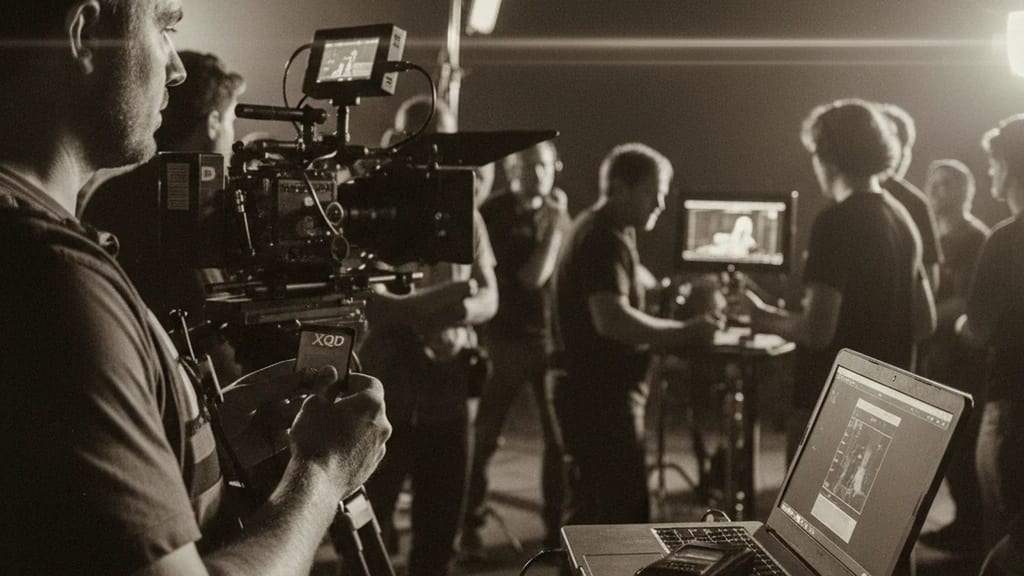
In cameras like the Sony FX9 or Nikon Z9, XQD cards enable the recording of 4K RAW footage without frame drops. In the documentary "Free Solo" (2018), the camera teams used XQD cards for extended uncompressed recording sequences in extreme environments. The high write speeds prevent buffer overflows during rapid scene changes or action sequences. The robust form factor is suitable for handheld work and gimbal setups where shocks occur. The disadvantage is the higher cost compared to SD cards and limited camera compatibility.
Comparison & Alternatives
Compared to SD cards (up to 300 MB/s) and CompactFlash (up to 160 MB/s), XQD offers significantly higher speeds. CFexpress Type B is succeeding XQD as its successor, but uses the same card slots and is partially backward compatible. While XQD is primarily used in high-end cameras, SD cards remain more economical for standard HD productions. Panasonic's P2 cards achieve similar speeds but are larger and more expensive. The choice depends on camera compatibility and the project's required data rates.