Filmlexikon.
Support
UV Filter
Camera · Equipment

UV Filter

Murnau AI illustration
15lb sandbag 20 c stand 216 diffusion 250 diffusion 251 diffusion 25lb sandbag 35lb sandbag 40 c stand

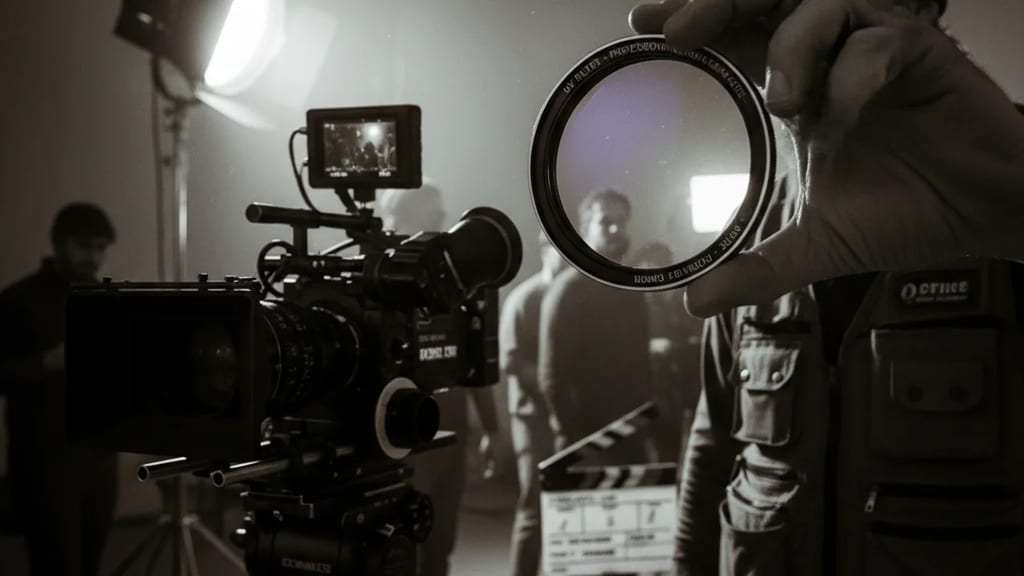
Optical glass filter with UV-blocking coatings that eliminates blue color casts. Primarily used today as protective glass for lenses against dust and impact damage.

Technical Details

UV filters are made of optical glass with special coatings that absorb or reflect UV radiation. Standard UV filters have a transmission of 85-95% at 400nm, dropping to below 5% at 350nm. The filter strength is indicated in millimeters (usually 2-4mm), with threads following standardized diameters from 37mm to 127mm. UV filters are divided into UV-Haze filters (which additionally block bluish haze) and pure UV filters. Modern multi-coated filters reduce reflections to below 0.5% per surface.

History & Development

UV filters emerged in the 1930s with the widespread adoption of color film material, which was particularly sensitive to UV radiation. Kodak developed the first standardized UV filter for the film industry in 1935. In the 1960s, UV-Haze filters became standard in landscape photography and film production. With the transition to digital cinematography starting in 2000, their importance declined, as digital sensors are significantly less sensitive to UV than analog film material.

Practical Use in Film

In exterior shots at high altitudes or by the sea, where UV radiation is more intense, UV filters prevent bluish color casts and reduced contrast. Classic examples include mountain sequences in "The Sound of Music" (1965) or beach scenes in "Lawrence of Arabia" (1962), where UV filters ensured natural skin tones. Today, the UV filter primarily serves as a protective filter for expensive lenses against dust, saltwater, and mechanical damage. Many DoPs use it continuously as a "protective glass" and only remove it in critical low-light situations.

Comparison & Alternatives

UV filters differ from polarizing filters in their neutral color rendition and from ND filters in their lack of light reduction. Skylight filters (1A/1B) combine UV blocking with slight warming. In digital post-production, UV-related color casts can be corrected afterward, causing UV filters to lose importance. Modern lenses often integrate UV-blocking coatings. Clear filters without UV blocking often serve as pure protective filters today.
From the crafts

Perspectives

Cinematographer

Ich setze UV-Filter hauptsächlich als Schutzglas ein, besonders bei Außendrehs mit Sand, Salzluft oder mechanischer Beanspruchung der Optiken. In kritischen Low-Light-Situationen oder bei Gegenlicht entferne ich sie, da selbst hochwertige Filter minimale Reflexionen und Kontrastminderung verursachen können. Bei digitalen Kameras ist der UV-Effekt vernachlässigbar, aber der Objektivschutz rechtfertigt den Einsatz.

Director

Für mich ist der UV-Filter ein technisches Tool ohne direkten kreativen Einfluss auf die Bildsprache. Er ermöglicht mir jedoch, in rauen Umgebungen zu drehen, ohne ständig Sorge um teure Objektive haben zu müssen. In Hochgebirgs- oder Wüstenszenen kann er subtil natürlichere Hauttöne bewahren, was der Authentizität meiner Charakterdarstellung zugutekommt.

Producer

UV-Filter kosten 50-300 Euro je nach Objektiv, sind aber deutlich günstiger als Objektivreparaturen oder -ersatz. Sie reduzieren Versicherungsrisiken und Ausfallzeiten bei Equipment-Schäden erheblich. Besonders bei internationalen Drehs in staubigen oder salzhaltigen Umgebungen amortisieren sie sich durch vermiedene Reinigungskosten und verlängerte Lebensdauer der Optiken.

More in the lexikon

Related terms

Test your knowledge

Quiz

1. Was beschreibt „UV-Filter" am besten?

2. Zu welchem Department gehört „UV-Filter"?

3. Wie viele verschiedene Fachperspektiven bietet dieser Eintrag?

Report an error
From the Filmfarm ecosystem

Understand visual language, budget productions, connect crew.

The Lexikon is part of the Filmfarm ecosystem — alongside budgeting (FilmBalance), an industry magazine (FilmCircus) and crew networking (FilmCall, CrewMesh). One shared vocabulary for the whole production.

FilmFarm FilmRadarComing soonFilmPulseComing soonFilmNumbersComing soonFilmCapitalComing soonFilmLabComing soonFilmBalanceComing soonFilmCircusComing soon