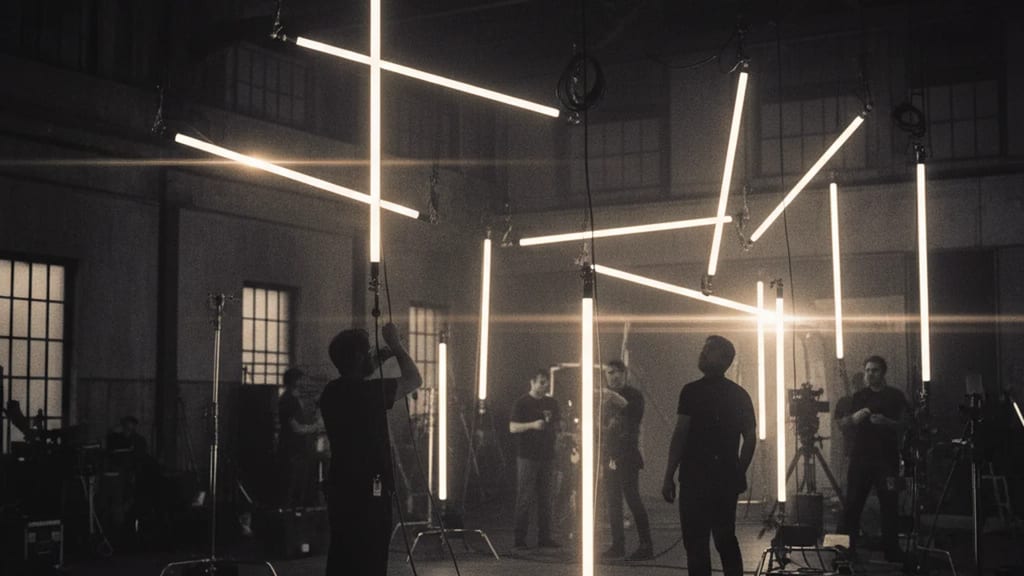
LED tube lights (3,000–12,000 lm) with adjustable color temperature (2,700K–6,500K) and DMX control. Create precise light lines for realistic office and neon lighting on set.
Technical Details
Modern LED tube lights achieve light outputs of 3,000 to 12,000 lumens with a power consumption of 30-120 watts. The color temperature can be continuously adjusted between 2,700K and 6,500K, with a CRI value of at least 95 for accurate color rendition. Standard lengths are 61cm (2ft), 122cm (4ft), and 183cm (6ft). The beam characteristic is typically 120° horizontal by 60° vertical. Professional models feature DMX-512 control and achieve dimming levels from 0.1% to 100% without color shift.
History & Development
Cinematographer Conrad Hall first used fluorescent tubes in 1963 for "The Cool Hand Luke" to authentically replicate the harsh neon lights of prison scenes. In 1987, Kino Flo revolutionized the industry with flicker-free high-frequency ballasts specifically for film productions. Starting in 2012, LED tubes gradually replaced fluorescent variants as they achieve full brightness instantly and require no warm-up phase.
Practical Use in Film
Roger Deakins used hundreds of LED tubes in "Blade Runner 2049" (2017) for the futuristic interiors to create hard light lines. For office sequences, tube lights authentically mimic ceiling lighting without the issues of real neon tubes. As background lights, they are ideal for evenly illuminating walls or as hidden light sources in furniture. Their low power consumption enables battery-powered solutions for 8-12 hours of continuous operation.
Comparison & Alternatives
Unlike panel lights, tube lights create precise light lines rather than diffuse illumination. LED strips offer more flexibility due to their bendability but do not achieve the light output of tubes. Practical lights like real neon tubes flicker at 50Hz and are not dimmable. Modern RGBW tubes combine basic lighting with color effects and are increasingly replacing separate effect lights for accent lighting.