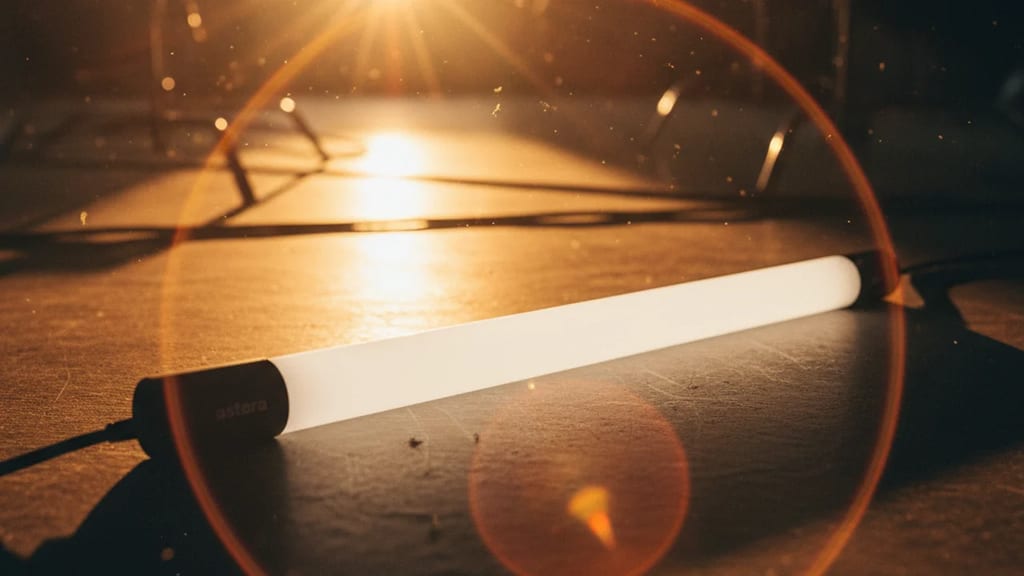
Astera LED tube with 54 Wh battery, up to 20h runtime, CRI>96, IP65-rated, controlled via app or DMX for on-set lighting.
Technical Details
The Helios Tube features an integrated 54 Wh lithium-ion battery, enabling an operating time of up to 20 hours at minimum output. Color rendering achieves CRI>96 and TLCI>97. The anodized aluminum housing is IP65 rated for dust and water resistance and weighs 1.1 kg. Control is managed via the Astera app through Bluetooth or DMX512/CRMX wireless protocol. Three variants exist: the Standard version, the Plus version with enhanced features, and the Titan version with a higher light output of 3,000 lumens.
History & Development
Astera introduced the Helios Tube at NAB in Las Vegas in 2018, after the German company had been developing LED solutions for film and events since 2008. The development was based on experience with the pixel-controllable Titan Tube from 2016. In 2020, the Helios Tube Plus followed with improved battery life and additional effects. In 2022, Astera expanded the system with the Helios Kit variants, offering different accessory configurations.
Practical Use in Film
Gaffers utilize the Helios Tube as a practical light source (practical) in set designs, for example, as a neon tube in offices or as an RGB accent light. In "The Batman" (2022), cinematographer Greig Fraser used Helios Tubes for the characteristic red-green lighting in interiors. The wireless design allows for quick positioning in confined spaces without a power supply. Typical workflows include pre-programming light sequences via the app and synchronizing multiple tubes for complex color gradients. Disadvantages include limited battery life at full power and lower light intensity compared to mains-powered alternatives.
Comparison & Alternatives
The Helios Tube competes with the ARRI SkyPanel S30-C as a larger, mains-powered alternative and the Quasar Science Q-LED X as a direct competitor in the tube segment. Compared to traditional Kinoflo tubes, it offers color flexibility without gel filters, but with less light output. For outdoor daylight shooting, HMI lights are more suitable, while the Helios Tube excels in controlled interior shots and run-and-gun productions.