Filmlexikon.
Support
Tone
Theory · Terms

Tone

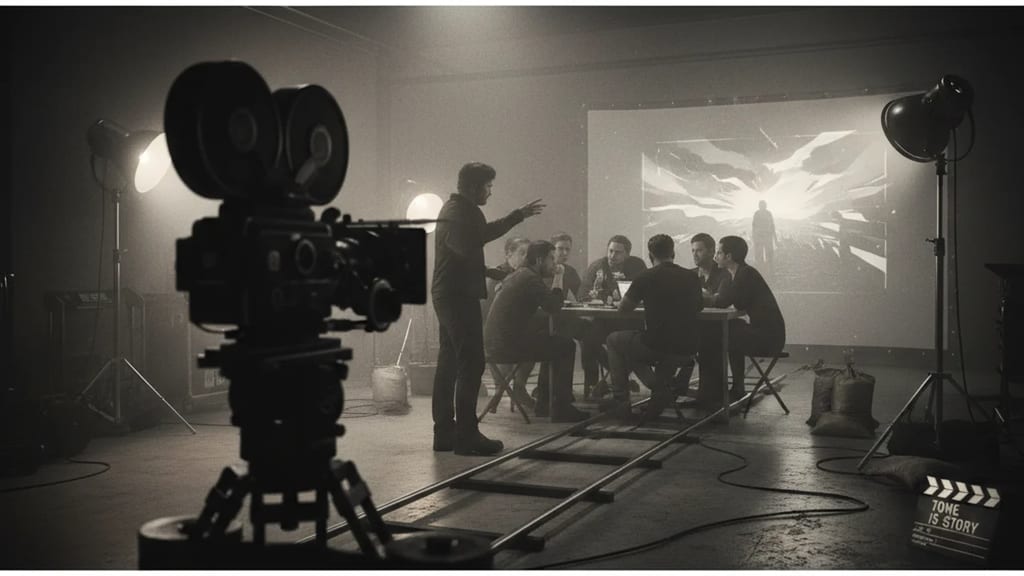
Murnau AI illustration
audio sound motif sonorous sound cinema brand voice

Overall technical and artistic aesthetic achieved through color temperature (2700K–6500K), contrast, editing rhythm, and focal length choices to deliberately shape mood and atmosphere.

Technical Details

Tone manifests measurably in color temperature (2700K-6500K for various moods), contrast ratios (1:4 to 1:1000 depending on desired intensity), and frequency distribution in the soundtrack (bass emphasis below 200Hz for threat, treble boost above 8kHz for nervousness). In terms of image composition, filmmakers work with defined focal lengths: wide-angle lenses below 35mm for isolation, telephoto lenses above 85mm for intimacy. Editing rhythms vary between 0.5 seconds (hectic) to 8 seconds per shot (contemplation).

History & Development

The term was established in 1946 by André Bazin's film reviews in "Cahiers du Cinéma." Orson Welles' "Citizen Kane" (1941) is considered a milestone for conscious tone control through Greg Toland's deep focus experiments with f/16 apertures. In the 1970s, Gordon Willis developed the "Prince of Darkness" concept for "The Godfather" with exposures 1-2 stops below standard. Digital Intermediate (DI) since 2000 enables precise tone control in post-production through Look-Up Tables (LUTs) with 33³ data points.

Practical Application in Film

Roger Deakins works with specific color palettes in "Blade Runner 2049": orange (2000K-3200K) for memories, blue (5600K-7000K) for the present. Emmanuel Lubezki switches between natural daylight (5600K) and candlelight (1900K) without artificial fill light in "The Revenant." Horror productions systematically use infrasound below 20Hz and asymmetrical image divisions in a 7:3 ratio instead of the classic rule of thirds.

Comparison & Alternatives

Tone differs from genre through its variability within a film – while "Thriller" represents a categorization, tone can shift between intimate (50mm focal lengths) and threatening passages (14mm wide-angle with extreme low-angle shots). Modern adaptive tone systems like Dolby Vision with scene-specific metadata for HDR displays (0.005-10,000 cd/m²) are contemporary. Alternative terms like "Mood" or "Atmosphere" describe similar concepts but focus more on individual aspects rather than the overall structure.

From the crafts

Perspectives

Cinematographer

Ich arbeite mit präzisen LUT-Tabellen und Farbtemperatur-Messungen, um die gewünschte Tonalität bereits am Set zu erreichen. Meine Lichtsetups mit spezifischen Kontrastverhältnissen und Brennweitenwahl bestimmen maßgeblich, ob eine Szene bedrohlich oder warmherzig wirkt – nachträgliche Korrekturen kosten Zeit und Qualität.

Director

Ich definiere die Tonalität bereits im Drehbuch durch Regieanweisungen für Schauspielführung und visuelle Metaphern. Jede Sequenz bekommt eine emotionale Zielrichtung, die ich durch Tempo, Bildsprache und Sounddesign steuere – die Tonalität ist mein direktester Zugang zur emotionalen Manipulation des Publikums.

Producer

Tonalitätswechsel bedeuten zusätzliche Drehtage für verschiedene Lichtsetups und erweiterte Post-Production-Budgets. Ich kalkuliere 15-20% mehr Zeit für Farbkorrektur bei komplexen Tonalitätskonzepten und plane entsprechende Pufferzeiten, da nachträgliche Änderungen der Grundstimmung extrem kostspielig werden können.

More in the lexikon

Related terms

Test your knowledge

Quiz

1. Was beschreibt „Tonalität" am besten?

2. Zu welchem Department gehört „Tonalität"?

3. Wie viele verschiedene Fachperspektiven bietet dieser Eintrag?

Report an error
From the Filmfarm ecosystem

Understand visual language, budget productions, connect crew.

The Lexikon is part of the Filmfarm ecosystem — alongside budgeting (FilmBalance), an industry magazine (FilmCircus) and crew networking (FilmCall, CrewMesh). One shared vocabulary for the whole production.

FilmFarm FilmRadarComing soonFilmPulseComing soonFilmNumbersComing soonFilmCapitalComing soonFilmLabComing soonFilmBalanceComing soonFilmCircusComing soon