Filmlexikon.
Support
Sound Motif
Theory · Terms

Sound Motif

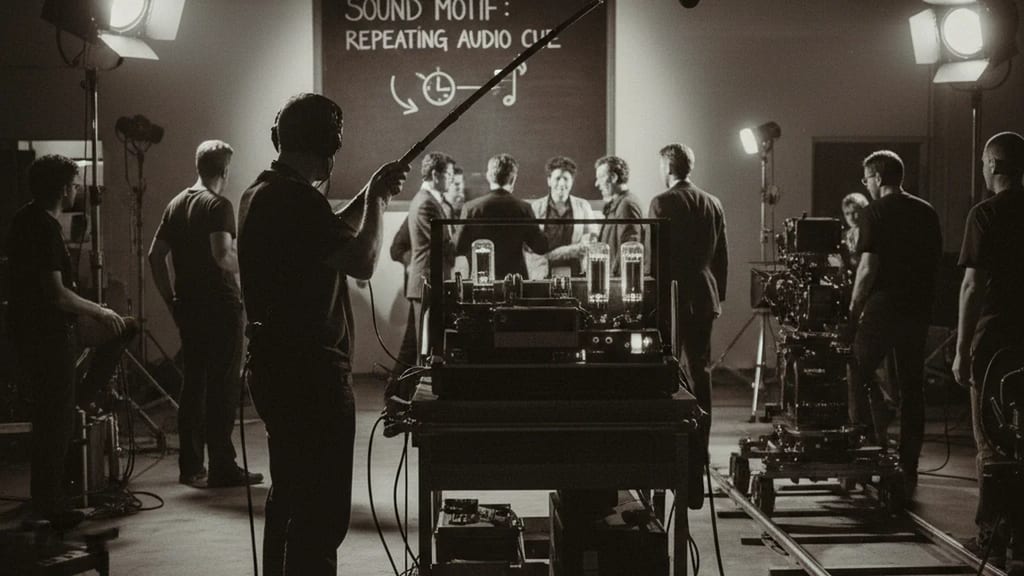
Murnau AI illustration
15lb sandbag 20 c stand 216 diffusion 250 diffusion 251 diffusion 25lb sandbag 35lb sandbag 40 c stand

Recurring sound element for narrative structure, recorded at 48 kHz/24-bit at -18 dBFS. Comprises mechanical, atmospheric, or synthetic sounds in the 200–2000 Hz range.

Technical Details

Sound motifs are typically recorded at 48 kHz/24-bit and stored as separate stems in the Pro Tools timeline at -18 dBFS. The fundamental frequency usually lies between 200-2000 Hz for optimal intelligibility across various playback systems. Classic variants include mechanical motifs (clock tick, heartbeat at 60-80 BPM), atmospheric motifs (wind noise, water drops), and synthetic motifs (electronic pulses, modulated sine waves). During implementation, variations of ±10% in pitch and tempo are used to avoid mechanical repetition.

History & Development

Alfred Hitchcock first systematically used a sound motif in "The Birds" (1963) with the electronically generated bird sound by Remi Gassmann and Oskar Sala. Walter Murch perfected the technique in "The Godfather Part II" (1974) with the recurring wind motif. The digital revolution from 1990 onwards enabled precise manipulation: sampling rates of 96 kHz and time-stretching algorithms like PSOLA allowed for seamless integration. David Lynch and Alan Splet developed the concept of "Sonic Signatures" in the 1980s – sound motifs as the acoustic DNA of individual characters.

Practical Application in Film

Christopher Nolan uses the slowed-down Edith Piaf song "Non, je ne regrette rien" as a structuring sound motif across different time layers in "Inception" (2010). Denis Villeneuve establishes alien communication in "Arrival" (2016) through a 7-second bass motif at 40 Hz. The workflow begins in post-production: sound motifs are categorized in the sound library, assigned SMPTE timecode, and implemented across all mixing stages at a constant volume (-12 dBFS for dialogue scenes, -6 dBFS for action sequences).

Comparison & Alternatives

While the leitmotif is melodically structured, the sound motif works with pure timbres and textures. Audio logos last under 3 seconds and serve brand identification. Soundscapes create atmospheric continuity without motivic repetition. Modern AI-based tools like AudioStellar or LANDR enable automatic motif recognition and placement, but do not replace the dramaturgical decision of the sound designer. In dialogue-heavy productions, subtle sound motifs (ambience variations) dominate, while aggressive mechanical motifs are used in action films.
From the crafts

Perspectives

Cinematographer

Tonmotive beeinflussen meine Schnittrhythmen erheblich - wenn der Tonmeister ein 4-Sekunden-Motiv alle 45 Sekunden wiederholt, plane ich meine Einstellungsgrößen entsprechend. Bei mechanischen Motiven wie Herzschlag synchronisiere ich bewusst Handheld-Bewegungen mit dem 80-BPM-Takt. Das schafft unbewusste Verbindungen zwischen Bild und Ton, die das Publikum physisch spürt.

Director

Ich entwickle Tonmotive bereits im Drehbuch - der wiederkehrende Radiostatic in "Lost Highway" war von Anfang an als Übergang zwischen Realitätsebenen konzipiert. Tonmotive funktionieren wie akustische Reime: Sie schaffen Bedeutung durch Wiederholung und Variation. In der Postproduktion arbeite ich mit 3-5 Grundmotiven, die ich wie musikalische Themen durch den gesamten Film webe.

Producer

Ein professionelles Tonmotiv-Design kostet 8.000-15.000 Euro zusätzlich und verlängert die Postproduktion um 3-4 Tage. Dafür reduziert es Musikkosten um bis zu 30%, da weniger komponierte Musik benötigt wird. Bei internationalen Verleih zahlt sich das aus - Tonmotive funktionieren sprachunabhängig und müssen nicht lokalisiert werden, im Gegensatz zu Dialog oder kulturspezifischen Musikstücken.

More in the lexikon

Related terms

Test your knowledge

Quiz

1. Was beschreibt „Tonmotiv" am besten?

2. Zu welchem Department gehört „Tonmotiv"?

3. Wie viele verschiedene Fachperspektiven bietet dieser Eintrag?

Report an error
From the Filmfarm ecosystem

Understand visual language, budget productions, connect crew.

The Lexikon is part of the Filmfarm ecosystem — alongside budgeting (FilmBalance), an industry magazine (FilmCircus) and crew networking (FilmCall, CrewMesh). One shared vocabulary for the whole production.

FilmFarm FilmRadarComing soonFilmPulseComing soonFilmNumbersComing soonFilmCapitalComing soonFilmLabComing soonFilmBalanceComing soonFilmCircusComing soon