Cinematographer
Aus DoP-Perspektive ist dieses Element essentiell für die visuelle Gestaltung. Es ermöglicht mir die gewünschte Farbstimmung und das ästhetische Bild konsistent umzusetzen.
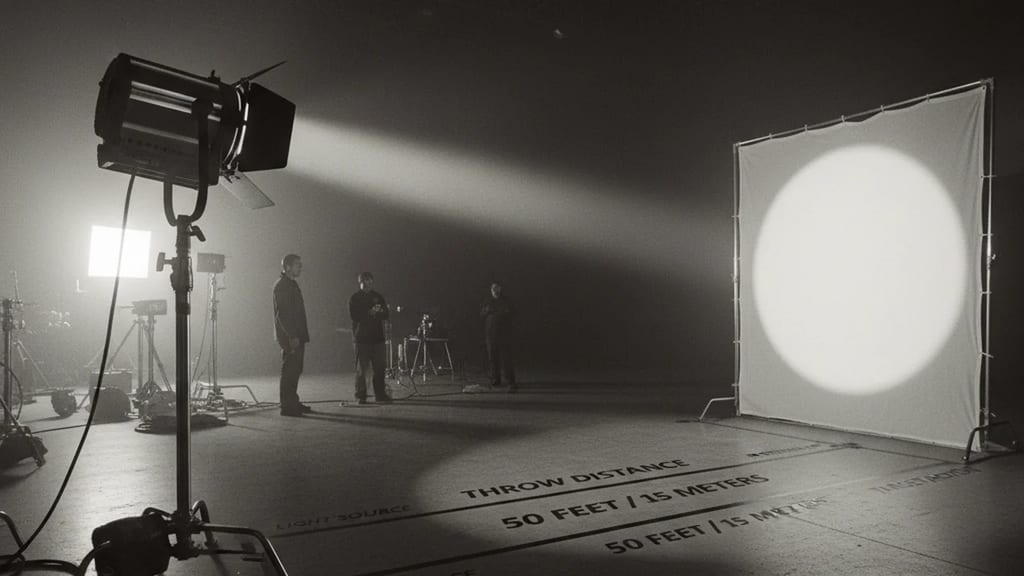
Distance between a light source and subject or surface; determines brightness and light diffusion via the inverse square law.
Throw Distance—in German simply "Wurfweite" or "Lampenabstand"—refers to the distance between the light fixture and what it illuminates: the actor's face, a wall, the floor. It is one of the first parameters a gaffer decides on when placing a lamp. Not only because the distance determines whether you have enough light on the subject, but because it simultaneously controls how soft or hard the light appears and how large the illuminated area is.
Important distinction: In the world of video and projectors, "throw" refers to the distance from the projector to the screen, often expressed as a ratio (throw ratio). In set lighting, however, it concerns the actual lamp-to-subject distance and its effect on brightness and light character.
Throw Distance cannot be understood without the Inverse Square Law. The brightness on the subject decreases with the square of the distance—if you double the throw distance, only a quarter of the brightness arrives, not half. Conversely, the illuminated area quadruples: what hits a small spot from one meter away covers four times the area from two meters away—but significantly darker.
This leads to a practical lever that every DoP knows: the closer the lamp is to the subject, the faster the light becomes darker towards the depth (steeper falloff). If the lamp is far away, the difference in brightness between the front and back of the image area is small—the light appears flatter and more even.
| Distance Change | Brightness on Subject | Illuminated Area |
|---|---|---|
| Distance doubled | one quarter | fourfold |
| Distance halved | fourfold | one quarter |
Throw Distance is always a compromise between three things simultaneously: brightness, light softness, and falloff. A parallel practical example—if you want soft light, you move a large, diffuse source close to the face. This makes the source relatively large and thus soft, but costs you strong falloff: if the actor moves back a step, they disappear into darkness. If you need even light across a movement, you move the lamp further away and increase the power.
Beam character plays a role: Narrowly focused spot sources work over long throw distances because they maintain their intensity within a narrow cone. Wide flood setups, on the other hand, are tools for short to medium distances because the energy is quickly distributed over a large area.
Aus DoP-Perspektive ist dieses Element essentiell für die visuelle Gestaltung. Es ermöglicht mir die gewünschte Farbstimmung und das ästhetische Bild konsistent umzusetzen.
Diese professionelle Lösung erhöht die Produktionseffizienz und reduziert Post-Production-Anforderungen. Sie ermöglicht flexible, schnelle Anpassungen während des Drehs.
Als Gaffer ist dies ein unverzichtbares Werkzeug meines täglichen Handwerkszeugs. Es ermöglicht mir professionelle Lichtkontrolle und schnelle Anpassungen auf Set, was Zeit spart und Qualität sichert.
1. Zu welchem Department gehört „Wurfweite"?
2. Wie viele verschiedene Fachperspektiven bietet dieser Eintrag?
The Lexikon is part of the Filmfarm ecosystem — alongside budgeting (FilmBalance), an industry magazine (FilmCircus) and crew networking (FilmCall, CrewMesh). One shared vocabulary for the whole production.