Filmlexikon.
Support
Theatrical Cut
Directing · Terms

Theatrical Cut

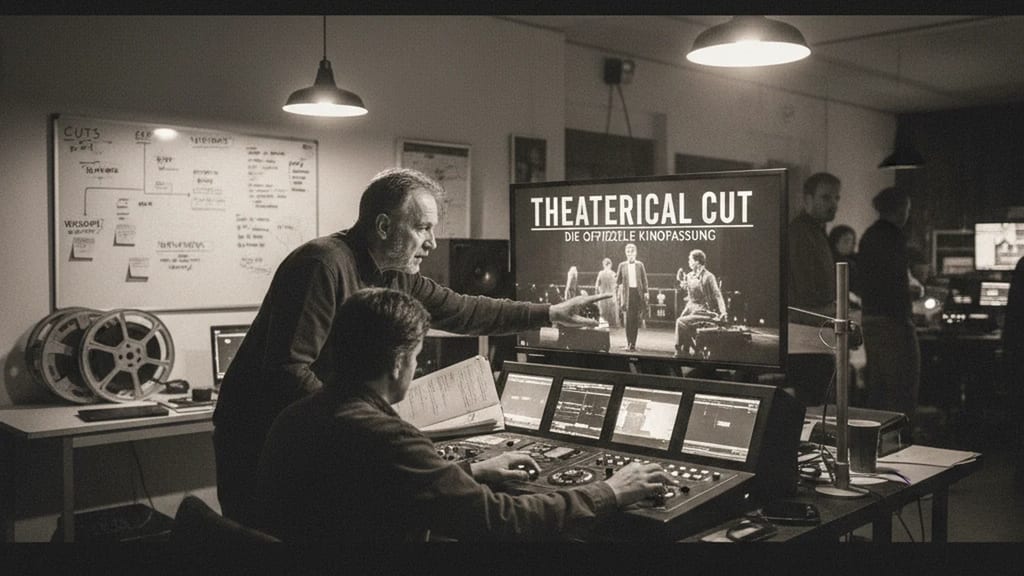
Murnau AI illustration
axial cut cross cut cross cutting cut cutter cutting on dialogue cutting on movement cutting rhythm

The official version of a film released for theatrical exhibition — typically shorter than subsequent Director's Cuts.

Technical Details

Theatrical cuts adhere to an optimal screening duration of 90-180 minutes, with most blockbusters falling between 120-150 minutes. At 24 frames per second, this equates to approximately 172,800-216,000 individual frames. The cut undergoes the standard color grading process for cinema projection with specific gamma curves (2.6 for DCI cinemas) and is delivered in DCP (Digital Cinema Package) format or, less commonly, on 35mm film. Technical parameters such as Dolby Atmos sound mixing, HDR grading, and aspect ratio are primarily established for this version.

History & Development

Until the 1970s, effectively only one film version existed – the theatrical cut. Ridley Scott's "Blade Runner" (1982), with its seven different editing versions, established awareness of alternative cuts. The term "Theatrical Cut" only became necessary when studios began producing extended Director's Cuts for VHS and later DVD. Today, multiple editing versions often exist concurrently during post-production – one for cinemas, others for streaming services or international markets.

Practical Application in Film

The theatrical cut of "Apocalypse Now" (1979) runs for 153 minutes, while Coppola's "Redux" version spans 202 minutes – 49 minutes of additional material. In "Justice League" (2017), the Theatrical Cut (120 min.) and the Snyder Cut (242 min.) differ fundamentally in structure and content. Studios strategically shorten theatrical cuts: a shorter runtime allows for more screenings per day and higher revenue. Violence scenes are reduced for lower age ratings, and complex subplot structures are streamlined.

Comparison & Alternatives

The Director's Cut represents the unedited director's vision, while the Extended Cut integrates additional material. Assembly Cuts are initial rough cuts without final editing. Internationally, theatrical cuts vary significantly: the US theatrical cut of "The Wolf of Wall Street" runs 180 minutes, while in Germany it is 176 minutes due to cuts. Streaming platforms often favor longer versions as there are no time slot restrictions. TV versions are created through further cuts and censorship for commercial breaks and broadcast times.
From the crafts

Perspectives

Cinematographer

Ich komponiere meine Einstellungen immer mit dem Wissen, dass bestimmte Szenen möglicherweise gekürzt werden - deshalb achte ich darauf, dass wichtige visuelle Informationen auch in reduzierten Schnittfolgen erhalten bleiben. Das Color Grading führe ich primär für die Kinoprojektion durch, da diese Version die höchsten technischen Anforderungen stellt und als Referenz für alle anderen Fassungen dient.

Director

Die Kinofassung zwingt mich zur narrativen Präzision - jede Szene muss ihre Daseinsberechtigung beweisen, wenn ich nur 120 Minuten zur Verfügung habe. Ich entwickle bereits im Drehbuch alternative Szenenstrukturen, weil ich weiß, dass charakterentwickelnde Nebenhandlungen oft der Schere zum Opfer fallen. Die emotionale Wirkung muss in komprimierter Form funktionieren.

Producer

Eine 140-Minuten-Kinofassung generiert täglich etwa 20% weniger Vorstellungen als eine 110-Minuten-Version - das entspricht bei einem erfolgreichen Film mehreren Millionen Dollar Umsatzeinbußen. Gleichzeitig kalkuliere ich bereits die Verwertung alternativer Fassungen mit ein, da Director's Cuts auf Blu-ray zusätzliche Erlöse von 15-25% bringen können. Die Kinofassung ist Geschäftsgrundlage, nicht künstlerisches Endprodukt.

More in the lexikon

Related terms

Test your knowledge

Quiz

1. Was beschreibt „Kinofassung" am besten?

2. Zu welchem Department gehört „Kinofassung"?

3. Wie viele verschiedene Fachperspektiven bietet dieser Eintrag?

Report an error
From the Filmfarm ecosystem

Understand visual language, budget productions, connect crew.

The Lexikon is part of the Filmfarm ecosystem — alongside budgeting (FilmBalance), an industry magazine (FilmCircus) and crew networking (FilmCall, CrewMesh). One shared vocabulary for the whole production.

FilmFarm FilmRadarComing soonFilmPulseComing soonFilmNumbersComing soonFilmCapitalComing soonFilmLabComing soonFilmBalanceComing soonFilmCircusComing soon