Filmlexikon.
Support
Tair-3
Camera · Terms

Tair-3

Murnau AI illustration
flow para roll take

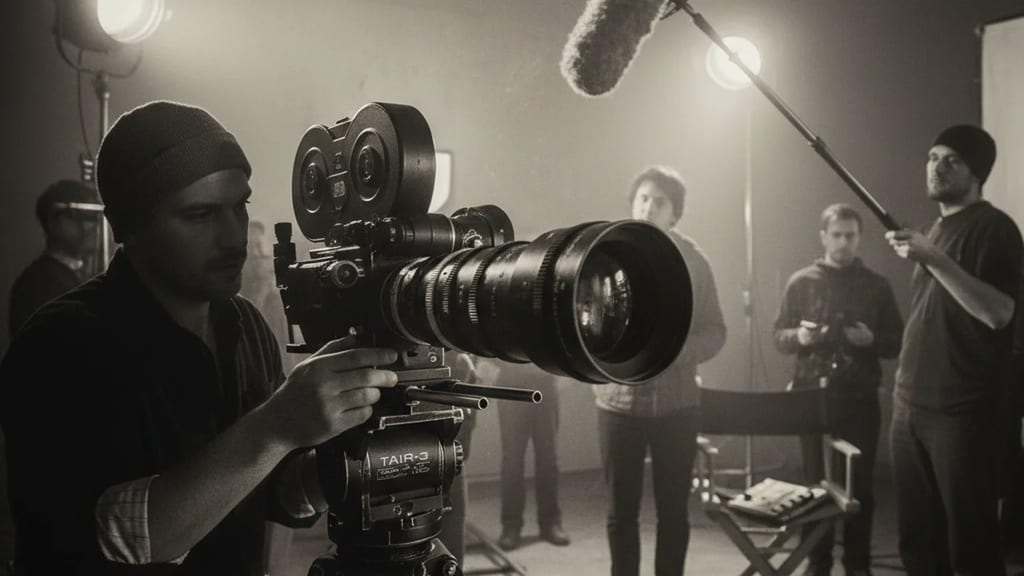
Soviet 300mm f/4.5 telephoto lens (1958–1992) with 15-blade aperture for soft bokeh. 1.8 kg, 6m minimum focus, distinctive rendering prized for vintage aesthetics.

Technical Details

The Tair-3 weighs 1.8 kg with a length of 265mm and a filter diameter of 95mm. The minimum focusing distance is 6 meters, and the aperture range extends from f/4.5 to f/22 in half-stop increments. The lens features 15 aperture blades for a nearly circular aperture opening. Various mounts were produced: M42, M39, and specifically for Pentacon-Six cameras. The optical construction consists of four elements, with the rear two lenses designed as a cemented doublet. The coating was initially single, later multi-layered.

History & Development

Development began in 1954 based on captured Zeiss documentation from Jena. Mass production started in 1958 and continued until 1992, with an estimated 50,000 units produced. In 1963, the lens received an improved multi-layer coating, recognizable by its characteristic red-violet reflection. In the 1970s, a revised version followed with improved mechanics and more precise manufacturing. The Tair-3 was the first Soviet 300mm lens for 35mm cameras and established Soviet telephoto lenses internationally.

Practical Use in Film

Sergei Eisenstein used a Tair-3 for exterior shots in his unfinished film "Ivan the Terrible Part III" (1958). The lens was particularly suitable for documentaries due to its compact design and affordable price. The 15-blade aperture produces a soft bokeh, ideal for portraits with shallow depth of field. At wide open aperture, the lens exhibits characteristic chromatic aberrations on high-contrast edges, which is artistically used for vintage looks. Sharpness performance reaches its maximum at f/8.

Comparison & Alternatives

Compared to contemporary Western 300mm lenses like the Zeiss Sonnar 300mm f/4, the Tair-3 offered similar optical performance at a significantly lower price. Modern alternatives include autofocus telephoto lenses from Canon, Nikon, or Sony, which, however, do not reproduce the characteristic rendering of the Soviet lens. The Tair-11A (135mm f/2.8) from the same series offers a shorter focal length with a similar optical philosophy. For an analog look in digital productions, the Tair-3 remains relevant with adapters on modern cameras.
From the crafts

Perspectives

Cinematographer

Ich schätze das Tair-3 für seine cremige Hintergrundunschärfe bei f/4,5, die durch die 15 Blendenlamellen entsteht - perfekt für isolierte Porträts mit charaktervollem Vintage-Look. Der manuelle Fokus erfordert präzise Arbeit, aber die durchgehende Blende und das konstante Gewicht machen Follow-Focus-Operationen berechenbar. Die chromatischen Aberrationen bei Offenblende nutze ich gezielt für nostalgische Filmstile.

Director

Das Tair-3 komprimiert Räume auf eine Art, die emotionale Nähe schafft, selbst wenn Schauspieler physisch distanziert sind - ideal für intime Dialoge ohne aufdringliche Kameranähe. Die weiche Zeichnung bei Offenblende unterstützt melancholische oder träumerische Sequenzen, während die Kompression Hintergründe abstrahiert und den Fokus auf Charaktere lenkt. Für Periodenfilme bietet es authentische optische Eigenschaften der 1960er Jahre.

Producer

Ein gebrauchtes Tair-3 kostet 300-800 Euro versus 5.000+ für moderne 300mm-Objektive - bei kleineren Produktionen ein entscheidender Kostenfaktor ohne Qualitätsverlust für den gewünschten Look. Die Robustheit sowjetischer Fertigung bedeutet minimale Ausfallzeiten, allerdings erfordert der manuelle Fokus erfahrene Kameraassistenten. Adapter für moderne Kameras kosten zusätzlich 150-300 Euro, aber die Gesamtinvestition bleibt unter 10% vergleichbarer Neuware.

More in the lexikon

Related terms

Test your knowledge

Quiz

1. Zu welchem Department gehört „Tair-3"?

2. Wie viele verschiedene Fachperspektiven bietet dieser Eintrag?

Report an error
From the Filmfarm ecosystem

Understand visual language, budget productions, connect crew.

The Lexikon is part of the Filmfarm ecosystem — alongside budgeting (FilmBalance), an industry magazine (FilmCircus) and crew networking (FilmCall, CrewMesh). One shared vocabulary for the whole production.

FilmFarm FilmRadarComing soonFilmPulseComing soonFilmNumbersComing soonFilmCapitalComing soonFilmLabComing soonFilmBalanceComing soonFilmCircusComing soon