Filmlexikon.
Support
Stunt Performer
Stunts · Terms

Stunt Performer

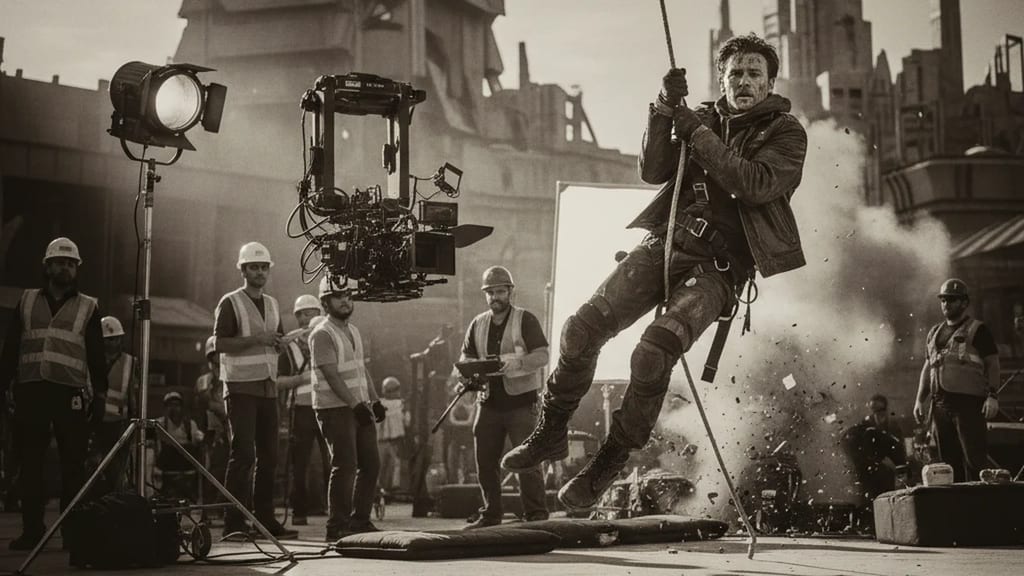
Murnau AI illustration
stunt utility stunt stunt coordinator stunt double

Professional substitute for actors in high-risk sequences, specialized in vehicle stunts, choreographed combat, falls, or fire work. Must precisely replicate the actor's movement patterns for seamless editing.

Technical Details

Stunt performers specialize in defined categories: High Falls (falls from a height of 4.5 meters), Precision Driving (vehicle stunts at speeds over 80 km/h), Fire Burns (fire stunts with temperatures up to 800°C), Fight Choreography, and Wire Work. Protective equipment includes fire-resistant Nomex suits, spinal protectors with 15mm padding, and special crash mats with a 30cm foam core. Wire rigs operate with steel cables of 3-6mm diameter and tensile forces up to 2000 Newtons.

History & Development

The first documented stuntman was Frank Hanaway, who fell from a horse for 5 dollars in "The Great Train Robbery" in 1903. Yakima Canutt revolutionized vehicle stunts between 1930 and 1950 and developed standardized safety protocols. The Stuntmen's Association of Motion Pictures was founded in 1961, followed by the first female stunt organization in 1973. Since the 1990s, CGI techniques have supplemented practical stunts but rarely replaced them entirely.

Practical Application in Film

In "Mad Max: Fury Road" (2015), Guy Norris' team performed over 80% of the stunts practically, including 150 vehicle maneuvers at speeds up to 100 km/h. "John Wick" (2014) set new standards for close-quarters combat choreography with 87North, requiring 6-8 weeks of pre-training for the stunt doubles. Modern productions budget for 1-3 stunt performers per lead actor; in action films, this ratio increases to 5-8 specialists per protagonist.

Comparison & Alternatives

Stunt Coordinators plan and supervise all dangerous scenes, while Stunt Doubles exclusively perform for specific actors. Motion capture technology has increasingly replaced wire work for supernatural movements since 2010, but practical stunts remain indispensable for realistic action sequences. Virtual stunts using volumetric capture cost 50,000-200,000 Euros per sequence, while practical stunts are budgeted at 5,000-25,000 Euros per day.
From the crafts

Perspectives

Cinematographer

Ich plane Kamerafahrten und -positionen präzise mit dem Stunt-Team ab, da Sicherheitszonen von 3-5 Metern um Fahrzeuge oder Explosionen eingehalten werden müssen. Bei High-Speed-Aufnahmen verwende ich Phantom-Kameras mit 1000fps, um Stunts in Zeitlupe zu erfassen und gleichzeitig Sicherheitsabstände zu vergrößern.

Director

Ich arbeite bereits im Drehbuchstadium mit Stunt Coordinators zusammen, um machbare Action-Sequenzen zu entwickeln, die der Charakterentwicklung dienen. Die Glaubwürdigkeit der Stunts beeinflusst direkt die emotionale Wirkung - praktische Effekte erzeugen authentische Reaktionen bei Schauspielern, die CGI nicht ersetzen kann.

Producer

Ich kalkuliere 15-25% des Gesamtbudgets für Stunt-Abteilungen bei Action-Produktionen und benötige spezialisierte Versicherungen mit Prämien von 2-4% der Produktionskosten. Stunt-Teams erfordern 2-3 Wochen Vorbereitungszeit und können Drehtage um 30-50% verlängern, bieten jedoch langfristige Kosteneinsparungen gegenüber VFX-lastigen Alternativen.

More in the lexikon

Related terms

Test your knowledge

Quiz

1. Zu welchem Department gehört „Stuntman"?

2. Wie viele verschiedene Fachperspektiven bietet dieser Eintrag?

Report an error
From the Filmfarm ecosystem

Understand visual language, budget productions, connect crew.

The Lexikon is part of the Filmfarm ecosystem — alongside budgeting (FilmBalance), an industry magazine (FilmCircus) and crew networking (FilmCall, CrewMesh). One shared vocabulary for the whole production.

FilmFarm FilmRadarComing soonFilmPulseComing soonFilmNumbersComing soonFilmCapitalComing soonFilmLabComing soonFilmBalanceComing soonFilmCircusComing soon