Filmlexikon.
Support
Streak Filter
Camera · Equipment

Streak Filter

Murnau AI illustration
15lb sandbag 20 c stand 216 diffusion 250 diffusion 251 diffusion 25lb sandbag 35lb sandbag 40 c stand

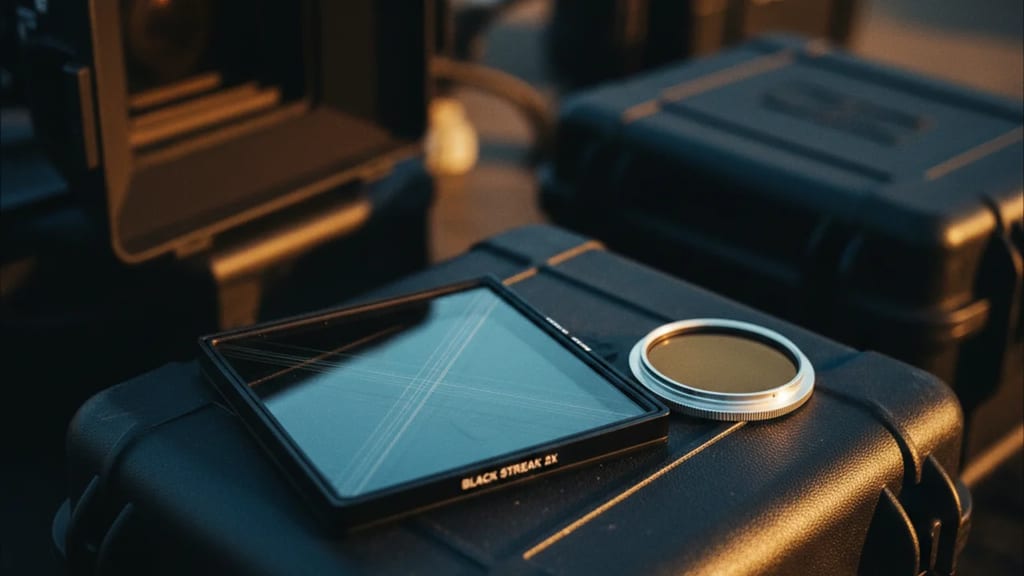
Diffraction grating filter (100–300 lines/mm) that disperses light sources into directional rays. Most pronounced at wide apertures, diminishes at f/8 and smaller.

Technical Details

Streak filters use diffraction gratings with 100-300 lines per millimeter, etched onto glass or optical acrylic. Standard versions produce streaks 2mm to 15mm long at an aperture of f/2.8. Variants include Blue Streak (enhances blue spectral components), Supernova (4-8 rays), Anamorphic Streak (horizontal lines), and Multi-Image Prisms (multiple light refractions). The filters are available in sizes from 77mm to 138mm for matte box systems. The effect intensifies at wide apertures and significantly diminishes at f/8.

History & Development

Tiffen developed the first commercial streak filters in 1978 as an alternative to complex optical trick effects in post-production. The filter was first prominently used in "Star Trek: The Motion Picture" (1979) for depicting the Enterprise engines. In the 1980s, the streak filter became standard for science fiction productions. Since 2010, these filters have experienced a resurgence due to the anamorphic renaissance, as they enhance the coveted "analog look" of digital footage.

Practical Use in Film

Cinematographer Michael Ballhaus used streak filters in "Goodfellas" (1990) for the nightclub sequences to atmospherically enhance artificial light. "Blade Runner 2049" (2017) combined 1/4 Blue Streak filters with practical light sources for the neon-dominated street scenes. The filter amplifies existing light sources but does not create effects without corresponding highlights in the image. Modern workflows often combine streak filters with LED panels at a 5600K color temperature for optimal light refraction. Disadvantages: Loss of contrast with heavy use and unwanted reflections in backlight shots.

Comparison & Alternatives

Streak filters differ from star filters by creating directional instead of radial rays. Pro-Mist filters produce diffuse halos without sharp lines. In post-production, similar effects can be created with plugins like Optical Flares, but without the natural light interaction of the optical filter. Anamorphic lenses create horizontal streaks as a natural side effect of their design. For practical light sources below 500 lux, streak filters remain ineffective; digital flares in color correction offer an alternative here.

From the crafts

Perspectives

Cinematographer

Ich setze Streak Filter gezielt bei Nachtaufnahmen mit praktischen Lichtquellen ein – LED-Strips und Neon-Röhren bekommen dadurch diese begehrte filmische Qualität. Wichtig ist die Blende: ab f/5.6 wird der Effekt bereits schwächer, ab f/8 praktisch unsichtbar, deshalb plane ich meine Belichtung entsprechend und halte die Schärfentiefe über Lighting statt Blende.

Director

Streak Filter helfen mir dabei, urbane Nachtszenen oder futuristische Settings mit minimalen Mitteln atmosphärisch aufzuladen – die Streaks verstärken die Trennung zwischen warmen und kalten Lichtquellen. Ich nutze sie bewusst sparsam, nur in Szenen wo die Technologie der Geschichte dient, denn der Effekt kann schnell dated wirken und von der Performance ablenken.

Producer

Ein 4x5.65" Streak Filter kostet 180-350 Euro – vernachlässigbar im Kamera-Budget, aber deutlich günstiger als entsprechende VFX-Effekte in der Post. Zeitersparnis in der Color Correction, da der Look bereits beim Dreh entsteht und nicht nachträglich entwickelt werden muss, allerdings bindet uns das auf den Effekt fest ohne nachträgliche Korrekturmöglichkeit.

More in the lexikon

Related terms

Test your knowledge

Quiz

1. Was beschreibt „Streak Filter" am besten?

2. Zu welchem Department gehört „Streak Filter"?

3. Wie viele verschiedene Fachperspektiven bietet dieser Eintrag?

Report an error
From the Filmfarm ecosystem

Understand visual language, budget productions, connect crew.

The Lexikon is part of the Filmfarm ecosystem — alongside budgeting (FilmBalance), an industry magazine (FilmCircus) and crew networking (FilmCall, CrewMesh). One shared vocabulary for the whole production.

FilmFarm FilmRadarComing soonFilmPulseComing soonFilmNumbersComing soonFilmCapitalComing soonFilmLabComing soonFilmBalanceComing soonFilmCircusComing soon