Filmlexikon.
Support
Sting
Sound · Terms

Sting

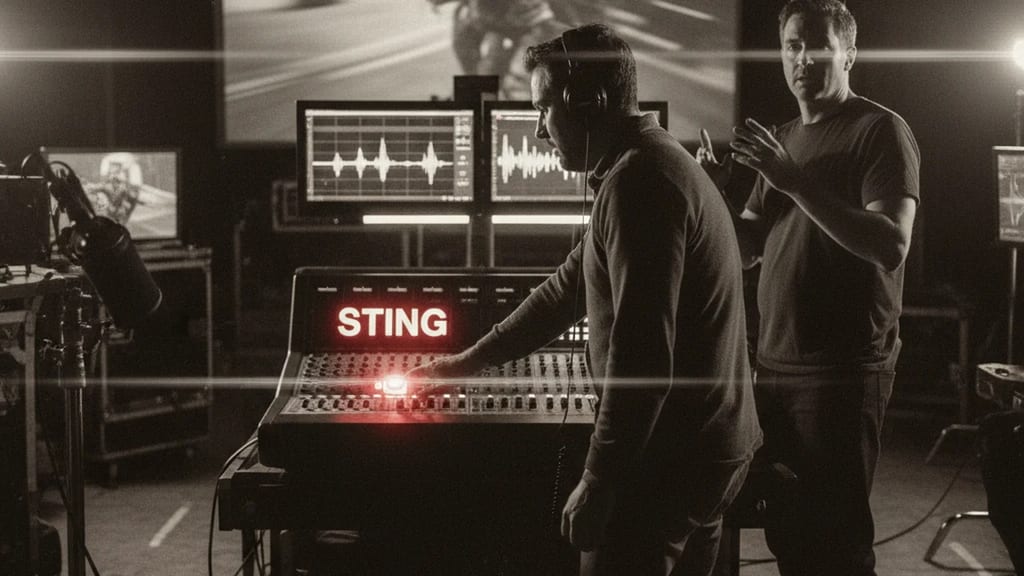
Murnau AI illustration
stinger stem tonangel signature sound

Sharp, impactful musical accent with steep frequency rise (2-8 kHz) and attack time under 50ms, used to punctuate dramatic moments in film.

Technical Details

Stings typically employ steep frequency rises between 2-8 kHz for maximum attention and utilize dynamic jumps of at least 15-20 dB above the baseline level. Typical orchestrations include brass clusters, timpani strikes, or electronic synthesizer hits. The attack time is under 50 milliseconds, while the decay phase varies between 1-10 seconds. Three main types dominate: Punctuation Stings (abrupt endings), Transition Stings (with fade-out), and Suspense Stings (ascending tonal sequences without resolution).

History & Development

The first documented use of stings in film occurred in 1933 in "King Kong" by composer Max Steiner, who used orchestral hits to emphasize dinosaur appearances. Bernard Herrmann established the legendary string sting in 1960 with "Psycho," consisting of 16 parallel violins in a high register. The 1970s saw the emergence of electronic stings, beginning with Walter Carlos' "A Clockwork Orange" (1971). Digital Audio Workstations enabled precise, sample-level timing control from the 1990s onwards.

Practical Application in Film

Hans Zimmer's "Inception" (2010) features the famous "BRAAAM" sting – a deep, distorted horn sound at 55 Hz that became a standard for blockbusters. Classic applications include jump scares in horror films (attack time under 20ms), plot twists in thrillers, and character introductions. The workflow begins with temp stings in the rough cut, followed by custom compositions in post-production. Stings require precise frame-accurate synchronization, as even a 2-3 frame offset can reduce their psychological impact.

Comparison & Alternatives

In contrast to Bumpers (longer transitions between scenes) and Bridges (melodic connecting elements), stings focus exclusively on punctual accents. Sound logos last 3-5 seconds and convey brand identity, while stings function purely narratively. Modern alternatives include Reverse Stings (backward played builds) and Layered Stings with up to 8 superimposed elements. Minimalist directors like Denis Villeneuve replace traditional stings with subtle spatial audio changes or strategic silence.
From the crafts

Perspectives

Cinematographer

Wenn der Komponist einen Sting auf 24 Frames exakt plant, synchronisiere ich meine Kamerabewegung entsprechend – ein Push-In muss genau mit dem Attack-Peak zusammenfallen. Bei Steadicam-Fahrten kalkuliere ich 2-3 Frames Vorlauf, da die mechanische Trägheit der Kamera sonst den musikalischen Akzent untergräbt. Stings bestimmen oft meine Schnittfrequenz: Ein 8-Sekunden-Sting braucht mindestens 12 Frames Hold auf dem Zielbild.

Director

Stings setze ich strategisch nur 3-4 Mal pro Film ein, da Overuse die Wirkung verwässert – wie in Marvel-Produktionen, wo jede Heroengeste einen Sting bekommt. Beim Timing arbeite ich mit dem Editor frame-genau: Der Sting muss exakt mit der Pupillenerweiterung des Schauspielers synchron laufen. In Dialogszenen platziere ich Stings nur in natürliche Atempausen, niemals über gesprochene Wörter.

Producer

Ein maßgeschneiderter Sting kostet zwischen 800-2500 Euro Komponistenhonorar plus 1200-3000 Euro Studiozeit für Live-Orchester. Temp-Tracks aus Libraries kosten 150-400 Euro Lizenz, schaffen aber rechtliche Probleme bei internationaler Auswertung. Ich budgetiere 15% der Musikkosten für Stings und plane 2-3 Revision-Zyklen ein, da Regisseure hier besonders akribisch sind.

More in the lexikon

Related terms

Test your knowledge

Quiz

1. Zu welchem Department gehört „Sting"?

2. Wie viele verschiedene Fachperspektiven bietet dieser Eintrag?

Report an error
From the Filmfarm ecosystem

Understand visual language, budget productions, connect crew.

The Lexikon is part of the Filmfarm ecosystem — alongside budgeting (FilmBalance), an industry magazine (FilmCircus) and crew networking (FilmCall, CrewMesh). One shared vocabulary for the whole production.

FilmFarm FilmRadarComing soonFilmPulseComing soonFilmNumbersComing soonFilmCapitalComing soonFilmLabComing soonFilmBalanceComing soonFilmCircusComing soon