Technical Details
Standard stereo operates with a channel separation of 60° and a listening distance corresponding to an equilateral triangle between the listening position and the speakers. Frequency reproduction is linear from 20 Hz to 20 kHz per channel at 16-bit/44.1 kHz (CD standard) or 24-bit/48 kHz (film standard). Stereo signals are recorded as Left/Right (L/R), Mid/Side (M/S), or X/Y configurations. With the M/S technique, a mid-signal is combined with a side-signal, allowing the stereo width to be adjusted retrospectively.
History & Development
In 1931, Alan Blumlein at EMI developed the fundamentals of stereophony and patented the "binaural sound" system. In 1940, Walt Disney first used multi-channel sound in cinema with "Fantasia" (Fantasound system). Commercial breakthrough was achieved in 1958 with stereo records. Stereo established itself in film in the 1970s through Dolby Stereo, which decoded four channels (L, C, R, S) from an optical soundtrack. Today, stereo forms the basis of all multi-channel systems from 5.1 to Dolby Atmos.
Practical Application in Film
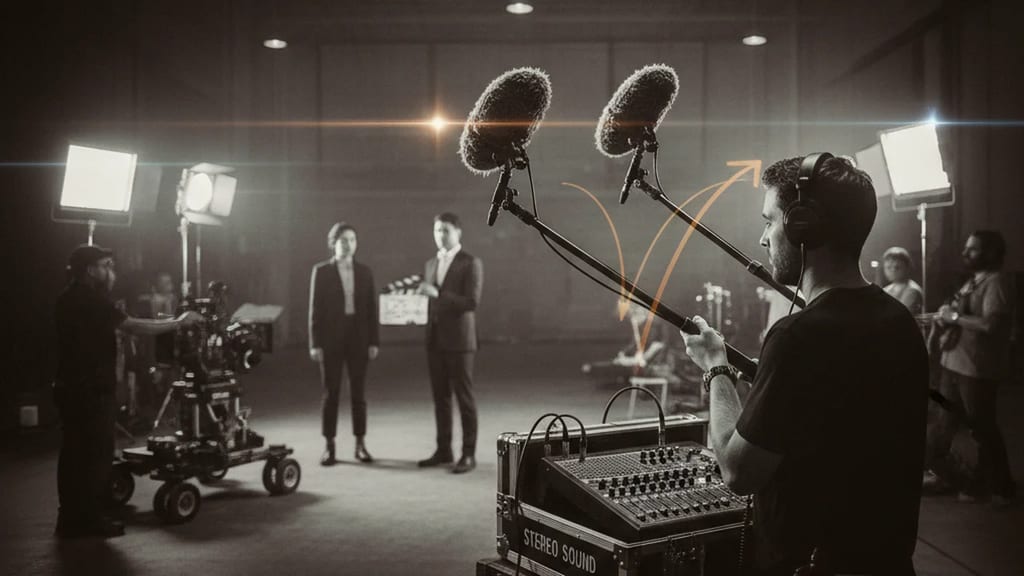
Stereo recordings are made using stereo microphone pairs such as the Schoeps CMIT 5 with CCM 41 as an M/S setup or two Neumann U87s in an AB arrangement with a 2-3 meter distance. Dialogue scenes are usually recorded in mono and positioned in stereo during post-production, while atmospheres and music utilize native stereo recordings. "Apocalypse Now" (1979) was one of the first films to consistently use stereo sound design for spatial storytelling. The stereo base is varied between 0-100% to control the emotional impact.
Comparison & Alternatives
Stereo differs from mono by its spatiality and from surround formats by its limitation to two channels. Binaural audio, on the other hand, simulates natural hearing perception via headphones through HRTF calculations. While stereo is optimized for music playback, 5.1 or 7.1 surround offer more precise localization for film applications. On streaming platforms, stereo is used as a fallback format when surround decoders are missing. Object-based audio like Dolby Atmos extends stereo with height information but retains the L/R basic structure.